Department of Orthopaedic Surgery, Center for Musculoskeletal Research, Vanderbilt University Medical Center, Nashville, Tennessee, United States of America.
Vanderbilt Institute of Clinical and Translational Research, Vanderbilt University Medical Center, Nashville, Tennessee, United States of America.
PLoS One. 2022 Feb 15;17(2):e0263562. doi: 10.1371/journal.pone.0263562. eCollection 2022.
To synthesize evidence on physical activity interventions that used wearables, either alone or in combination with education or rehabilitation, in adults following orthopaedic surgical procedures.
PubMed, CINAHL, PsycINFO and EMBASE were searched for randomized controlled trials of wearable-based interventions from each database's inception to August 2021 in patients undergoing orthopaedic surgery. Relevant outcomes included physical activity, physical function, pain, psychological distress, or general health. PEDro scale scoring ranges from 0 to 10 and was used to appraise studies as high (≥7), moderate (5-6), or poor (<5) quality.
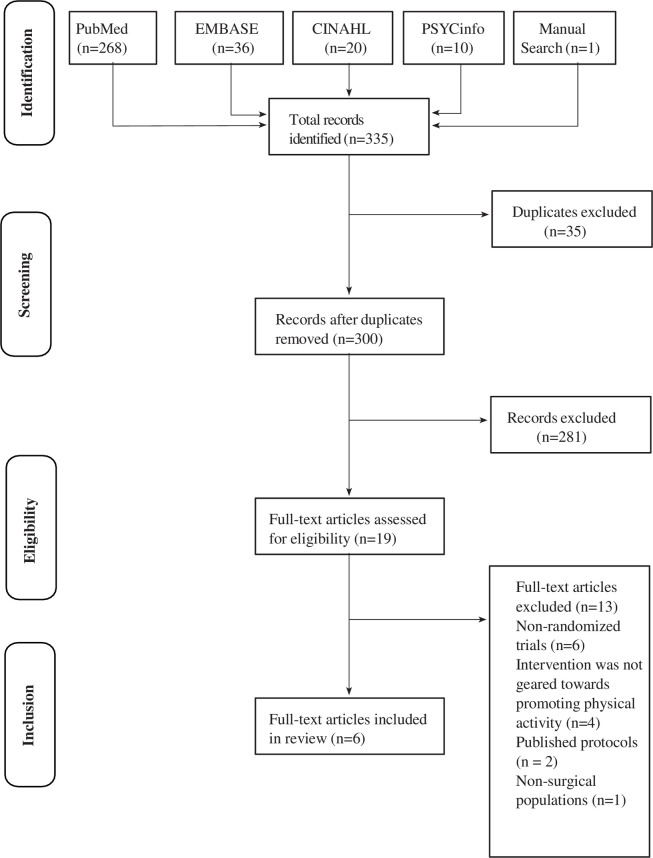
Of 335 articles identified, 6 articles met eligibility criteria. PEDro scores ranged from 2 to 6, with 3 studies of moderate quality and 3 of poor quality. Studies included patients undergoing total knee (number; n = 4) or total knee or hip (n = 1) arthroplasty and lumbar disc herniation surgery (n = 1). In addition to wearables, intervention components included step diary (n = 2), motivational interviewing (n = 1), goal setting (n = 2), tailored exercise program (n = 2), or financial incentives (n = 1). Interventions were delivered in-person (n = 2), remotely (n = 3) or in a hybrid format (n = 1). Intervention duration ranged from 6 weeks to 6 months. Compared to controls, 3 moderate quality studies reported greater improvement in steps/day; however, 1 moderate and 2 poor quality studies showed no between-group difference in physical function, pain, or quality of life. No serious adverse events related to the use of wearable were reported.
The effects of physical activity interventions using wearables, either delivered in-person or remotely, appear promising for increasing steps per day after joint arthroplasty; however, this finding should be viewed with caution since it is based on 3 moderate quality studies. Further research is needed to determine the therapeutic effects of using wearables as an intervention component in patients undergoing other orthopaedic surgical procedures.
PROSPERO Registration Number: CRD42020186103.
综合评估在接受骨科手术后,使用可穿戴设备(单独或与教育或康复相结合)进行的体育活动干预措施的证据。
从每个数据库的创建到 2021 年 8 月,在接受骨科手术的患者中,使用 PubMed、CINAHL、PsycINFO 和 EMBASE 搜索可穿戴设备干预的随机对照试验。相关结局包括体力活动、身体功能、疼痛、心理困扰或一般健康。PEDro 量表评分为 0 到 10 分,用于评估研究的质量为高(≥7)、中(5-6)或低(<5)。
在 335 篇文章中,有 6 篇符合入选标准。PEDro 评分为 2 到 6 分,其中 3 项为中等质量,3 项为低质量。研究对象包括接受全膝关节(例数;n = 4)或全膝关节或髋关节(n = 1)置换术和腰椎间盘突出症手术(n = 1)的患者。除了可穿戴设备外,干预措施还包括步数日记(n = 2)、动机访谈(n = 1)、目标设定(n = 2)、量身定制的运动计划(n = 2)或经济激励(n = 1)。干预措施通过面对面(n = 2)、远程(n = 3)或混合方式(n = 1)进行。干预时间从 6 周到 6 个月不等。与对照组相比,3 项中等质量的研究报告了每日步数的显著改善;然而,1 项中等质量和 2 项低质量的研究显示,身体功能、疼痛或生活质量无组间差异。没有报告与可穿戴设备使用相关的严重不良事件。
在接受关节置换术后,通过面对面或远程方式使用可穿戴设备进行的体育活动干预措施,在增加每日步数方面似乎很有前景;然而,这一发现应该谨慎看待,因为它仅基于 3 项中等质量的研究。需要进一步的研究来确定在接受其他骨科手术的患者中,使用可穿戴设备作为干预措施的组成部分的治疗效果。
PROSPERO 注册号:CRD42020186103。