Department of Surgery, University of Alabama at Birmingham, Birmingham, Al 35294, USA.
Department of Pathology, Michigan Medicine, Ann Arbor, Michigan 48109, USA.
Neoplasia. 2022 Mar;25:53-61. doi: 10.1016/j.neo.2022.01.004. Epub 2022 Feb 12.
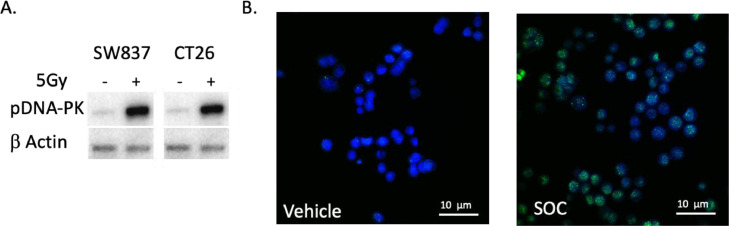
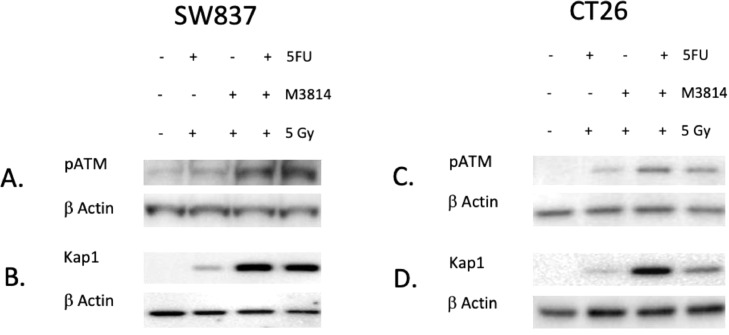
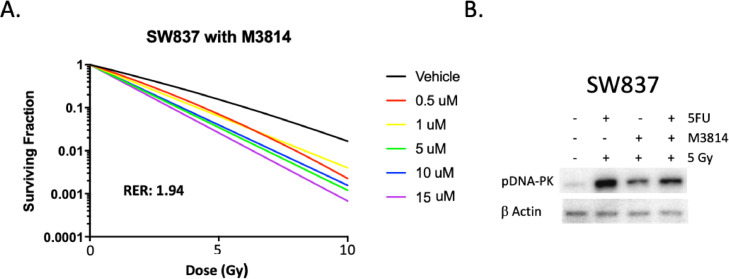
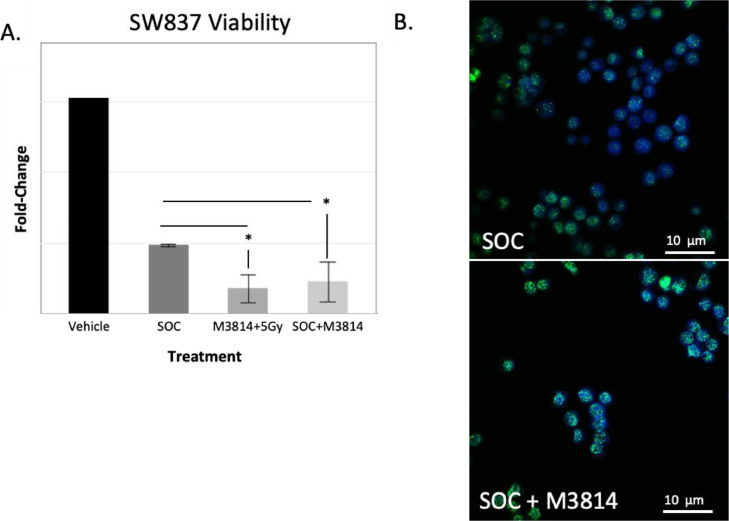
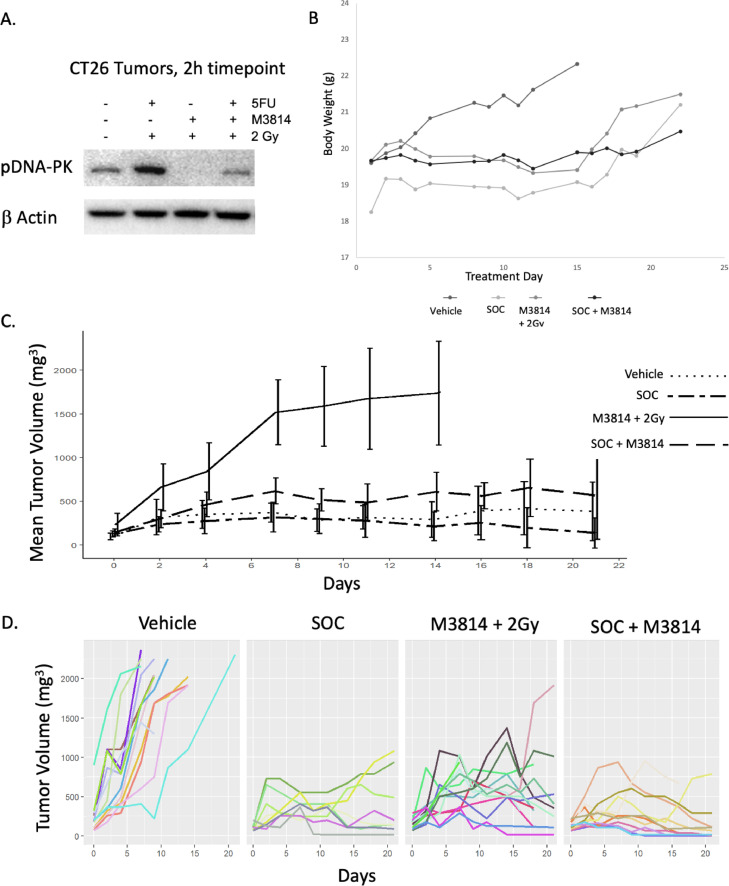
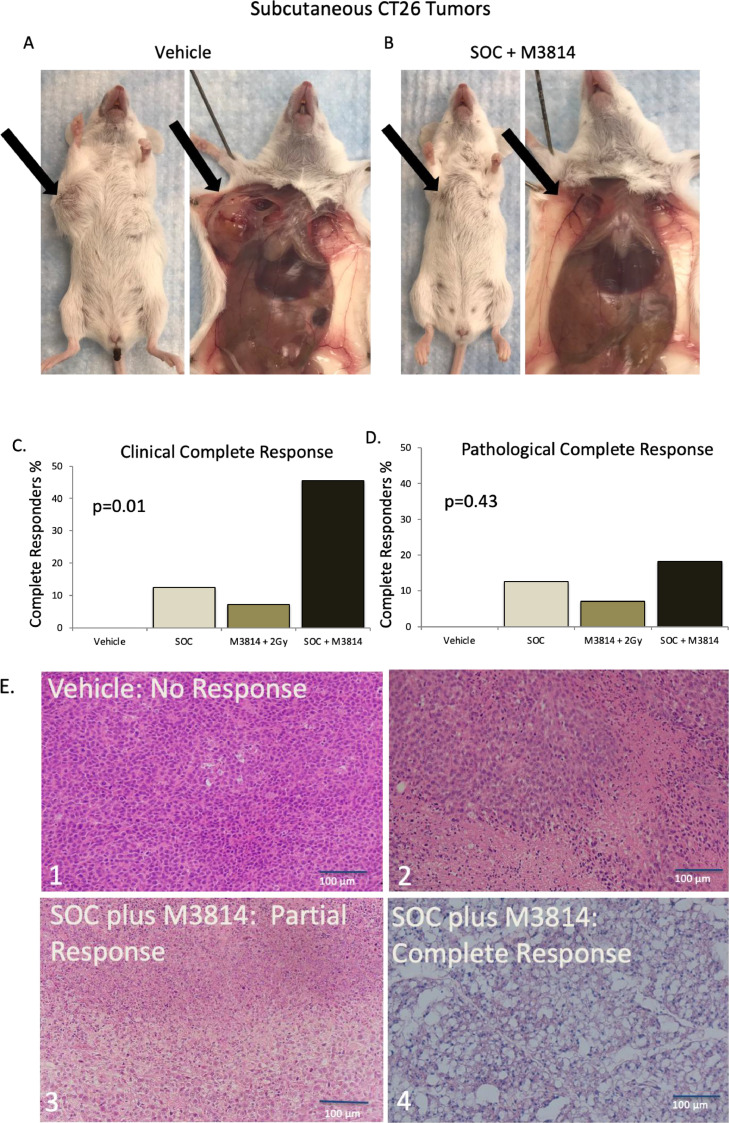
Treatment of locally advanced rectal cancer includes chemoradiation and surgery, but patient response to treatment is variable. Patients who have a complete response have improved outcomes; therefore, there is a critical need to identify mechanisms of resistance to circumvent them. DNA-PK is involved in the repair of DNA double-strand breaks caused by radiation, which we found to be increased in rectal cancer after treatment. We hypothesized that inhibiting this complex with a DNA-PK inhibitor, Peposertib (M3814), would improve treatment response. We assessed pDNA-PK in a rectal cancer cell line and mouse model utilizing western blotting, viability assays, γH2AX staining, and treatment response. The three treatment groups were: standard of care (SOC) (5-fluorouracil (5FU) with radiation), M3814 with radiation, and M3814 with SOC. SOC treatment of rectal cancer cells increased pDNA-PK protein and increased γH2AX foci, but this was abrogated by the addition of M3814. Mice with CT26 tumors treated with M3814 with SOC did not differ in average tumor size but individual tumor response varied. The clinical complete response rate improved significantly with the addition of M3814 but pathological complete response did not. We investigated alterations in DNA repair and found that Kap1 and pATM are increased after M3814 addition suggesting this may mediate resistance. When the DNA-PK inhibitor, M3814, is combined with SOC treatment, response improved in some rectal cancer models but an increase in other repair mechanisms likely diminishes the effect. A clinical trial is ongoing to further explore the role of DNA-PK inhibition in rectal cancer treatment.
局部晚期直肠癌的治疗包括放化疗和手术,但患者对治疗的反应各不相同。完全缓解的患者预后较好;因此,迫切需要确定耐药的机制并加以规避。DNA-PK 参与辐射引起的 DNA 双链断裂的修复,我们发现治疗后直肠癌中 DNA-PK 增加。我们假设用 DNA-PK 抑制剂 Peposertib(M3814)抑制该复合物会改善治疗反应。我们利用 Western blot、细胞活力测定、γH2AX 染色和治疗反应评估了直肠癌细胞系和小鼠模型中的 pDNA-PK。三组治疗方法为:标准治疗(SOC)(氟尿嘧啶[5FU]联合放疗)、M3814 联合放疗和 M3814 联合 SOC。SOC 处理直肠癌细胞会增加 pDNA-PK 蛋白并增加 γH2AX 焦点,但 M3814 的加入会消除这种情况。SOC 联合 M3814 治疗 CT26 肿瘤的小鼠平均肿瘤大小无差异,但个体肿瘤反应不同。SOC 联合 M3814 治疗显著提高了临床完全缓解率,但病理完全缓解率没有提高。我们研究了 DNA 修复的改变,发现 Kap1 和 pATM 在 M3814 加入后增加,表明这可能介导耐药性。当 DNA-PK 抑制剂 M3814 与 SOC 联合治疗时,一些直肠癌模型的反应得到改善,但其他修复机制的增加可能会降低这种效果。一项临床试验正在进行中,以进一步探索 DNA-PK 抑制在直肠癌治疗中的作用。