Department of Clinical Psychology, The Third Xiangya Hospital, Central South University, Changsha, Hunan, China.
School of Nursing and Healthcare Leadership, University of Washington Tacoma, Tacoma, Washington, USA.
BMJ Open. 2022 Feb 15;12(2):e053501. doi: 10.1136/bmjopen-2021-053501.
Insomnia has a remarkably negative effect on the work, quality of life and psychosomatic health of individuals, and imposes a substantial economic burden on society. Mindfulness-based interventions (MBIs) have proven beneficial in the treatment of insomnia. However, the effect of mobile or online-based (mHealth) MBIs requires further verification. This study will evaluate the effectiveness of an mHealth MBI, 'Mindful Living with Insomnia' (MLWI), relative to that of mHealth cognitive behavioural therapy for insomnia (CBT-I).
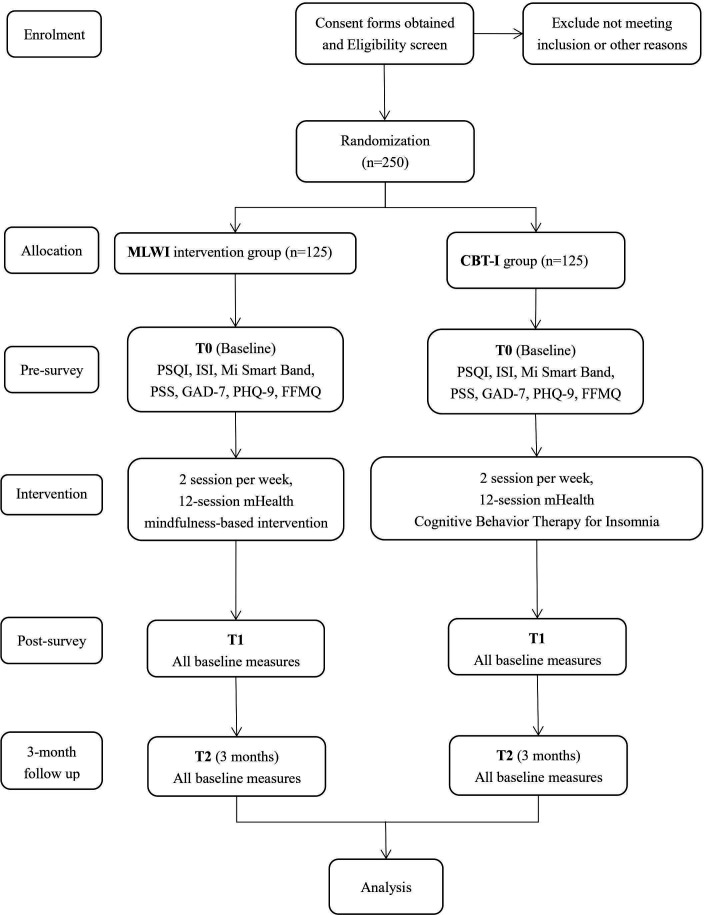
The study is an mHealth, randomised controlled trial. Two hundred and fifty participants will be allocated randomly and equally to either the MLWI or CBT-I group. The intervention will involve 12 sessions over a 6-week course, with 2, 30 min sessions per week. The primary outcomes are sleep quality, severity of insomnia symptoms and sleep activity, according to the Pittsburgh Sleep Quality Index, Insomnia Severity Index and sleep tracker Mi Smart Band, respectively. The secondary outcomes are perceived stress, anxiety, depression and mindfulness. Outcomes will be evaluated at the baseline, end of the intervention period and at the 3-month follow-up. Data analyses will include covariance, regression analysis, χ, t-test and Pearson's correlations. Participants will be recruited from January to June 2022, or until the recruitment process is complete. The follow-up will be completed in December 2022. All trial results should be available by the end of December 2022.
Full approval for this study has been obtained from the Ethics Committee at The Third Xiangya Hospital, Central South University, Changsha, China (21010). Study results will be disseminated via social media and peer-reviewed publications.
NCT04806009.
失眠对个体的工作、生活质量和身心健康有显著的负面影响,并给社会带来巨大的经济负担。基于正念的干预(MBIs)已被证明对失眠的治疗有益。然而,移动或在线(mHealth)MBIs 的效果需要进一步验证。本研究将评估 mHealth MBI“正念失眠生活(MLWI)”与 mHealth 认知行为疗法治疗失眠(CBT-I)的疗效。
该研究是一项 mHealth 随机对照试验。将 250 名参与者随机平均分配到 MLWI 或 CBT-I 组。干预将涉及 6 周的 12 个疗程,每周 2 次,每次 30 分钟。主要结局指标是匹兹堡睡眠质量指数(PSQI)、失眠严重程度指数(ISI)和睡眠追踪器 Mi Smart Band 分别评估睡眠质量、失眠症状严重程度和睡眠活动。次要结局指标是感知压力、焦虑、抑郁和正念。将在基线、干预结束时和 3 个月随访时评估结果。数据分析将包括协方差、回归分析、χ、t 检验和 Pearson 相关分析。参与者将从 2022 年 1 月至 6 月招募,或直到招募过程完成。随访将于 2022 年 12 月完成。所有试验结果应在 2022 年 12 月底前提供。
本研究已获得中国长沙中南大学湘雅三医院伦理委员会的全面批准(21010)。研究结果将通过社交媒体和同行评议出版物进行传播。
NCT04806009。