Spanish Red Cross Nursing School. University of Seville, Avda. Cruz Roja 1, 41009 Seville, Spain.
Department of Nursing, University of Seville, 41009 Seville, Spain.
Int J Environ Res Public Health. 2020 Sep 2;17(17):6401. doi: 10.3390/ijerph17176401.
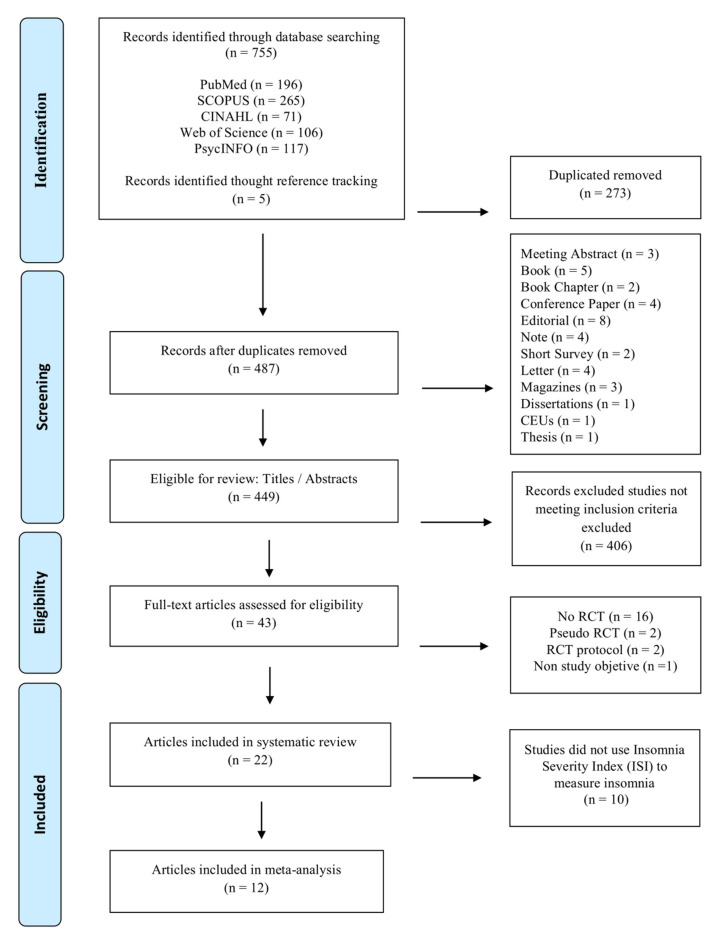
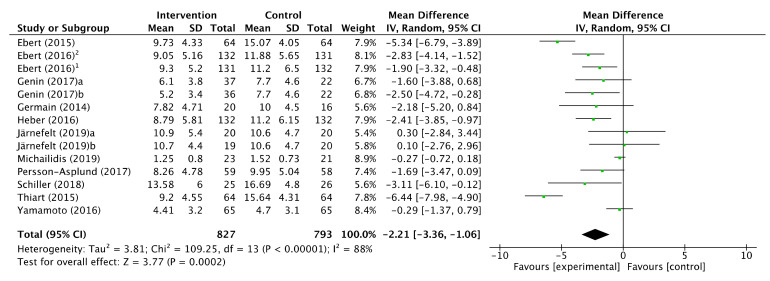
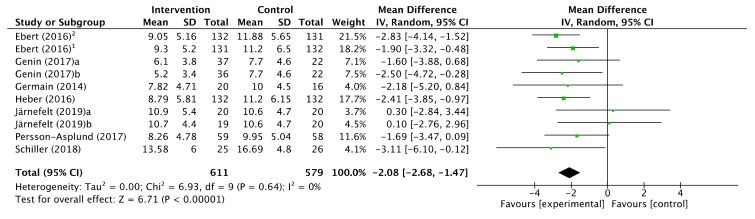
The aim of this systematic review and meta-analysis was to identify and evaluate the impact of interventions to improve or reduce insomnia in the workforce through randomized clinical trials. Following the recommendations of the PRISMA and MARS statement, a systematic literature search was carried out on the PubMed, Web of Science, CINHAL, and PsycINFO databases, with no restrictions on the language or publication date. For the meta-analysis, a random-effects model and the were used as outcome measures. To assess the risk of bias and the quality of evidence, the Cochrane Collaboration tool and the GRADE method were used, respectively. Twenty-two studies were included in the systematic review and 12 studies in the meta-analysis, making a total of 14 intervention groups with a sample of 827 workers. Cognitive behavioral therapy was the most widely used intervention. According to the estimated difference between the means, a moderate effect for the reduction of insomnia symptoms after the intervention (MD -2.08, CI 95%: [-2.68, -1.47]) and a non-significant degree of heterogeneity were obtained ( = 0.64; I = 0%). The quality of the evidence and the risk of bias were moderate. The results suggest that interventions on insomnia in the workplace are effective for improving workers' health, and that improvements in the quality of sleep and a decrease in the symptoms of insomnia are produced, thanks to an increase in weekly sleeping hours and a reduction in latency at sleep onset. As regards work, they also led to improvements in productivity, presenteeism, and job burnout.
本系统评价和荟萃分析的目的是通过随机临床试验确定和评估改善或减少工作人群失眠的干预措施的影响。根据 PRISMA 和 MARS 声明的建议,在 PubMed、Web of Science、CINHAL 和 PsycINFO 数据库中进行了系统的文献搜索,对语言或出版日期没有限制。对于荟萃分析,使用了随机效应模型和 作为结果测量指标。为了评估偏倚风险和证据质量,分别使用了 Cochrane 协作工具和 GRADE 方法。系统评价纳入了 22 项研究,荟萃分析纳入了 12 项研究,共有 14 个干预组,共 827 名工人。认知行为疗法是应用最广泛的干预措施。根据均值差异的估计值,干预后失眠症状得到中度改善(MD-2.08,95%CI:[-2.68,-1.47]),异质性程度不显著( = 0.64;I = 0%)。证据质量和偏倚风险为中等。结果表明,工作场所的失眠干预措施对于改善工人的健康是有效的,并且通过增加每周睡眠时间和减少入睡潜伏期,产生了改善睡眠质量和减少失眠症状的效果。在工作方面,它们还提高了生产力、出席率和工作倦怠。