Badiee Ryan K, Popowitz Emma, Mark Ian T, Alcon Andre, Hwang Joan, Rorison Eve, Auguste Kurtis I, Hoffman William Y, Sun Peter P, Pomerantz Jason H
Division of Plastic and Reconstructive Surgery, Department of Surgery, UCSF Craniofacial Center, University of California San Francisco, San Francisco, Calif.
Department of Radiology, University of California San Francisco, San Francisco, Calif.
Plast Reconstr Surg Glob Open. 2022 Feb 9;10(2):e4097. doi: 10.1097/GOX.0000000000004097. eCollection 2022 Feb.
Strip craniectomy with orthotic helmet therapy (SCOT) is an increasingly supported treatment for metopic craniosynostosis, although the long-term efficacy of deformity correction remains poorly defined. We compared the longterm outcomes of SCOT versus open cranial vault reconstruction (OCVR).
Patients who underwent OCVR or SCOT for isolated metopic synostosis with at least 3 years of follow-up were identified at our institution. Anthropometric measurements were used to assess baseline severity and postoperative skull morphology. Independent laypersons and craniofacial surgeons rated the appearance of each patient's 3D photographs, compared to normal controls.
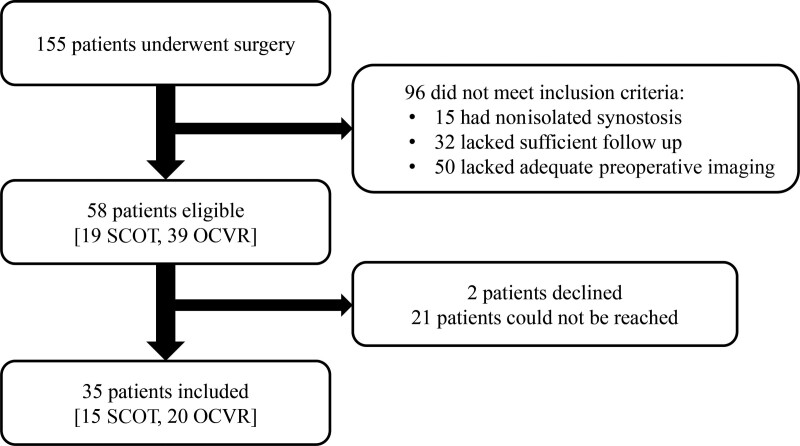
Thirty-five patients were included (15 SCOT and 20 OCVR), with similar follow-up between groups (SCOT 7.9 ± 3.2 years, OCVR 9.2 ± 4.1 years). Baseline severity and postoperative anthropometric measurements were equivalent. Independent adolescent raters reported that the forehead, eye, and overall appearance of SCOT patients was better than OCVR patients ( < 0.05, all comparisons). Craniofacial surgeons assigned Whitaker class I to a greater proportion of SCOT patients with moderate-to-severe synostosis (72.2 ± 5.6%) compared with OCVR patients with the same severity (33.3 ± 9.2%, = 0.02). Parents of children who underwent SCOT reported equivalent satisfaction with the results of surgery (100% versus 95%, > 0.99), and were no more likely to report bullying (7% versus 15%, = 0.82).
SCOT was associated with superior long-term appearance and perioperative outcomes compared with OCVR. These findings suggest that SCOT should be the treatment of choice for patients with a timely diagnosis of metopic craniosynostosis.
带矫正头盔疗法的条状颅骨切除术(SCOT)是一种越来越受支持的治疗额缝早闭的方法,尽管畸形矫正的长期疗效仍不明确。我们比较了SCOT与开放性颅骨穹窿重建术(OCVR)的长期疗效。
在我们机构中识别出接受OCVR或SCOT治疗孤立性额缝早闭且至少随访3年的患者。采用人体测量学方法评估基线严重程度和术后颅骨形态。与正常对照相比,由独立的外行人及颅面外科医生对每位患者的三维照片外观进行评分。
共纳入35例患者(15例SCOT和20例OCVR),两组随访时间相似(SCOT组7.9±3.2年,OCVR组9.2±4.1年)。基线严重程度和术后人体测量结果相当。独立的青少年评估者报告称,SCOT患者的前额、眼睛及整体外观优于OCVR患者(所有比较P<0.05)。与相同严重程度的OCVR患者(33.3±9.2%)相比,颅面外科医生将更多中度至重度缝早闭的SCOT患者评定为惠特克I级(72.2±5.6%,P = 0.02)。接受SCOT治疗患儿的家长对手术结果的满意度相当(100%对95%,P>0.99),且报告孩子受欺负的可能性也无差异(7%对15%,P = 0.82)。
与OCVR相比,SCOT具有更好的长期外观和围手术期疗效。这些发现表明,对于及时诊断为额缝早闭的患者,SCOT应作为首选治疗方法。