Vandegrift Kurt J, Yon Michele, Surendran-Nair Meera, Gontu Abhinay, Amirthalingam Saranya, Nissly Ruth H, Levine Nicole, Stuber Tod, DeNicola Anthony J, Boulanger Jason R, Kotschwar Nathan, Aucoin Sarah Grimké, Simon Richard, Toal Katrina, Olsen Randall J, Davis James J, Bold Dashzeveg, Gaudreault Natasha N, Richt Juergen A, Musser James M, Hudson Peter J, Kapur Vivek, Kuchipudi Suresh V
The Center for Infectious Disease Dynamics, Department of Biology and Huck Institutes of the Life Sciences, The Pennsylvania State University, University Park, PA, 16802, USA.
Animal Diagnostic Laboratory, Department of Veterinary and Biomedical Sciences and Huck Institutes of the Life Sciences, The Pennsylvania State University, PA,16802, USA.
bioRxiv. 2022 Feb 7:2022.02.04.479189. doi: 10.1101/2022.02.04.479189.
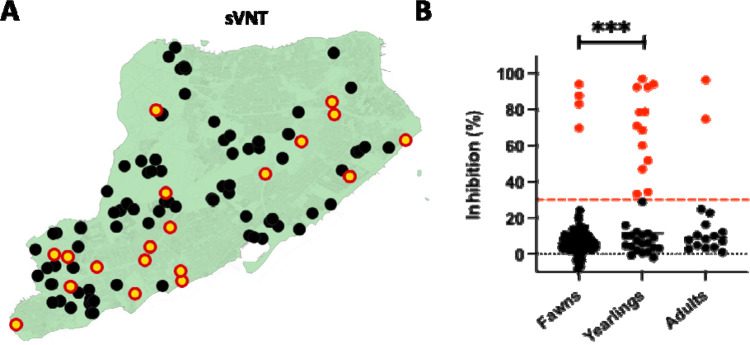
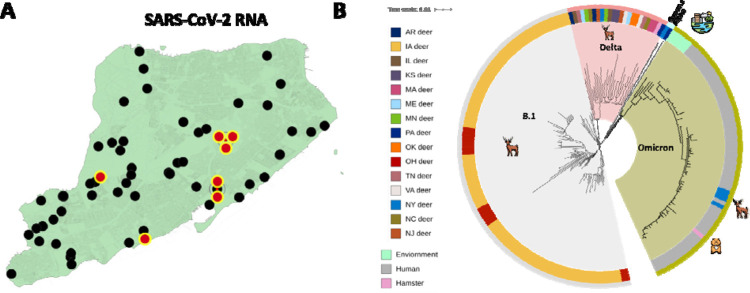
White-tailed deer ( ) are highly susceptible to infection by SARS-CoV-2, with multiple reports of widespread spillover of virus from humans to free-living deer. While the recently emerged SARS-CoV-2 B.1.1.529 Omicron variant of concern (VoC) has been shown to be notably more transmissible amongst humans, its ability to cause infection and spillover to non-human animals remains a challenge of concern. We found that 19 of the 131 (14.5%; 95% CI: 0.10-0.22) white-tailed deer opportunistically sampled on Staten Island, New York, between December 12, 2021, and January 31, 2022, were positive for SARS-CoV-2 specific serum antibodies using a surrogate virus neutralization assay, indicating prior exposure. The results also revealed strong evidence of age-dependence in antibody prevalence. A significantly (χ , p < 0.001) greater proportion of yearling deer possessed neutralizing antibodies as compared with fawns (OR=12.7; 95% CI 4-37.5). Importantly, SARS-CoV-2 nucleic acid was detected in nasal swabs from seven of 68 (10.29%; 95% CI: 0.0-0.20) of the sampled deer, and whole-genome sequencing identified the SARS-CoV-2 Omicron VoC (B.1.1.529) is circulating amongst the white-tailed deer on Staten Island. Phylogenetic analyses revealed the deer Omicron sequences clustered closely with other, recently reported Omicron sequences recovered from infected humans in New York City and elsewhere, consistent with human to deer spillover. Interestingly, one individual deer was positive for viral RNA and had a high level of neutralizing antibodies, suggesting either rapid serological conversion during an ongoing infection or a "breakthrough" infection in a previously exposed animal. Together, our findings show that the SARS-CoV-2 B.1.1.529 Omicron VoC can infect white-tailed deer and highlights an urgent need for comprehensive surveillance of susceptible animal species to identify ecological transmission networks and better assess the potential risks of spillback to humans.
These studies provide strong evidence of infection of free-living white-tailed deer with the SARS-CoV-2 B.1.1.529 Omicron variant of concern on Staten Island, New York, and highlight an urgent need for investigations on human-to-animal-to-human spillovers/spillbacks as well as on better defining the expanding host-range of SARS-CoV-2 in non-human animals and the environment.
白尾鹿对严重急性呼吸综合征冠状病毒2(SARS-CoV-2)高度易感,有多项报告表明病毒从人类广泛传播至自由放养的鹿。虽然最近出现的SARS-CoV-2 B.1.1.529奥密克戎变异株(VoC)在人类中具有明显更高的传播性,但其感染非人类动物并传播的能力仍是一个令人担忧的挑战。我们发现,在2021年12月12日至2022年1月31日期间,在纽约斯塔滕岛机会性采集的131只白尾鹿中,有19只(14.5%;95%置信区间:0.10 - 0.22)使用替代病毒中和试验检测出SARS-CoV-2特异性血清抗体呈阳性,表明先前已接触过该病毒。结果还显示出抗体流行率存在强烈的年龄依赖性证据。与幼鹿相比,一岁鹿拥有中和抗体的比例显著更高(χ ,p < 0.001)(优势比=12.7;95%置信区间4 - 37.5)。重要的是,在68只采样鹿中的7只(10.29%;95%置信区间:0.0 - 0.20)的鼻拭子中检测到SARS-CoV-2核酸,全基因组测序确定SARS-CoV-2奥密克戎变异株(B.1.1.529)在斯塔滕岛的白尾鹿中传播。系统发育分析表明,鹿的奥密克戎序列与最近在纽约市及其他地方从感染人类中分离出的其他奥密克戎序列紧密聚类,这与病毒从人类传播至鹿一致。有趣的是,一只鹿的病毒RNA呈阳性且具有高水平的中和抗体,这表明在正在进行的感染过程中血清学快速转换,或者是先前接触过病毒的动物发生了“突破性”感染。总之,我们的研究结果表明,SARS-CoV-2 B.1.1.529奥密克戎变异株可感染白尾鹿,并强调迫切需要对易感动物物种进行全面监测,以识别生态传播网络,并更好地评估病毒回传给人类的潜在风险。
这些研究提供了有力证据,证明纽约斯塔滕岛的自由放养白尾鹿感染了SARS-CoV-2 B.1.1.529奥密克戎变异株,并强调迫切需要对人传人、人传动物再传人以及更好地确定SARS-CoV-2在非人类动物和环境中不断扩大的宿主范围进行调查。