Centre des Sciences Humaines, Delhi, India.
Ceped/IRD/Université de Paris/INSERM, Paris, France.
PLoS One. 2022 Feb 16;17(2):e0263187. doi: 10.1371/journal.pone.0263187. eCollection 2022.
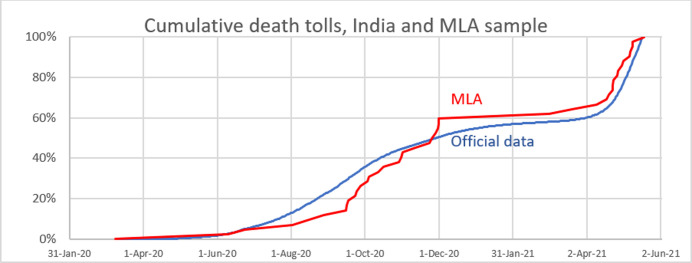
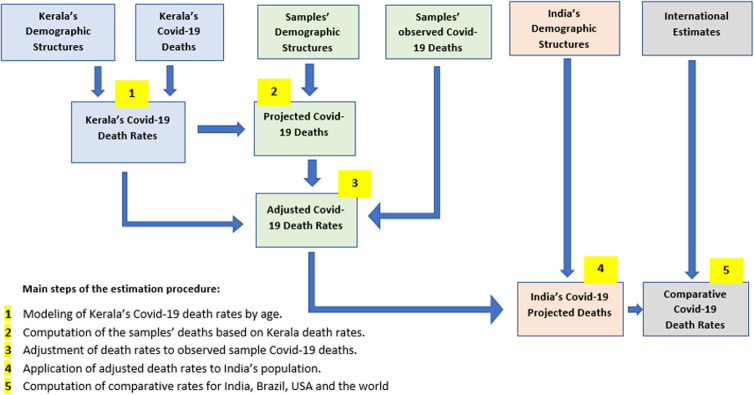
The absence of reliable registration of Covid-19 deaths in India has prevented proper assessment and monitoring of the coronavirus pandemic. In addition, India's relatively young age structure tends to conceal the severity of Covid-19 mortality, which is concentrated in older age groups. In this paper, we present four different demographic samples of Indian populations for which we have information on both their demographic structures and death outcomes. We show that we can model the age distribution of Covid-19 mortality in India and use this modeling to estimate Covid-19 mortality in the country. Our findings point to a death toll of approximately 3.2-3.7 million persons by early November 2021. Once India's age structure is factored in, these figures correspond to one of the most severe cases of Covid-19 mortality in the world. India has recorded after February 2021 the second outbreak of coronavirus that has affected the entire country. The accuracy of official statistics of Covid-19 mortality has been questioned, and the real number of Covid-19 deaths is thought to be several times higher than reported. In this paper, we assembled four independent population samples to model and estimate the level of Covid-19 mortality in India. We first used a population sample with the age and sex of Covid-19 victims to develop a Gompertz model of Covid-19 mortality in India. We applied and adjusted this mortality model on two other national population samples after factoring in the demographic characteristics of these samples. We finally derive from these samples the most reasonable estimate of Covid-19 mortality level in India and confirm this result using a fourth population sample. Our findings point to a death toll of about 3.2-3.7 million persons by late May 2021. This is by far the largest number of Covid-19 deaths in the world. Once standardized for age and sex structure, India's Covid-19 mortality rate is above Brazil and the USA. Our analysis shows that existing population samples allow an alternative estimation of deaths due to Covid-19 in India. The results imply that only one out of 7-8 deaths appear to have been recorded as a Covid-19 death in India. The estimates also point to a very high Covid-19 mortality rate, which is even higher after age and sex standardization. The magnitude of the pandemic in India requires immediate attention. In the absence of effective remedies, this calls for a strong response based on a combination of non-pharmaceutical interventions and the scale-up of vaccination to make them accessible to all, with an improved surveillance system to monitor the progression of the pandemic and its spread across India's regions and social groups.
印度缺乏可靠的新冠死亡登记,这使得对冠状病毒大流行的适当评估和监测受到阻碍。此外,印度相对年轻的年龄结构往往掩盖了新冠死亡率的严重程度,新冠死亡率主要集中在年龄较大的群体中。在本文中,我们提出了印度人口的四个不同的人口学样本,我们掌握了这些样本的人口结构和死亡结果信息。我们表明,我们可以对印度新冠死亡率的年龄分布进行建模,并使用该模型来估计印度的新冠死亡率。我们的研究结果表明,到 2021 年 11 月初,印度的死亡人数约为 320 万至 370 万。考虑到印度的年龄结构后,这些数字相当于世界上最严重的新冠死亡病例之一。自 2021 年 2 月以来,印度记录了第二次冠状病毒爆发,该爆发影响了全国。新冠死亡率的官方统计数据的准确性受到了质疑,实际的新冠死亡人数被认为比报告的高出数倍。在本文中,我们收集了四个独立的人口样本,以对印度的新冠死亡率进行建模和估计。我们首先使用一个包含新冠病毒受害者年龄和性别的人口样本,建立了一个印度新冠死亡率的戈曼模型。在考虑了这些样本的人口特征后,我们将这个死亡率模型应用于另外两个全国性人口样本,并对其进行了调整。最后,我们从这些样本中得出了印度新冠死亡率水平的最合理估计,并使用第四个人口样本对该结果进行了验证。我们的研究结果表明,到 2021 年 5 月底,印度的死亡人数约为 320 万至 370 万。这是迄今为止世界上新冠死亡人数最多的国家。在按年龄和性别结构标准化后,印度的新冠死亡率高于巴西和美国。我们的分析表明,现有的人口样本可以对印度因新冠病毒死亡的人数进行替代估计。研究结果表明,印度只有 1/7-1/8 的新冠死亡病例被记录为新冠死亡病例。这些估计还表明,新冠死亡率非常高,在按年龄和性别标准化后更高。印度大流行的规模需要立即引起关注。在缺乏有效补救措施的情况下,这需要采取一种强有力的应对措施,这种措施基于非药物干预措施和扩大疫苗接种的结合,使所有人都能获得疫苗,并建立一个改进的监测系统,以监测大流行的进展及其在印度各地区和社会群体中的传播。