Shalitin Shlomit, Phillip Moshe, Yackobovitch-Gavan Michal
The Jesse Z. and Sara Lea Shafer Institute of Endocrinology and Diabetes, National Center for Childhood Diabetes Schneider Children's Medical Center of Israel, Petah Tikva, Israel.
Sackler Faculty of Medicine, Tel Aviv University, Tel Aviv, Israel.
Int J Obes (Lond). 2022 Jun;46(6):1160-1167. doi: 10.1038/s41366-022-01092-5. Epub 2022 Feb 16.
The current coronavirus disease 2019 (COVID-19) pandemic has health, social, and economic implications. Our primary objective was to evaluate changes in body mass index (BMI) from the pre-pandemic to COVID-19 pandemic period among a large pediatric population in Israel.
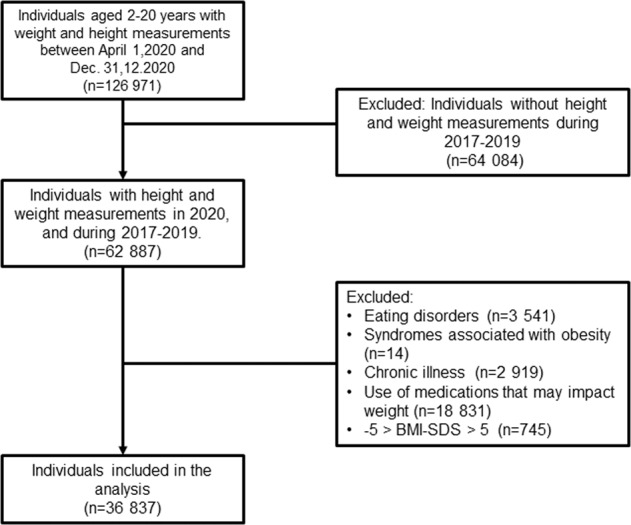
This retrospective cohort study is based on data from Clalit Health Services, the largest health maintenance organization in Israel. The data accessed included sociodemographic, anthropometric, and clinical parameters of persons aged 2-20 years with at least one BMI measurement during 2017-2019 (pre-pandemic period) and one between April 1, 2020 and December 31, 2020 (pandemic period).
The cohort comprised 36,837 individuals (50.8% females); median age 11.2 years, 83.6% were Jewish and 10.3% of Arab ethnicity. BMI-SDS increased in both sexes (p < 0.001), in both ethnicities (p < 0.001), in all socioeconomic position clusters (p < 0.001), in children aged 2-18 years (P < 0.001), and in children with underweight or normal-weight in the pre-pandemic period (p < 0.001). For 21,610 individuals (35.6%), BMI-SDS increased ≥0.25 SD. The increase in BMI-SDS was greater in children aged 2-6 compared to 6.1-18 years; BMI-SDS decreased among those aged 18.1-20 years (P < 0.001). The increase in BMI-SDS was greater among those with underweight than normal weight; BMI-SDS decreased among those with overweight and obesity (P < 0.001). During the pandemic, overweight or obesity presented in 11.2% of those with normal weight in the pre-pandemic period; and obesity presented in 21.4% of those with overweight in the pre-pandemic period.
The COVID-19 pandemic correlated with overall weight gain among children and adolescents, with the most substantial weight gain in children aged 2-6 years. Notably, the most significant increase in BMI-SDS was observed in children with underweight; BMI-SDS decreased in children with overweight and obesity. Policies should be established during the pandemic that focus on increasing physical activity, reducing sedentary time, and promoting healthy diets.
当前的2019冠状病毒病(COVID-19)大流行对健康、社会和经济都有影响。我们的主要目标是评估以色列大量儿童人群在疫情前至COVID-19大流行期间体重指数(BMI)的变化。
这项回顾性队列研究基于以色列最大的健康维护组织Clalit Health Services的数据。所获取的数据包括2017 - 2019年(疫情前时期)至少有一次BMI测量值,以及2020年4月1日至2020年12月31日(大流行时期)至少有一次BMI测量值的2至20岁人群的社会人口统计学、人体测量学和临床参数。
该队列包括36837人(50.8%为女性);中位年龄11.2岁,83.6%为犹太人,10.3%为阿拉伯族裔。男女两性(p < 0.001)、两个族裔(p < 0.001)、所有社会经济地位组(p < 0.001)、2至18岁儿童(P < 0.001)以及疫情前体重过轻或体重正常的儿童(p < 0.001)的BMI标准差评分(BMI-SDS)均有所增加。对于21610人(35.6%),BMI-SDS增加≥0.25标准差。2至6岁儿童的BMI-SDS增幅大于6.1至18岁儿童;18.1至20岁儿童的BMI-SDS下降(P < 0.001)。体重过轻儿童的BMI-SDS增幅大于体重正常儿童;超重和肥胖儿童的BMI-SDS下降(P < 0.001)。在大流行期间,疫情前体重正常的人群中有11.2%出现超重或肥胖;疫情前超重的人群中有21.4%出现肥胖。
COVID-19大流行与儿童和青少年总体体重增加相关,2至6岁儿童体重增加最为显著。值得注意的是,体重过轻儿童的BMI-SDS增加最为明显;超重和肥胖儿童的BMI-SDS下降。在大流行期间应制定相关政策,重点是增加身体活动、减少久坐时间并促进健康饮食。