Leipzig University Hospital for Children and Adolescents, Leipzig University, Liebigstr. 20a, 04103, Leipzig, Germany.
Center for Pediatric Research, Leipzig University, Liebigstr. 20a, 04103, Leipzig, Germany.
Int J Obes (Lond). 2022 Jan;46(1):144-152. doi: 10.1038/s41366-021-00968-2. Epub 2021 Sep 23.
BACKGROUND/OBJECTIVES: There is a concern that measures aiming to limit a further spread of COVID-19, e.g., school closures and social distancing, cause an aggravation of the childhood obesity epidemic. Therefore, we compared BMI trends during the 15 years before and during the COVID-19 pandemic.
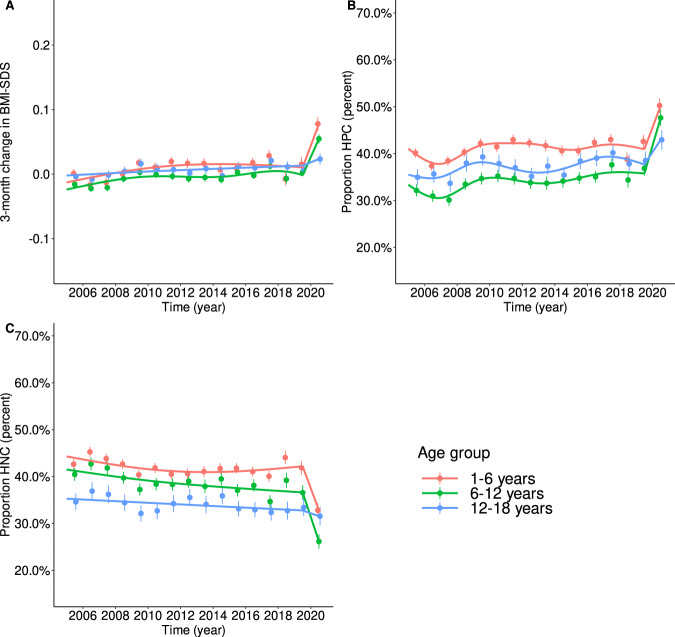
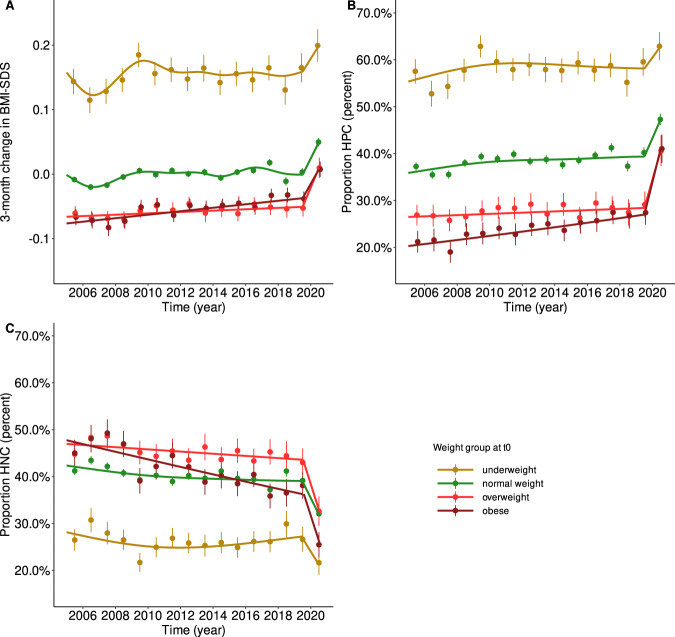
SUBJECTS/METHODS: To assess the change in weight dynamics during the first months of COVID-19, we compared the trends of 3-month change in BMI-SDS (ΔBMI-SDS) and the proportions of children showing a high positive (HPC) or high negative (HNC) weight change between 2005 and 2019 and the respective changes from 2019 (pre-pandemic) to 2020 (after the onset of anti-pandemic measures) in more than 150,000 children (9689 during the pandemic period). The period of 3 months corresponds approximately to the first lockdown period in Germany.
During the COVID-19 pandemic, we found a substantial weight gain across all weight and age groups, reflected by an increase in the 3-month change in BMI-SDS (β = 0.05, p < 0.001), an increase in the proportion of children showing HPC (OR = 1.4, p < 0.001), and a decrease in the proportion of children showing HNC (OR = 0.7, p < 0.001). Besides, we found the same trends since 2005 on a low but stable level with a yearly increase of ΔBMI-SDS by β = 0.001 (p < 0.001), the odds of HPC increased by OR = 1.01 (p < 0.001), and the odds of HNC decreased by OR = 0.99 (p < 0.001). These rather small effects accumulated to β = 0.02, OR = 1.14, and OR = 0.85 over the whole period 2005-2019. Alarmingly, both the long-term and the short-term effects were most pronounced in the obese subgroup.
There are positive dynamics in different measures of weight change, indicating a positive trend in weight gain patterns, especially within the group of children with obesity. These dynamics are likely to be escalated by COVID-19-related measures. Thus, they may lead to a significant further aggravation of the childhood obesity pandemic.
背景/目的:人们担心旨在限制 COVID-19 进一步传播的措施,例如学校关闭和社交距离,会加剧儿童肥胖症的流行。因此,我们比较了 COVID-19 大流行之前和期间的 BMI 趋势。
受试者/方法:为了评估 COVID-19 最初几个月体重变化的趋势,我们比较了 2005 年至 2019 年和 2019 年(大流行前)至 2020 年(大流行开始后)之间 3 个月 BMI-SDS(ΔBMI-SDS)变化的趋势和表现出高正(HPC)或高负(HNC)体重变化的儿童比例,在超过 150,000 名儿童中(大流行期间有 9689 名儿童)。3 个月的时间段大致对应于德国的第一次封锁期。
在 COVID-19 大流行期间,我们发现所有体重和年龄组的体重都有实质性增加,这反映在 BMI-SDS 的 3 个月变化增加(β=0.05,p<0.001)、表现出 HPC 的儿童比例增加(OR=1.4,p<0.001)和表现出 HNC 的儿童比例减少(OR=0.7,p<0.001)。此外,自 2005 年以来,我们以较低但稳定的水平发现了相同的趋势,每年 BMI-SDS 的增加为 β=0.001(p<0.001),HPC 的几率增加为 OR=1.01(p<0.001),HNC 的几率降低为 OR=0.99(p<0.001)。这些相对较小的影响在 2005-2019 年期间累计为 β=0.02、OR=1.14 和 OR=0.85。令人震惊的是,长期和短期影响在肥胖亚组中最为明显。
体重变化的不同衡量标准都存在积极的动态,表明体重增加模式呈积极趋势,尤其是在肥胖儿童群体中。这些动态可能会因与 COVID-19 相关的措施而加剧。因此,它们可能会导致儿童肥胖症大流行的显著恶化。