Zhang Haojie, Wang Bin, Chen Chi, Sun Ying, Chen Jie, Tan Xiao, Xia Fangzhen, Zhang Jihui, Lu Yingli, Wang Ningjian
Institute and Department of Endocrinology and Metabolism, Shanghai Ninth People's Hospital, Shanghai Jiao Tong University School of Medicine, Shanghai, China.
Sleep Assessment Unit, Department of Psychiatry, Faculty of Medicine, The Chinese University of Hong Kong, Shatin, Hong Kong SAR, China.
Front Neurosci. 2022 Jan 31;16:725478. doi: 10.3389/fnins.2022.725478. eCollection 2022.
Unhealthy sleep behaviors may be potential risk factors for chronic kidney disease (CKD). We aimed to examine the associations of combined sleep patterns and genetic susceptibility with incident CKD.
This large-scale prospective cohort study included 370,671 participants without CKD at baseline (2006-2010) in UK Biobank data. Five sleep behaviors were made up of sleep duration, insomnia, snoring, chronotype, and daytime sleepiness according to questionnaire. Overall sleep patterns by summing the five scores were created. Weighted genetic risk score of kidney function was calculated. Incident CKD was recorded from death register, primary care, and hospital inpatient records. A subset of 41,130 individuals who participated both the initial assessment visit and follow-up visit (2012+) was also used.
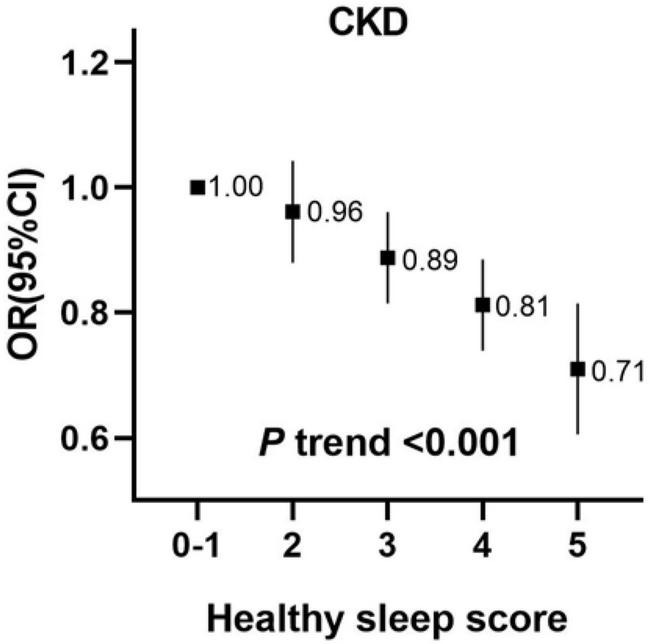
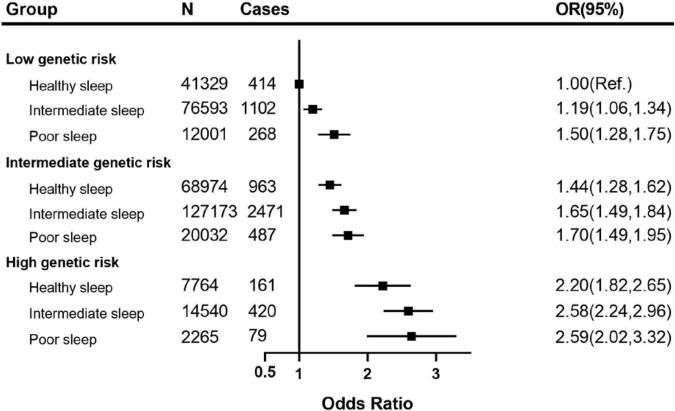
During a median follow-up of 10.6 years (about 3.9 million person-years), we documented 6,365 patients with incident CKD. In five sleep behaviors, sleep 7-8 h/day, free of insomnia and no frequent daytime sleepiness were independently associated with incident CKD, with a 12% (95%CI 7-16), 9% (3-14), 13% (9-18) lower risk, respectively. Compared to those with a sleep score of 0-1, participants with a score of 5 had a 21% (10-31%) lower risk of CKD. 17.1% of CKD in this cohort could be attributed to total poor sleep pattern. Participants with high genetic risk and intermediate or poor sleep pattern showed the highest risk of CKD (OR = 2.58, 95%CI 2.24-2.96; OR = 2.59, 95%CI 2.02-3.32, respectively), although there was no significant interaction between sleep patterns and genetic risk categories. Among individuals who participated both the initial assessment visit and follow-up visit, we found that the association between amelioration of sleep pattern and risk of CKD was significant after fully adjustment (OR = 0.60, 95%CI 0.36-0.99), compared with group of stable sleep pattern.
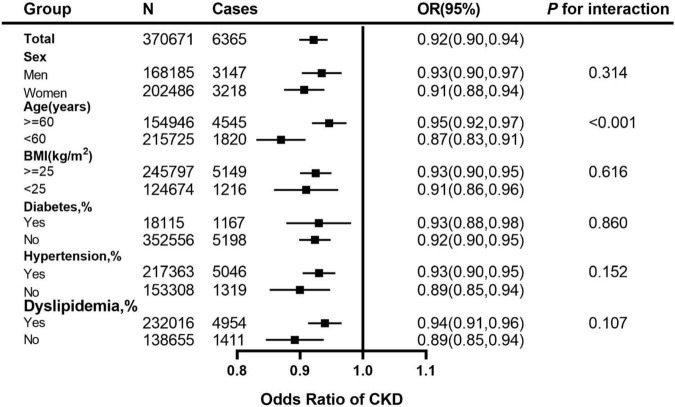
In this large prospective study, participants with a healthy sleep pattern was associated with a significant reduction of incident CKD risk no matter they had a high, intermediate, or low genetic risk.
不健康的睡眠行为可能是慢性肾脏病(CKD)的潜在危险因素。我们旨在研究联合睡眠模式和遗传易感性与CKD发病之间的关联。
这项大规模前瞻性队列研究纳入了英国生物银行数据中370,671名基线时(2006 - 2010年)无CKD的参与者。根据问卷,五种睡眠行为包括睡眠时间、失眠、打鼾、昼夜节律类型和日间嗜睡。通过将五个分数相加得出总体睡眠模式。计算肾功能的加权遗传风险评分。从死亡登记、初级保健和医院住院记录中记录CKD发病情况。还使用了41,130名既参加了初始评估访视又参加了随访访视(2012年及以后)的个体子集。
在中位随访10.6年(约390万人年)期间,我们记录了6365例CKD发病患者。在五种睡眠行为中,每天睡眠7 - 8小时、无失眠且无频繁日间嗜睡分别与CKD发病独立相关,风险分别降低12%(95%CI 7 - 16)、9%(3 - 14)、13%(9 - 18)。与睡眠评分为0 - 1分的参与者相比,评分为5分的参与者患CKD的风险降低21%(10 - 31%)。该队列中17.1%的CKD可归因于总体不良睡眠模式。遗传风险高且睡眠模式中等或较差的参与者患CKD的风险最高(OR = 2.58,95%CI 2.24 - 2.96;OR = 2.59,95%CI 2.02 - 3.32),尽管睡眠模式和遗传风险类别之间没有显著的相互作用。在既参加了初始评估访视又参加了随访访视的个体中,我们发现与稳定睡眠模式组相比,睡眠模式改善与CKD风险之间的关联在完全调整后具有显著性(OR = 0.60,95%CI 0.36 - 0.99)。
在这项大型前瞻性研究中,无论遗传风险高、中或低,具有健康睡眠模式的参与者患CKD的风险均显著降低。