Degrandmaison Jade, Rochon-Haché Samuel, Parent Jean-Luc, Gendron Louis
Centre de Recherche du Centre Hospitalier Universitaire de Sherbrooke, Département de Médecine, Institut de Pharmacologie de Sherbrooke, Faculté de Médecine et des Sciences de la Santé, Université de Sherbrooke, Sherbrooke, QC, Canada.
Centre de Recherche du Centre Hospitalier Universitaire de Sherbrooke, Département de Pharmacologie-Physiologie, Institut de Pharmacologie de Sherbrooke, Faculté de Médecine et des Sciences de la Santé, Université de Sherbrooke, Sherbrooke, QC, Canada.
Front Cell Neurosci. 2022 Jan 31;16:807549. doi: 10.3389/fncel.2022.807549. eCollection 2022.
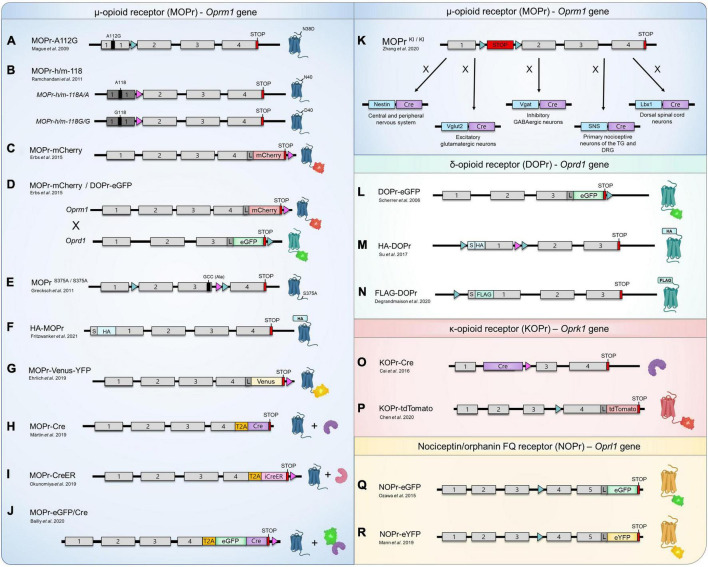
Due to their low expression levels, complex multi-pass transmembrane structure, and the current lack of highly specific antibodies, the assessment of endogenous G protein-coupled receptors (GPCRs) remains challenging. While most of the research regarding their functions was performed in heterologous systems overexpressing the receptor, recent advances in genetic engineering methods have allowed the generation of several unique mouse models. These animals proved to be useful to investigate numerous aspects underlying the physiological functions of GPCRs, including their endogenous expression, distribution, interactome, and trafficking processes. Given their significant pharmacological importance and central roles in the nervous system, opioid peptide receptors (OPr) are often referred to as prototypical receptors for the study of GPCR regulatory mechanisms. Although only a few GPCR knock-in mouse lines have thus far been generated, OPr are strikingly well represented with over 20 different knock-in models, more than half of which were developed within the last 5 years. In this review, we describe the arsenal of OPr (mu-, delta-, and kappa-opioid), as well as the opioid-related nociceptin/orphanin FQ (NOP) receptor knock-in mouse models that have been generated over the past years. We further highlight the invaluable contribution of such models to our understanding of the mechanisms underlying the regulation of OPr, which could be conceivably transposed to any other GPCR, as well as the limitations, future perspectives, and possibilities enabled by such tools.
由于内源性G蛋白偶联受体(GPCRs)表达水平低、具有复杂的多次跨膜结构且目前缺乏高特异性抗体,对其进行评估仍然具有挑战性。虽然关于其功能的大多数研究是在过表达该受体的异源系统中进行的,但基因工程方法的最新进展已使得能够生成几种独特的小鼠模型。这些动物被证明有助于研究GPCRs生理功能背后的诸多方面,包括它们的内源性表达、分布、相互作用组和运输过程。鉴于阿片肽受体(OPr)在药理学上具有重要意义且在神经系统中起核心作用,它们常被视为研究GPCR调节机制的典型受体。尽管迄今为止仅生成了少数几种GPCR基因敲入小鼠品系,但OPr却有超过20种不同的基因敲入模型,其中一半以上是在过去5年内开发的,这非常引人注目。在本综述中,我们描述了过去几年中生成的阿片肽受体(μ-、δ-和κ-阿片受体)以及与阿片类相关的孤啡肽/孤啡肽FQ(NOP)受体基因敲入小鼠模型。我们进一步强调了此类模型对我们理解OPr调节机制所做出的宝贵贡献,这种机制可以想象地应用于任何其他GPCR,同时也强调了此类工具的局限性、未来前景和可能性。