Corona Rebeca, Ordaz Benito, Robles-Osorio Ludivina, Sabath Ernesto, Morales Teresa
Instituto de Neurobiología, Universidad Nacional Autónoma de México, Querétaro, Mexico.
Facultad de Nutrición, Universidad Autónoma de Querétaro, Querétaro, Mexico.
Front Integr Neurosci. 2022 Jan 31;16:763986. doi: 10.3389/fnint.2022.763986. eCollection 2022.
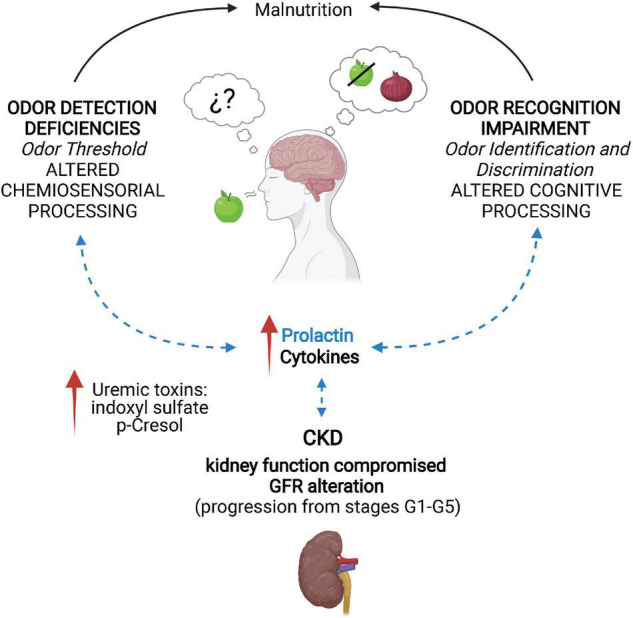
Chronic kidney disease (CKD) is a multifactorial pathology that progressively leads to the deterioration of metabolic functions and results from deficient glomerular filtration and electrolyte imbalance. Its economic impact on public health is challenging. Mexico has a high prevalence of CKD that is strongly associated with some of the most common metabolic disorders like diabetes and hypertension. The gradual loss of kidney functions provokes an inflammatory state and endocrine alterations affecting several systems. High serum levels of prolactin have been associated with CKD progression, inflammation, and olfactory function. Also, the nutritional status is altered due to impaired renal function. The decrease in calorie and protein intake is often accompanied by malnutrition, which can be severe at advanced stages of the disease. Nutrition and olfactory functioning are closely interconnected, and CKD patients often complain of olfactory deficits, which ultimately can lead to deficient food intake. CKD patients present a wide range of deficits in olfaction like odor discrimination, identification, and detection threshold. The chronic inflammatory status in CKD damages the olfactory epithelium leading to deficiencies in the chemical detection of odor molecules. Additionally, the decline in cognitive functioning impairs the capacity of odor differentiation. It is not clear whether peritoneal dialysis and hemodialysis improve the olfactory deficits, but renal transplants have a strong positive effect. In the present review, we discuss whether the olfactory deficiencies caused by CKD are the result of the induced inflammatory state, the hyperprolactinemia, or a combination of both.
慢性肾脏病(CKD)是一种多因素疾病,会逐渐导致代谢功能恶化,由肾小球滤过不足和电解质失衡引起。其对公共卫生的经济影响具有挑战性。墨西哥CKD的患病率很高,这与一些最常见的代谢紊乱如糖尿病和高血压密切相关。肾功能的逐渐丧失会引发炎症状态和影响多个系统的内分泌改变。高血清催乳素水平与CKD进展、炎症和嗅觉功能有关。此外,由于肾功能受损,营养状况也会改变。热量和蛋白质摄入的减少常伴有营养不良,在疾病晚期可能会很严重。营养和嗅觉功能密切相关,CKD患者常抱怨嗅觉缺陷,这最终可能导致食物摄入不足。CKD患者在嗅觉方面存在广泛的缺陷,如气味辨别、识别和检测阈值。CKD中的慢性炎症状态会损害嗅觉上皮,导致对气味分子的化学检测不足。此外,认知功能的下降会损害气味辨别能力。目前尚不清楚腹膜透析和血液透析是否能改善嗅觉缺陷,但肾移植有很强的积极作用。在本综述中,我们讨论了CKD引起的嗅觉缺陷是由诱导的炎症状态、高催乳素血症还是两者共同作用导致的。