• 文献检索
  • 文档翻译
  • 深度研究
  • 学术资讯
  • Suppr Zotero 插件Zotero 插件
  • 邀请有礼
  • 套餐&价格
  • 历史记录
应用&插件
Suppr Zotero 插件Zotero 插件浏览器插件Mac 客户端Windows 客户端微信小程序
定价
高级版会员购买积分包购买API积分包
服务
文献检索文档翻译深度研究API 文档MCP 服务
关于我们
关于 Suppr公司介绍联系我们用户协议隐私条款
关注我们

Suppr 超能文献

核心技术专利:CN118964589B侵权必究
粤ICP备2023148730 号-1Suppr @ 2026

文献检索

告别复杂PubMed语法,用中文像聊天一样搜索,搜遍4000万医学文献。AI智能推荐,让科研检索更轻松。

立即免费搜索

文件翻译

保留排版,准确专业,支持PDF/Word/PPT等文件格式,支持 12+语言互译。

免费翻译文档

深度研究

AI帮你快速写综述,25分钟生成高质量综述,智能提取关键信息,辅助科研写作。

立即免费体验

基于解析模型和机器学习模型的双散射质子系统综合输出估计

Comprehensive Output Estimation of Double Scattering Proton System With Analytical and Machine Learning Models.

作者信息

Zhu Jiahua, Cui Taoran, Zhang Yin, Zhang Yang, Ma Chi, Liu Bo, Nie Ke, Yue Ning J, Wang Xiao

机构信息

Department of Radiation Oncology, Rutgers-Cancer Institute of New Jersey, Rutgers-Robert Wood Johnson Medical School, New Brunswick, NJ, United States.

Department of Radiation Oncology, Reading Hospital, Tower Health, West Reading, PA, United States.

出版信息

Front Oncol. 2022 Jan 31;11:756503. doi: 10.3389/fonc.2021.756503. eCollection 2021.

DOI:10.3389/fonc.2021.756503
PMID:35174065
原文链接:https://pmc.ncbi.nlm.nih.gov/articles/PMC8841866/
Abstract

OBJECTIVES

The beam output of a double scattering proton system varies for each combination of beam option, range, and modulation and therefore is difficult to be accurately modeled by the treatment planning system (TPS). This study aims to design an empirical method using the analytical and machine learning (ML) models to estimate proton output in a double scattering proton system.

MATERIALS AND METHODS

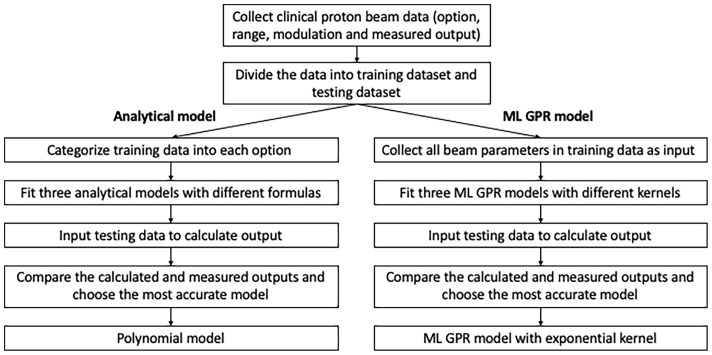
Three analytical models using polynomial, linear, and logarithm-polynomial equations were generated on a training dataset consisting of 1,544 clinical measurements to estimate proton output for each option. Meanwhile, three ML models using Gaussian process regression (GPR) with exponential kernel, squared exponential kernel, and rational quadratic kernel were also created for all options combined. The accuracy of each model was validated against 241 additional clinical measurements as the testing dataset. Two most robust models were selected, and the minimum number of samples needed for either model to achieve sufficient accuracy ( ± 3%) was determined by evaluating the mean average percentage error (MAPE) with increasing sample number. The differences between the estimated outputs using the two models were also compared for 1,000 proton beams with a randomly generated range, and modulation for each option.

RESULTS

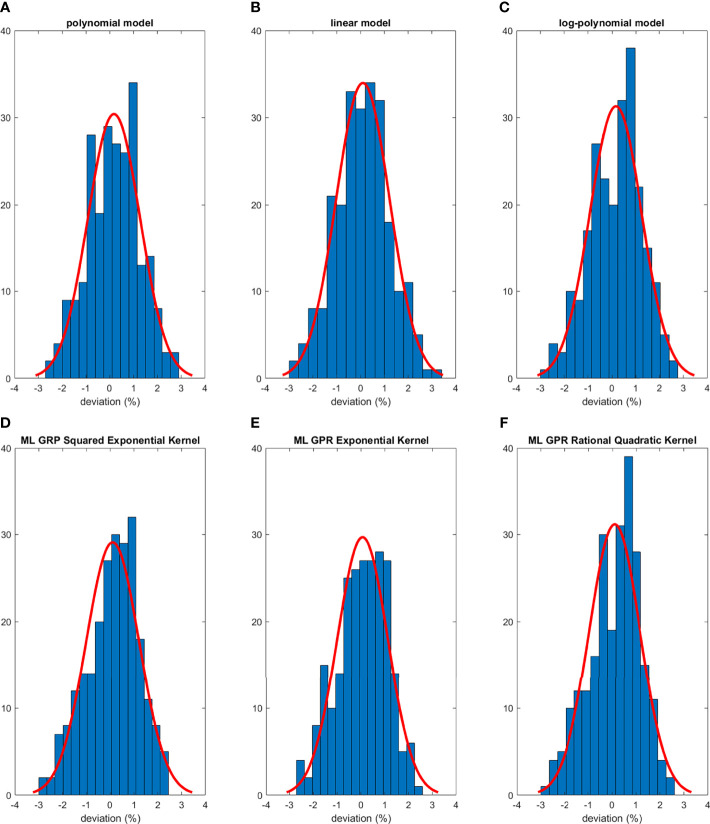
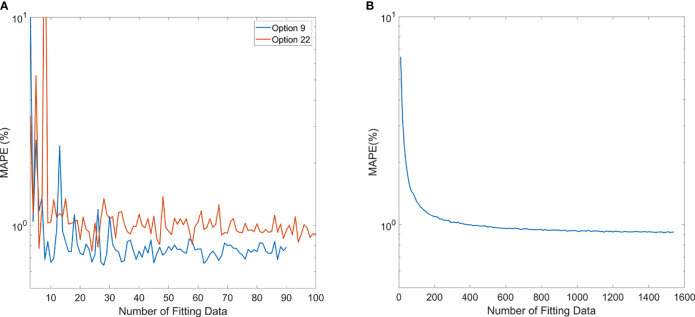
The polynomial model and the ML GPR model with exponential kernel yielded the most accurate estimations with less than 3% deviation from the measured outputs. At least 20 samples of each option were needed to build the polynomial model with less than 1% MAPE, whereas at least a total of 400 samples were needed for all beam options to build the ML GPR model with exponential kernel to achieve comparable accuracy. The two independent models agreed with less than 2% deviation using the testing dataset.

CONCLUSION

The polynomial model and the ML GPR model with exponential kernel were built for proton output estimation with less than 3% deviations from the measurements. They can be used as an independent output prediction tool for a double scattering proton beam and a secondary output check tool for a cross check between themselves.

摘要

目的

双散射质子系统的束流输出会因束流选项、射程和调制的每种组合而有所不同,因此治疗计划系统(TPS)难以对其进行精确建模。本研究旨在设计一种使用分析模型和机器学习(ML)模型的经验方法,以估计双散射质子系统中的质子输出。

材料与方法

在一个由1544次临床测量组成的训练数据集上,生成了使用多项式、线性和对数多项式方程的三种分析模型,以估计每个选项的质子输出。同时,还针对所有组合选项创建了三种使用具有指数核、平方指数核和有理二次核的高斯过程回归(GPR)的ML模型。每个模型的准确性通过另外241次临床测量作为测试数据集进行验证。选择了两个最稳健的模型,并通过评估随着样本数量增加的平均平均百分比误差(MAPE),确定每个模型达到足够准确性(±3%)所需的最少样本数量。还比较了使用这两个模型对1000束随机生成射程和每个选项调制的质子束的估计输出之间的差异。

结果

多项式模型和具有指数核的ML GPR模型产生了最准确的估计,与测量输出的偏差小于3%。构建MAPE小于1%的多项式模型,每个选项至少需要20个样本,而构建具有指数核的ML GPR模型以达到可比的准确性,所有束流选项总共至少需要400个样本。使用测试数据集时,这两个独立模型的偏差小于2%。

结论

构建了多项式模型和具有指数核的ML GPR模型用于质子输出估计,与测量值的偏差小于3%。它们可作为双散射质子束的独立输出预测工具,以及相互之间进行交叉检查的二次输出检查工具。
https://cdn.ncbi.nlm.nih.gov/pmc/blobs/f9ac/8841866/d5c9f134da52/fonc-11-756503-g007.jpg
https://cdn.ncbi.nlm.nih.gov/pmc/blobs/f9ac/8841866/be7e001666a5/fonc-11-756503-g001.jpg
https://cdn.ncbi.nlm.nih.gov/pmc/blobs/f9ac/8841866/f2ee55bb922f/fonc-11-756503-g002.jpg
https://cdn.ncbi.nlm.nih.gov/pmc/blobs/f9ac/8841866/0137704adc6a/fonc-11-756503-g003.jpg
https://cdn.ncbi.nlm.nih.gov/pmc/blobs/f9ac/8841866/41a229d6239c/fonc-11-756503-g004.jpg
https://cdn.ncbi.nlm.nih.gov/pmc/blobs/f9ac/8841866/e9335d6ad60d/fonc-11-756503-g005.jpg
https://cdn.ncbi.nlm.nih.gov/pmc/blobs/f9ac/8841866/b039c6169b3a/fonc-11-756503-g006.jpg
https://cdn.ncbi.nlm.nih.gov/pmc/blobs/f9ac/8841866/d5c9f134da52/fonc-11-756503-g007.jpg
https://cdn.ncbi.nlm.nih.gov/pmc/blobs/f9ac/8841866/be7e001666a5/fonc-11-756503-g001.jpg
https://cdn.ncbi.nlm.nih.gov/pmc/blobs/f9ac/8841866/f2ee55bb922f/fonc-11-756503-g002.jpg
https://cdn.ncbi.nlm.nih.gov/pmc/blobs/f9ac/8841866/0137704adc6a/fonc-11-756503-g003.jpg
https://cdn.ncbi.nlm.nih.gov/pmc/blobs/f9ac/8841866/41a229d6239c/fonc-11-756503-g004.jpg
https://cdn.ncbi.nlm.nih.gov/pmc/blobs/f9ac/8841866/e9335d6ad60d/fonc-11-756503-g005.jpg
https://cdn.ncbi.nlm.nih.gov/pmc/blobs/f9ac/8841866/b039c6169b3a/fonc-11-756503-g006.jpg
https://cdn.ncbi.nlm.nih.gov/pmc/blobs/f9ac/8841866/d5c9f134da52/fonc-11-756503-g007.jpg

相似文献

1
Comprehensive Output Estimation of Double Scattering Proton System With Analytical and Machine Learning Models.基于解析模型和机器学习模型的双散射质子系统综合输出估计
Front Oncol. 2022 Jan 31;11:756503. doi: 10.3389/fonc.2021.756503. eCollection 2021.
2
Prediction of the output factor using machine and deep learning approach in uniform scanning proton therapy.在均匀扫描质子治疗中使用机器学习和深度学习方法预测输出因子。
J Appl Clin Med Phys. 2020 Jul;21(7):128-134. doi: 10.1002/acm2.12899. Epub 2020 May 17.
3
A machine learning approach to the accurate prediction of monitor units for a compact proton machine.一种用于精确预测紧凑型质子机器的监测单位的机器学习方法。
Med Phys. 2018 May;45(5):2243-2251. doi: 10.1002/mp.12842. Epub 2018 Mar 23.
4
Evaluation of the influence of double and triple Gaussian proton kernel models on accuracy of dose calculations for spot scanning technique.双高斯和三高斯质子核模型对笔形束扫描技术剂量计算准确性的影响评估
Med Phys. 2016 Mar;43(3):1437-50. doi: 10.1118/1.4942386.
5
Comparability of three output prediction models for a compact passively double-scattered proton therapy system.紧凑型被动双散射质子治疗系统三种输出预测模型的可比性
J Appl Clin Med Phys. 2017 May;18(3):108-117. doi: 10.1002/acm2.12079. Epub 2017 Apr 19.
6
Implementation of an improved dose-per-MU model for double-scattered proton beams to address interbeamline modulation width variability.实现改进的剂量每 MU 模型,以解决双散射质子束的束间调制宽度变化。
J Appl Clin Med Phys. 2014 May 8;15(3):4748. doi: 10.1120/jacmp.v15i3.4748.
7
Implementation of output prediction models for a passively double-scattered proton therapy system.被动双散射质子治疗系统输出预测模型的实现。
Med Phys. 2016 Nov;43(11):6089. doi: 10.1118/1.4965046.
8
Development of a golden beam data set for the commissioning of a proton double-scattering system in a pencil-beam dose calculation algorithm.开发用于在笔形束剂量计算算法中调试质子双散射系统的金标准束数据集。
Med Phys. 2014 Sep;41(9):091710. doi: 10.1118/1.4893281.
9
Technical Note: An approach to building a Monte Carlo simulation model for a double scattering proton beam system.技术说明:建立双散射质子束系统蒙特卡罗模拟模型的方法。
Med Phys. 2018 Jun;45(6):2660-2666. doi: 10.1002/mp.12895. Epub 2018 Apr 18.
10
Machine learning-powered estimation of malachite green photocatalytic degradation with NML-BiFeO composites.基于NML-BiFeO复合材料的机器学习驱动孔雀石绿光催化降解估算
Sci Rep. 2024 Apr 15;14(1):8676. doi: 10.1038/s41598-024-58976-x.

本文引用的文献

1
Efficacy and feasibility of proton beam radiotherapy using the simultaneous integrated boost technique for locally advanced pancreatic cancer.采用同步整合升压技术的质子束放疗治疗局部晚期胰腺癌的疗效和可行性。
Sci Rep. 2020 Dec 10;10(1):21712. doi: 10.1038/s41598-020-78875-1.
2
First proton minibeam radiation therapy treatment plan evaluation.首例质子微束放射治疗计划评估。
Sci Rep. 2020 Apr 27;10(1):7025. doi: 10.1038/s41598-020-63975-9.
3
A machine learning approach to the accurate prediction of monitor units for a compact proton machine.
一种用于精确预测紧凑型质子机器的监测单位的机器学习方法。
Med Phys. 2018 May;45(5):2243-2251. doi: 10.1002/mp.12842. Epub 2018 Mar 23.
4
Implementation of output prediction models for a passively double-scattered proton therapy system.被动双散射质子治疗系统输出预测模型的实现。
Med Phys. 2016 Nov;43(11):6089. doi: 10.1118/1.4965046.
5
Machine Learning Approaches for Predicting Radiation Therapy Outcomes: A Clinician's Perspective.机器学习在预测放射治疗结果中的应用:临床医生的视角。
Int J Radiat Oncol Biol Phys. 2015 Dec 1;93(5):1127-35. doi: 10.1016/j.ijrobp.2015.07.2286. Epub 2015 Nov 11.
6
Dosimetric impact of number of treatment fields in uniform scanning proton therapy planning of lung cancer.肺癌均匀扫描质子治疗计划中治疗野数量的剂量学影响
J Med Phys. 2014 Oct;39(4):212-8. doi: 10.4103/0971-6203.144483.
7
Implementation of an improved dose-per-MU model for double-scattered proton beams to address interbeamline modulation width variability.实现改进的剂量每 MU 模型,以解决双散射质子束的束间调制宽度变化。
J Appl Clin Med Phys. 2014 May 8;15(3):4748. doi: 10.1120/jacmp.v15i3.4748.
8
Prediction of output factor, range, and spread-out bragg peak for proton therapy.质子治疗中输出因子、射程和扩展布拉格峰的预测。
Med Dosim. 2011 Summer;36(2):145-52. doi: 10.1016/j.meddos.2010.02.006. Epub 2010 Jul 5.
9
Radiological use of fast protons.快速质子的放射学应用。
Radiology. 1946 Nov;47(5):487-91. doi: 10.1148/47.5.487.
10
A procedure for calculation of monitor units for passively scattered proton radiotherapy beams.一种用于被动散射质子放射治疗束的监测单位计算方法。
Med Phys. 2008 Nov;35(11):5088-97. doi: 10.1118/1.2992055.