Department of Statistics, University of Dhaka, Dhaka, Bangladesh.
Public Health Foundation, Bangladesh (PHF, BD), Dhaka, Bangladesh.
Front Public Health. 2022 Jan 31;9:811345. doi: 10.3389/fpubh.2021.811345. eCollection 2021.
Whilst very limited studies have demonstrated a correlation between the COVID-19 pandemic and depressive symptoms amongst Bangladeshi medical students, the prevalence and associated factors of depressive symptoms as measured by the Patient Health Questionnaire (PHQ-9) remains widely unknown.
The study aimed to investigate the prevalence and factors associated with depression symptoms among Bangladeshi medical students during the COVID-19 pandemic lockdown period.
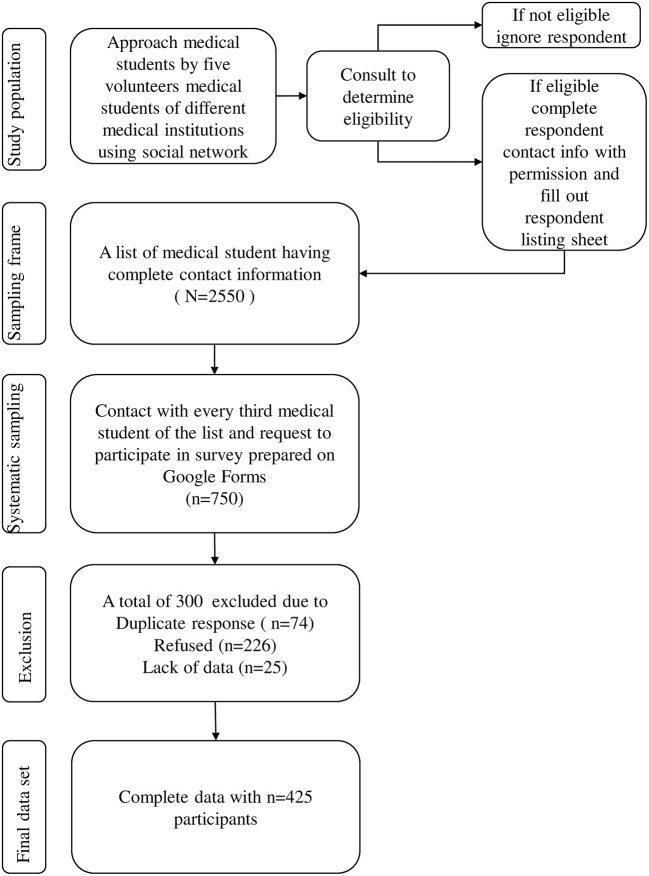
In this web-based cross-sectional pilot study, medical students' data was collected using the Google Forms web survey platform after obtaining electronic informed consent. A total of 425 medical students were selected using a systematic sampling technique to accumulate depression symptoms and demographic and pandemic-related information. Depression was measured by a self-administered, validated English version of the Patient Health Questionnaire (PHQ-9) tool. The descriptive analysis utilized frequency and percentages, while the stepwise binary logistic regression analysis was performed to investigate the factors associated with depressive symptoms.
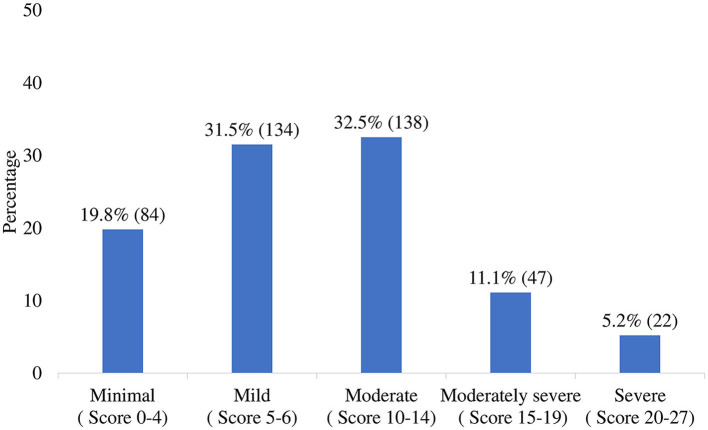
Among 425 medical students, 62.3% were female, 97.4% unmarried. Almost 80.2% of medical students had mild to severe levels of depressive symptoms as characterized by PHQ-9. A significantly higher probability of depression was found amongst female students (adjusted OR = 1.8), those who struggled to stay away from social media (adjusted OR = 1.8), those who tried to be optimistic for maintaining better psychology (adjusted OR = 11.1), and those who always had a sleeping difficulty in the last 4 weeks (adjusted OR = 8.9).
A very high prevalence of depression symptoms among Bangladeshi medical students was found across the majority of socio-demographic variables. The alarming prevalence and associated factors of depression suggests the need for follow-intensity psychosocial interventions designed for medical students during the COVID-19 pandemic.
尽管已有一些有限的研究表明 COVID-19 大流行与孟加拉国医学生的抑郁症状之间存在相关性,但仍广泛未知 PHQ-9 测量的抑郁症状的流行率及其相关因素。
本研究旨在调查 COVID-19 大流行封锁期间孟加拉国医学生抑郁症状的流行率及其相关因素。
在这项基于网络的横断面试点研究中,使用 Google 表单网络调查平台收集医学生的数据,在获得电子知情同意后进行。使用系统抽样技术选择了 425 名医学生,以积累抑郁症状和人口统计学及大流行相关信息。使用自我管理的经过验证的英文版患者健康问卷 (PHQ-9) 工具来衡量抑郁。描述性分析使用频率和百分比,而逐步二元逻辑回归分析则用于调查与抑郁症状相关的因素。
在 425 名医学生中,62.3%为女性,97.4%未婚。根据 PHQ-9,近 80.2%的医学生有轻度至重度的抑郁症状。研究发现,女性学生(调整后的 OR = 1.8)、难以远离社交媒体的学生(调整后的 OR = 1.8)、试图保持乐观以维持更好的心理状态的学生(调整后的 OR = 11.1)和过去 4 周内总是有睡眠困难的学生(调整后的 OR = 8.9),抑郁的可能性显著更高。
在大多数社会人口统计学变量中,发现孟加拉国医学生的抑郁症状发生率非常高。令人震惊的抑郁发生率及其相关因素表明,需要针对 COVID-19 大流行期间的医学生开展强化的社会心理干预。