Safa Farhana, Anjum Afifa, Hossain Sahadat, Trisa Tonima Islam, Alam Syeda Fatema, Abdur Rafi Md, Podder Vivek, Koly Kamrun Nahar, Azad Dewan Tasnia, Ahmad Wasi Uddin, Nodi Rhedeya Nury, Ashraf Fatema, Quamrul Akhter S M, Ahmed Helal Uddin, Hasan M Tasdik
Department of Public Health, Dalla Lana School of Public Health, University of Toronto, Canada.
Department of Public Health and Informatics, Jahangirnagar University, Dhaka, Bangladesh.
Child Youth Serv Rev. 2021 Mar;122:105912. doi: 10.1016/j.childyouth.2020.105912. Epub 2020 Dec 29.
The most recent global pandemic of COVID-19 has been creating multidimensional damages, including a detrimental impact on the mental health status of individuals. Medical students, a vulnerable cross-section of the population, may have perceived a myriad of psychological stressors during this crisis in the background of their prevailing stressful academic pressure and preexisting higher psychological and mental health issue.
To determine the prevalence of anxiety and depressive symptoms and to elucidate the psychological impact of COVID-19 pandemic on Bangladeshi medical students.
A cross-sectional study design was utilized to conduct this survey. The online survey including demographic questions, COVID-19 related questions, and the Hospital Anxiety and Depression Scale (HADS; higher scores on the subscales indicate higher levels of depressive and anxiety symptoms), was completed by 425 Bangladeshi medical students. Collected data were statistically analyzed by using SPSS (version 25.0) software.
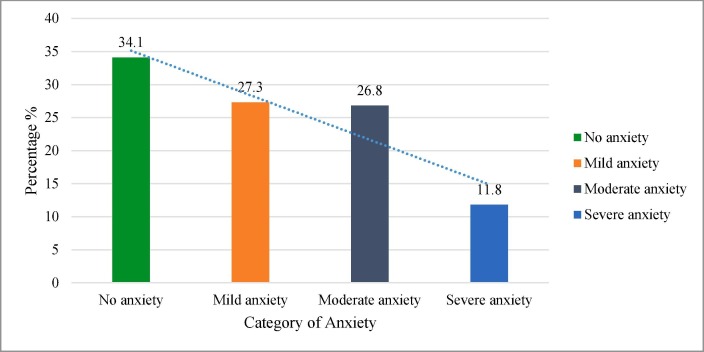
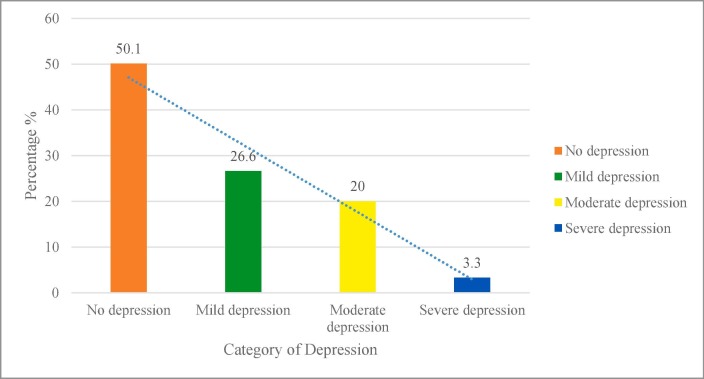
The HADS anxiety subscale revealed that 65.9% of the medical students had different levels of anxiety, ranging from mild (27.3%), moderate (26.8%), and severe (11.8%). As per HADS depression subscale, 49.9% of the medical students had varying degrees of depressive symptoms, with 3.3% of the participants had suffered from severe depressive symptoms. Female students had a relatively more anxiety and depressive symptoms when compared with males. The students, who were severely tensed of getting infected by the virus, were at higher risk of suffering from anxiety (3.5-fold) and depressive (2.7-fold) symptoms, when compared with no/minimally stressed students. Besides, fear of getting assaulted or humiliated on the way to hospital or home, not to be able to give maximum concentration on study after COVID-19 pandemic, students' present emotional status (agitation), had statistically significant higher risk of anxiety.
A substantial proportion of Bangladeshi medical students are experiencing pandemic-related adverse psychological impact. Poor mental health conditions of these vulnerable medical students pose important threat to their potential contribution in future health care. Thus, medical colleges and health authorities should focus on addressing their psychological needs and formulate effective strategies to ameliorate medical students' mental health status, particularly during any infectious disease outbreak.
最近的新冠疫情造成了多方面的损害,包括对个人心理健康状况产生不利影响。医学生作为人群中的一个脆弱群体,在这场危机期间,在其原本就紧张的学业压力以及先前存在的较高心理和精神健康问题的背景下,可能感受到了无数的心理压力源。
确定焦虑和抑郁症状的患病率,并阐明新冠疫情对孟加拉国医学生的心理影响。
采用横断面研究设计进行此项调查。425名孟加拉国医学生完成了在线调查,该调查包括人口统计学问题、与新冠疫情相关的问题以及医院焦虑抑郁量表(HADS;分量表得分越高表明抑郁和焦虑症状水平越高)。使用SPSS(版本25.0)软件对收集的数据进行统计分析。
HADS焦虑分量表显示,65.9%的医学生有不同程度的焦虑,从轻度(27.3%)、中度(26.8%)到重度(11.8%)。根据HADS抑郁分量表,49.9%的医学生有不同程度的抑郁症状,3.3%的参与者患有严重抑郁症状。与男性相比,女学生的焦虑和抑郁症状相对更多。与无压力/压力最小的学生相比,那些极度担心感染病毒的学生患焦虑症状(3.5倍)和抑郁症状(2.7倍)的风险更高。此外,担心在去医院或回家途中受到攻击或羞辱、新冠疫情后无法全神贯注学习、学生当前的情绪状态(激动),在统计学上有更高的焦虑风险。
相当一部分孟加拉国医学生正在经历与疫情相关的不良心理影响。这些脆弱医学生的心理健康状况不佳对他们未来在医疗保健方面的潜在贡献构成了重大威胁。因此,医学院校和卫生当局应关注满足他们的心理需求,并制定有效策略来改善医学生的心理健康状况,特别是在任何传染病爆发期间。