Buttenheim Alison, Milkman Katherine L, Duckworth Angela L, Gromet Dena M, Patel Mitesh, Chapman Gretchen
Department of Family and Community Health, School of Nursing, University of Pennsylvania, Philadelphia.
Department of Operations, Information and Decisions, The Wharton School, University of Pennsylvania, Philadelphia.
JAMA Netw Open. 2022 Feb 1;5(2):e2143388. doi: 10.1001/jamanetworkopen.2021.43388.
Despite the availability of safe and effective vaccines, many people fail to get vaccinated. Messages using behavioral science principles may increase vaccination rates.
To determine the effect on influenza vaccination rates of a text message telling patients that an influenza vaccine had been reserved for them.
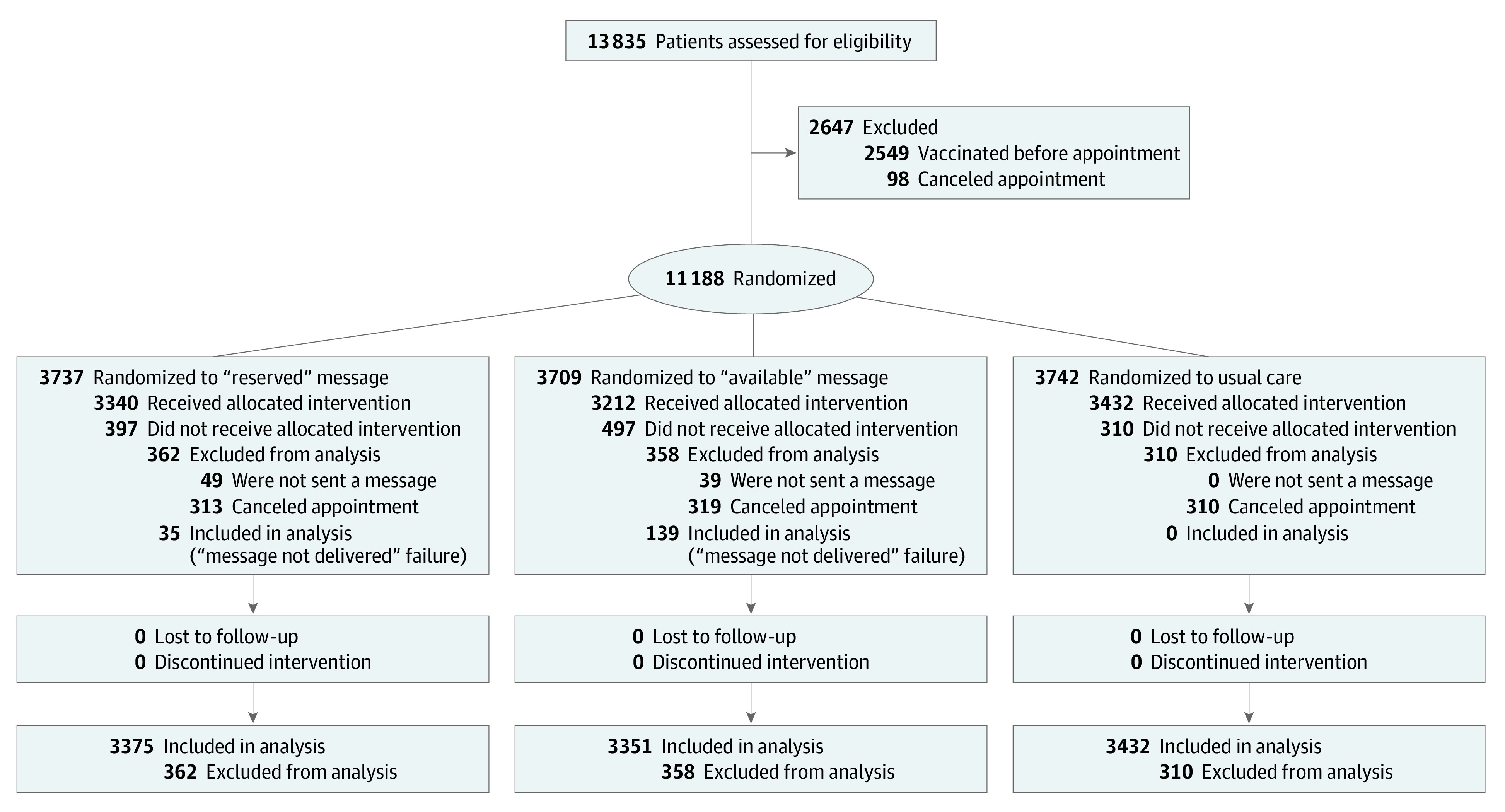
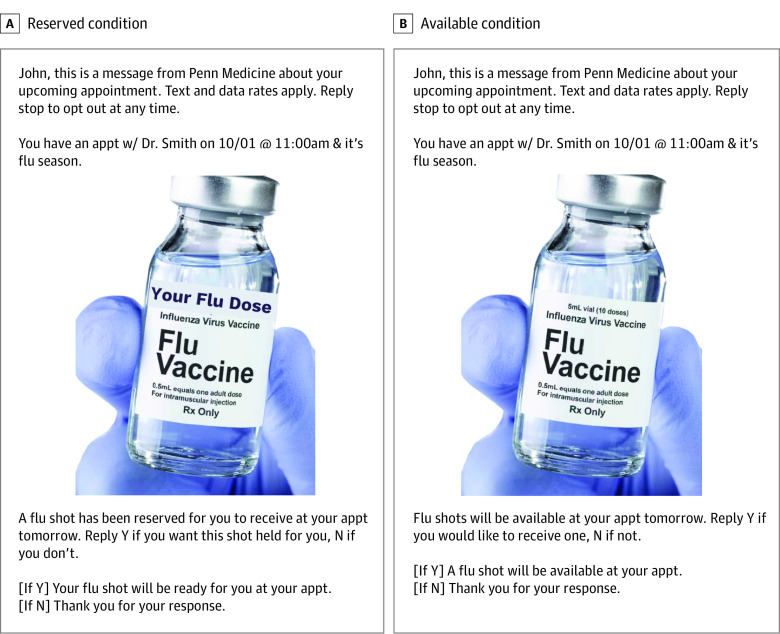
DESIGN, SETTING, AND PARTICIPANTS: As part of a larger influenza vaccine messaging megastudy, in this randomized clinical trial, 11 188 patients in 2 large health systems were assigned to receive a text message that stated "a flu shot has been reserved for you," a text message that stated "flu shots will be available," or no text message. Both messages included the option to reply yes (Y) or no (N) to indicate that the patient wanted to get vaccinated. Patients 18 years or older were included if they had new or routine (nonsick) primary care appointments scheduled from September 20, 2020, through March 31, 2021.
The evening before the scheduled appointment, patients in the 2 message conditions were sent 3 back-to-back SMS messages containing the study wording. Patients in the usual care control group did not receive any study messages.
Receipt of an influenza vaccine on the date of the patient's scheduled appointment.
A total of 11 188 patients were randomized to the reserved or the available message conditions or to usual care. The 10 158 patients analyzed in the study had a mean (SD) age of 50.61 (16.28) years; 5631 (55.43%) were women; and 7025 (69.16%) were White. According to health records, 4113 (40.49%) had been vaccinated in the previous influenza season, and 5420 (53.36%) were patients at Penn Medicine. In an intent-to-treat analysis, changes in vaccination rates in response to the reserved message did not reach statistical significance (increase of 1.4 percentage points, or 4% [P = .31]) compared with the message conveying that influenza vaccines were available. Relative to the usual care control, the reserved message increased vaccination rates by 3.3 percentage points, or 11% (P = .004). Patients in the reserved message condition were more likely to text back Y (1063 of 3375 [31.50%]) compared with those in the available message condition (887 of 3351 [26.47%]; χ2 = 20.64; P < .001), and those who replied Y were more likely to get vaccinated (1532 of 1950 [78.56%]) compared with those who did not (749 of 4776 [15.68%]; χ2 = 2400; P < .001).
This study found that patients who received text messages regarding flu vaccination had greater vaccine uptake than those who received no message. Messages that increase the likelihood that patients will indicate their intention to be vaccinated may also increase vaccination behavior.
ClincalTrials.gov Identifier: NCT04565353.
尽管有安全有效的疫苗,但许多人仍未接种疫苗。运用行为科学原理的信息可能会提高疫苗接种率。
确定向患者发送短信告知其流感疫苗已为其预留对流感疫苗接种率的影响。
设计、背景和参与者:作为一项更大规模的流感疫苗信息传递大型研究的一部分,在这项随机临床试验中,2个大型医疗系统中的11188名患者被分配接受一条短信,内容为“已为您预留了一剂流感疫苗”,或一条短信,内容为“将提供流感疫苗”,或不接收任何短信。两条短信都包含回复“是”(Y)或“否”(N)的选项,以表明患者想要接种疫苗。纳入2020年9月20日至2021年3月31日期间安排了新的或常规(非患病)初级保健预约的18岁及以上患者。
在预定预约的前一天晚上,向处于两种短信条件下的患者发送3条连续的短信,内容包含研究措辞。常规护理对照组的患者未收到任何研究短信。
在患者预定预约日期接种流感疫苗。
共有11188名患者被随机分配到预留或可获得短信条件组或常规护理组。研究中分析的10158名患者的平均(标准差)年龄为50.61(16.28)岁;5631名(55.43%)为女性;7025名(69.16%)为白人。根据健康记录,4113名(40.49%)在之前的流感季节接种过疫苗,5420名(53.36%)是宾夕法尼亚大学医学中心的患者。在意向性分析中,与传达流感疫苗可获得的短信相比,因预留短信导致的接种率变化未达到统计学显著性(增加1.4个百分点,即4%[P = 0.31])。相对于常规护理对照组,预留短信使接种率提高了3.3个百分点,即提高了11%(P = 0.004)。与可获得短信条件组的患者相比,处于预留短信条件下的患者更有可能回复“是”(3375名中的1063名[31.50%]对比3351名中的887名[26.47%];χ² = 20.64;P < 0.001),回复“是”的患者比未回复的患者更有可能接种疫苗(1950名中的1532名[78.56%]对比4776名中的749名[15.68%];χ² = 2400;P < 0.001)。
本研究发现,收到流感疫苗接种短信的患者比未收到短信的患者接种疫苗的比例更高。增加患者表明接种意愿可能性的短信也可能会增加接种行为。
ClinicalTrials.gov标识符:NCT04565353。