Department of Operations, Information and Decisions, The Wharton School, University of Pennsylvania, Philadelphia, PA 19104;
Department of Medicine, Perelman School of Medicine, University of Pennsylvania, Philadelphia, PA 19104.
Proc Natl Acad Sci U S A. 2021 May 18;118(20). doi: 10.1073/pnas.2101165118.
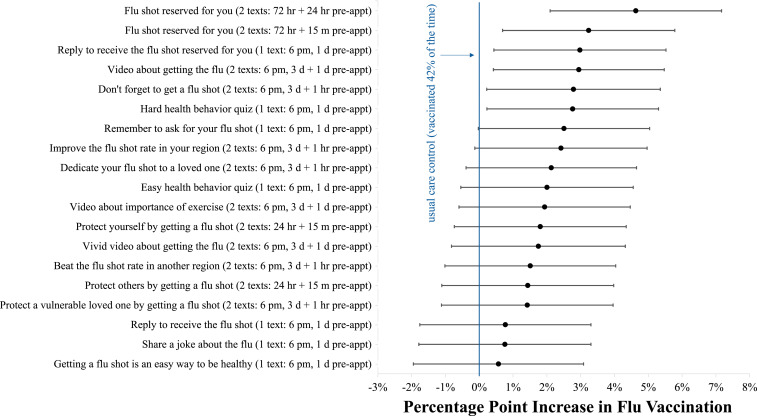
Many Americans fail to get life-saving vaccines each year, and the availability of a vaccine for COVID-19 makes the challenge of encouraging vaccination more urgent than ever. We present a large field experiment ( = 47,306) testing 19 nudges delivered to patients via text message and designed to boost adoption of the influenza vaccine. Our findings suggest that text messages sent prior to a primary care visit can boost vaccination rates by an average of 5%. Overall, interventions performed better when they were 1) framed as reminders to get flu shots that were already reserved for the patient and 2) congruent with the sort of communications patients expected to receive from their healthcare provider (i.e., not surprising, casual, or interactive). The best-performing intervention in our study reminded patients twice to get their flu shot at their upcoming doctor's appointment and indicated it was reserved for them. This successful script could be used as a template for campaigns to encourage the adoption of life-saving vaccines, including against COVID-19.
许多美国人每年都未能接种救命疫苗,而 COVID-19 疫苗的出现使得鼓励接种疫苗的挑战比以往任何时候都更加紧迫。我们进行了一项大规模现场试验(=47,306),测试了通过短信发送给患者的 19 种推动因素,旨在提高流感疫苗的接种率。我们的研究结果表明,在初级保健就诊前发送的短信可以将接种率平均提高 5%。总体而言,当干预措施被 1)构成为已经为患者预留的流感疫苗接种提醒,以及 2)与患者预期从其医疗保健提供者那里收到的通信类型一致时(即,不令人惊讶、随意或互动),效果更好。我们研究中表现最好的干预措施是两次提醒患者在即将到来的医生预约时接种流感疫苗,并指出这是为他们预留的。这个成功的方案可以用作鼓励接种救命疫苗(包括 COVID-19 疫苗)的运动模板。