Kühne Irina A, Ozarowski Andrew, Sultan Aizuddin, Esien Kane, Carter Anthony B, Wix Paul, Casey Aoife, Heerah-Booluck Mooneerah, Keene Tony D, Müller-Bunz Helge, Felton Solveig, Hill Stephen, Morgan Grace G
School of Chemistry, University College Dublin (UCD), Belfield, Dublin 4, Ireland.
FZU - Institute of Physics - Czech Academy of Sciences, Na Slovance 1999/2, Prague 8 182 21, Czech Republic.
Inorg Chem. 2022 Feb 28;61(8):3458-3471. doi: 10.1021/acs.inorgchem.1c03379. Epub 2022 Feb 17.
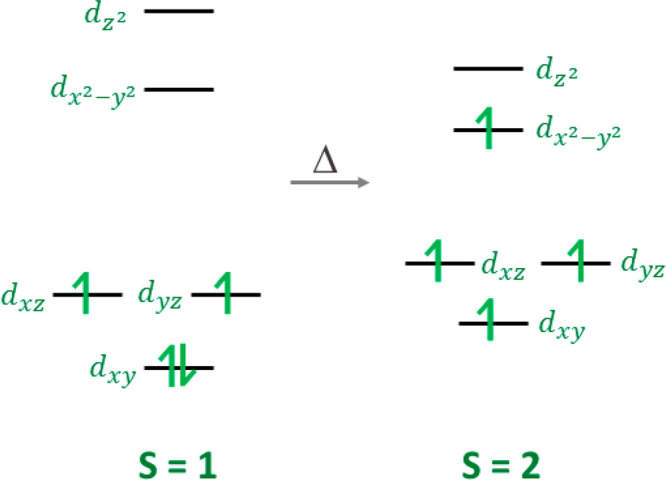
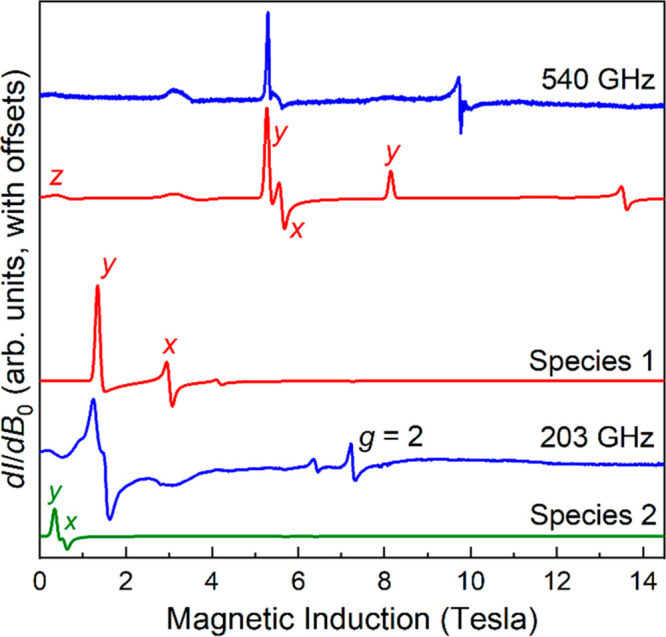
Structural, magnetic, and spectroscopic data on a Mn spin-crossover complex with Schiff base ligand 4-OMe-Sal323, isolated in crystal lattices with five different counteranions, are reported. Complexes of [Mn(4-OMe-Sal323)]X where X = ClO (), BF (), NO (), Br (), and I () crystallize isotypically in the chiral orthorhombic space group 222 with a range of spin state preferences for the [Mn(4-OMe-Sal323)] complex cation over the temperature range 5-300 K. Complexes and are high-spin, complex undergoes a gradual and complete thermal spin crossover, while complexes and show stepped crossovers with different ratios of spin triplet and quintet forms in the intermediate temperature range. High-field electron paramagnetic resonance was used to measure the zero-field splitting parameters associated with the spin triplet and quintet states at temperatures below 10 K for complexes and with respective values: = +23.38(1) cm, = +2.79(1) cm, and = +6.9(3) cm, with a distribution of parameters for the = 2 state. Solid-state circular dichroism (CD) spectra on high-spin complex at room temperature reveal a 2:1 ratio of enantiomers in the chiral conglomerate, and solution CD measurements on the same sample in methanol show that it is stable toward racemization. Solid-state UV-vis absorption spectra on high-spin complex and mixed = 1/ = 2 sample reveal different intensities at higher energies, in line with the different electronic composition. The statistical prevalence of homochiral crystallization of [Mn(4-OMe-Sal323)] in five lattices with different achiral counterions suggests that the chirality may be directed by the 4-OMe-Sal323 ligand.
报道了一种具有席夫碱配体4-OMe-Sal323的锰自旋交叉配合物的结构、磁性和光谱数据,该配合物在含有五种不同抗衡阴离子的晶格中分离得到。[Mn(4-OMe-Sal323)]X配合物(其中X = ClO₄⁻、BF₄⁻、NO₃⁻、Br⁻和I⁻)在5 - 300 K温度范围内,在手性正交空间群222中同型结晶,[Mn(4-OMe-Sal323)]配合物阳离子具有一系列自旋态偏好。配合物[Mn(4-OMe-Sal323)]ClO₄和[Mn(4-OMe-Sal323)]BF₄是高自旋的,配合物[Mn(4-OMe-Sal323)]NO₃经历逐渐且完全的热自旋交叉,而配合物[Mn(4-OMe-Sal323)]Br和[Mn(4-OMe-Sal323)]I在中间温度范围内显示出具有不同自旋三重态和五重态形式比例的阶梯式交叉。利用高场电子顺磁共振测量了配合物[Mn(4-OMe-Sal323)]Br和[Mn(4-OMe-Sal323)]I在10 K以下温度与自旋三重态和五重态相关的零场分裂参数,其值分别为:D = +23.38(1) cm⁻¹,E = +2.79(1) cm⁻¹以及D = +6.9(3) cm⁻¹,对于S = 2态存在D参数分布。室温下高自旋配合物[Mn(4-OMe-Sal323)]ClO₄的固态圆二色性(CD)光谱显示手性聚集体中对映体比例为2:1,在甲醇中对该样品进行的溶液CD测量表明其对外消旋稳定。高自旋配合物[Mn(4-OMe-Sal323)]ClO₄和混合的S = 1/S = 2样品[Mn(4-OMe-Sal323)]Br的固态紫外可见吸收光谱在较高能量处显示出不同强度,这与不同的电子组成一致。[Mn(4-OMe-Sal323)]在具有不同非手性抗衡阴离子的五个晶格中的同手性结晶的统计普遍性表明,手性可能由4-OMe-Sal323配体引导。