Environmental Science and Technology Laboratory, Department of Chemical Engineering, SRM Institute of Science and Technology, Kancheepuram district, Chennai, Tamil Nadu, 603203, India.
Department of Civil Engineering, SRM Institute of Science and Technology, Kancheepuram district, Chennai, Tamil Nadu, 603203, India.
Bull Environ Contam Toxicol. 2022 Dec;109(6):927-936. doi: 10.1007/s00128-022-03466-x. Epub 2022 Feb 18.
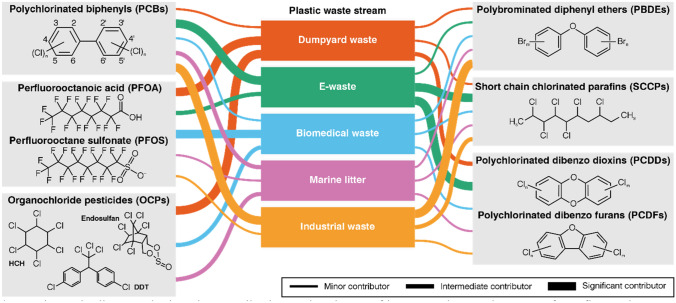
Improper handling of plastic waste and related chemical pollution has garnered much attention in recent years owing to the associated detrimental impacts on human health and the environment. This article reports an overview of the main interlinkages between persistent organic pollutants (POPs) and plastic in the waste management system of India. Both plastics and POPs share certain common traits such as persistence, resistance to biological degradation, and the ability to get transported over long distances. Throughout the processes of production, consumption, and disposal, plastics interact with and accumulate POPs through several mechanisms and end up co-existing in the environment. Plastic waste can undergo long-range transport through rivers and the oceans, break down into microplastics and get transported through the air, or remain locked in waste dump yards and landfills. Over time, environmental processes lead to the leaching and release of accumulated POPs from these plastic wastes. Plastic recycling in the Indian informal sector including smelting, scrubbing, and shredding of plastic waste, is also a potential major POPs source that demands further investigation. The presence of POPs in plastic waste and their fate in the plastic recycling process have not yet been elucidated. By enhancing our understanding of these processes, this paper may aid policy decisions to combat the release of POPs from different waste types and processes in India.
近年来,由于塑料废物处理不当和相关化学污染对人类健康和环境造成的不利影响,引起了广泛关注。本文概述了印度废物管理系统中持久性有机污染物(POPs)和塑料之间的主要相互关系。塑料和 POPs 具有某些共同特征,如持久性、抗生物降解性和长距离迁移能力。在生产、消费和处置过程中,塑料通过多种机制与 POPs 相互作用并积累,最终在环境中共存。塑料废物可通过河流和海洋进行长距离运输,分解为微塑料并通过空气传播,或被锁定在垃圾场和垃圾填埋场中。随着时间的推移,环境过程导致这些塑料废物中积累的 POPs 浸出和释放。印度非正规部门的塑料回收,包括塑料废物的熔炼、洗涤和粉碎,也是一个潜在的主要 POPs 来源,需要进一步调查。POPs 在塑料废物中的存在及其在塑料回收过程中的命运尚未阐明。通过增强对这些过程的理解,本文可能有助于印度做出政策决策,以防止不同废物类型和过程中 POPs 的释放。