Department of Child and Adolescent Healthcare, Children's Hospital of Soochow University, Suzhou, 215021, Jiangsu, China.
BMC Pediatr. 2022 Feb 18;22(1):98. doi: 10.1186/s12887-022-03159-8.
Short stature is defined as height below 2 standard deviations of the population with the same age, gender. This study is aimed to assess the characteristics of body composition in preschool children with short stature.
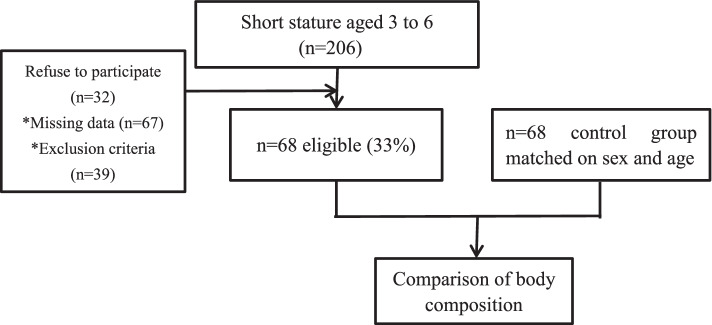
Anthropometric measurements and body composition were assessed in 68 preschool children aged 3 to 6 years old with short stature and 68 normal controls matched on age and gender. Height, weight and body composition (total body water, protein, minerals, body fat mass, fat-free mass, soft lean mass, skeletal muscle mass, and bone mineral contents) in the two groups were measured and compared.
The total body water, protein, minerals, body fat mass, fat-free mass, soft lean mass, skeletal muscle mass, and bone mineral contents were lower in preschool children with short stature than controls (P < 0.05). Body mass index and fat mass index did not differ between groups. Fat-free mass index was significantly lower in short stature group than controls (t = 2.17, P = 0.03). Linear regression analysis showed that there was a positive correlation between height and fat-free mass index [β, 1.99 (0.59, 3.39), P = 0.01], a negative correlation between height and body fat percentage [β, - 0.20 (- 0.38, - 0.01), P = 0.04]. The proportions of fat-free mass in the upper limbs were significantly lower (Right,t = - 2.78,Left t = - 2.76, P < 0.05, respectively) in short stature, although body fat distribution was not.
The fat-free mass such as protein and bone minerals is lower in preschool children with short stature, suggesting the monitoring of fat-free mass for early identification and intervention.
身材矮小定义为身高低于同年龄、同性别的人群的 2 个标准差。本研究旨在评估身材矮小学龄前儿童的身体成分特征。
对 68 名 3 至 6 岁身材矮小的学龄前儿童和 68 名年龄和性别相匹配的正常对照儿童进行人体测量和身体成分评估。测量并比较两组儿童的身高、体重和身体成分(全身水分、蛋白质、矿物质、体脂肪量、去脂体重、柔软瘦体重、骨骼肌量和骨矿物质含量)。
与对照组相比,身材矮小的学龄前儿童的全身水分、蛋白质、矿物质、体脂肪量、去脂体重、柔软瘦体重、骨骼肌量和骨矿物质含量均较低(P<0.05)。两组间的体质指数和脂肪量指数无差异。与对照组相比,身材矮小组的去脂体重指数显著较低(t=2.17,P=0.03)。线性回归分析显示,身高与去脂体重指数呈正相关[β,1.99(0.59,3.39),P=0.01],身高与体脂肪百分比呈负相关[β,-0.20(-0.38,-0.01),P=0.04]。尽管身体脂肪分布没有差异,但身材矮小组上肢的去脂体重比例明显较低(右侧,t=-2.78;左侧,t=-2.76,P<0.05)。
身材矮小的学龄前儿童的去脂体重(如蛋白质和骨矿物质)较低,提示监测去脂体重,以便早期识别和干预。