MRM Proteomics Inc, Montreal, Quebec, Canada.
Segal Cancer Proteomics Centre, Lady Davis Institute, Jewish General Hospital, McGill University, Montreal, Quebec, Canada.
Mol Cell Proteomics. 2022 May;21(5):100212. doi: 10.1016/j.mcpro.2022.100212. Epub 2022 Feb 17.
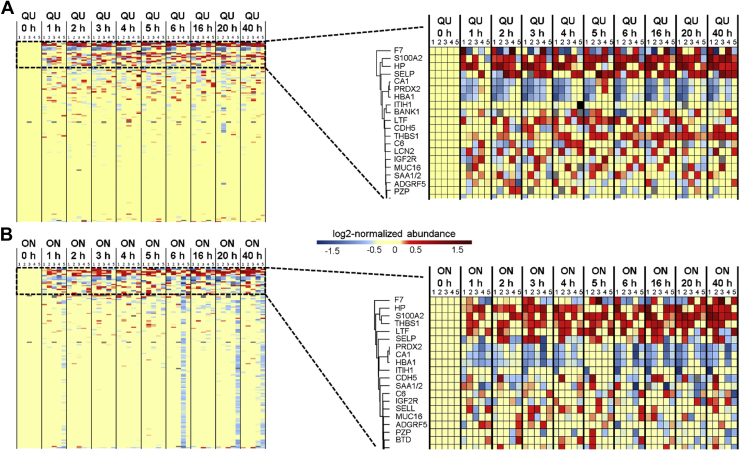
Plasma is an important biofluid for clinical research and diagnostics. In the clinic, unpredictable delays-from minutes to hours-between blood collection and plasma generation are often unavoidable. These delays can potentially lead to protein degradation and modification and might considerably affect intact protein measurement methods such as sandwich enzyme-linked immunosorbent assays that bind proteins on two epitopes to increase specificity, thus requiring largely intact protein structures. Here, we investigated, using multiple reaction monitoring mass spectrometry (MRM-MS), how delays in plasma processing affect peptide-centric "bottom-up" proteomics. We used validated assays for proteotypic peptide surrogates of 270 human proteins to analyze plasma generated after whole blood had been kept at room temperature from 0 to 40 h to mimic delays that occur in the clinic. Moreover, we evaluated the impact of different plasma-thawing conditions on MRM-based plasma protein quantitation. We demonstrate that >90% of protein concentration measurements were unaffected by the thawing procedure and by up to 40-h delayed plasma generation, reflected by relative standard deviations (RSDs) of <30%. Of the 159 MRM assays that yielded quantitative results in 60% of the measured time points, 139 enabled a stable protein quantitation (RSD <20%), 14 showed a slight variation (RSD 20-30%), and 6 appeared unstable/irreproducible (RSD > 30%). These results demonstrate the high robustness and thus the potential for MRM-based plasma-protein quantitation to be used in a clinical setting. In contrast to enzyme-linked immunosorbent assay, peptide-based MRM assays do not require intact three-dimensional protein structures for an accurate and precise quantitation of protein concentrations in the original sample.
血浆是临床研究和诊断的重要生物液体。在临床上,从采血到生成血浆之间的时间往往难以预测,会有几分钟到几个小时的延迟。这些延迟可能导致蛋白质降解和修饰,并可能极大地影响到完整蛋白质测量方法,如结合两个表位上的蛋白质以提高特异性的夹心酶联免疫吸附测定法,从而要求蛋白质结构基本完整。在这里,我们使用多重反应监测质谱(MRM-MS)研究了血浆处理延迟如何影响基于肽的“自上而下”蛋白质组学。我们使用经过验证的 270 个人类蛋白质的特征肽替代物的测定法,分析了在室温下保持全血 0 至 40 小时后生成的血浆,以模拟临床上发生的延迟。此外,我们评估了不同的血浆解冻条件对基于 MRM 的血浆蛋白质定量的影响。我们证明,解冻过程和长达 40 小时的延迟生成血浆对 >90%的蛋白质浓度测量值没有影响,这反映在相对标准偏差(RSD)<30%。在产生定量结果的 159 个 MRM 测定法中,有 139 个能够实现稳定的蛋白质定量(RSD <20%),14 个显示出轻微变化(RSD 20-30%),而 6 个显示不稳定/不可重复(RSD > 30%)。这些结果表明,基于 MRM 的血浆蛋白质定量具有很高的稳健性,因此有可能在临床环境中使用。与酶联免疫吸附测定法不同,基于肽的 MRM 测定法不需要完整的三维蛋白质结构,即可准确、精确地定量原始样品中的蛋白质浓度。