Immunology Department, Noguchi Memorial Institute for Medical Research (NMIMR), University of Ghana, Accra, Ghana.
School of Life Science and Technology, University of Electronic Science and Technology of China, Chengdu, China.
Malar J. 2022 Feb 19;21(1):57. doi: 10.1186/s12936-022-04078-w.
Asymptomatic malaria infections can serve as potential reservoirs for malaria transmission. The density of parasites contained in these infections range from microscopic to submicroscopic densities, making the accurate detection of asymptomatic parasite carriage highly dependent on the sensitivity of the tools used for the diagnosis. This study sought to evaluate the sensitivities of a variety of molecular and serological diagnostic tools at determining the prevalence of asymptomatic Plasmodium falciparum parasite infections in two communities with varying malaria parasite prevalence.
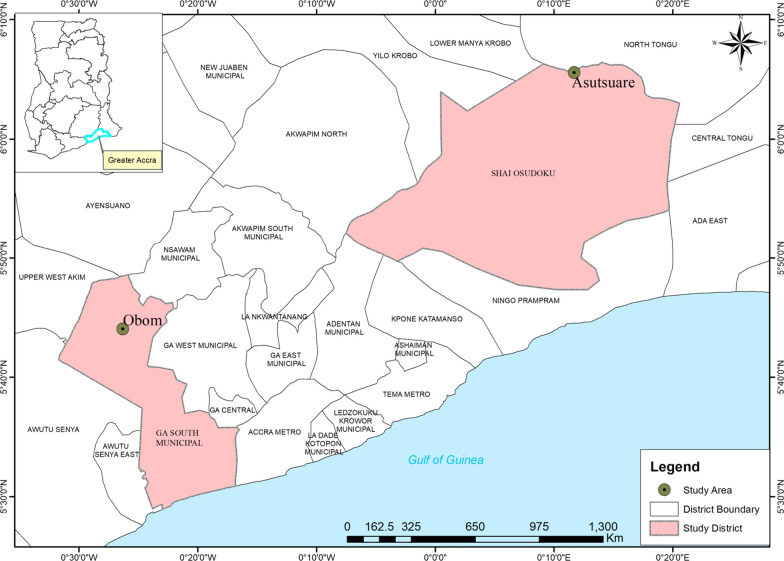
Whole blood was collected from 194 afebrile participants aged between 6 and 70 years old living in a high (Obom) and a low (Asutsuare) malaria transmission setting of Ghana. Thick and thin blood smears, HRP2 based malaria rapid diagnostic test (RDT) and filter paper dried blood spots (DBS) were prepared from each blood sample. Genomic DNA was extracted from the remaining blood and used in Plasmodium specific photo-induced electron transfer polymerase chain reaction (PET-PCR) and Nested PCR, whilst the HRP2 antigen content of the DBS was estimated using a bead immunoassay. A comparison of malaria parasite prevalence as determined by each method was performed.
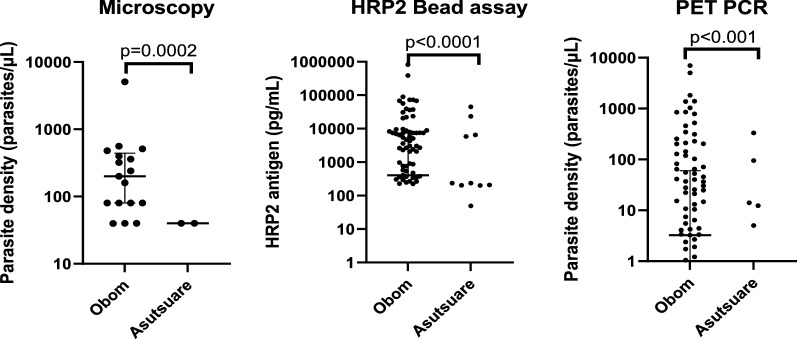
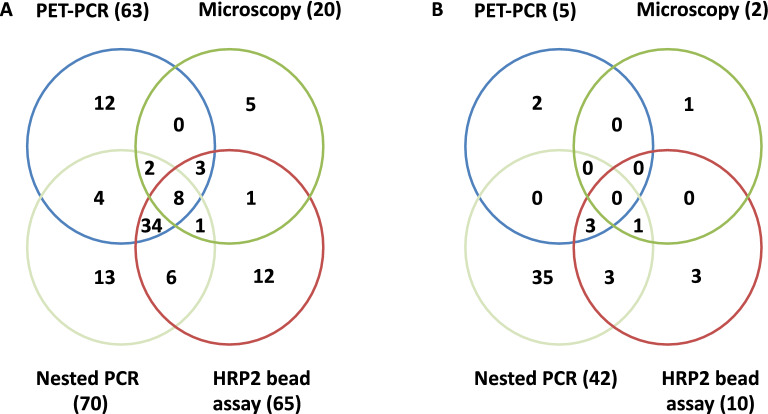
Parasite prevalence in the high transmission site of Obom was estimated at 71.4%, 61.9%, 60%, 37.8% and 19.1% by Nested PCR, the HRP2 bead assay, PET-PCR, HRP2-RDT and microscopy respectively. Parasite prevalence in the low transmission site of Asutsuare was estimated at 50.1%, 11.2%, 5.6%, 0% and 2.2% by Nested PCR, the HRP2 bead assay, PET-PCR, RDT and microscopy, respectively. The diagnostic performance of Nested PCR, PET-PCR and the HRP2 bead assay was similar in Obom but in Asutsuare, Nested PCR had a significantly higher sensitivity than PET-PCR and the HRP2 bead assay, which had similar sensitivity.
Nested PCR exhibited the highest sensitivity by identifying the highest prevalence of asymptomatic P. falciparum in both the high and low parasite prevalence settings. However, parasite prevalence estimated by the HRP2 bead assay and PET-PCR had the highest level of inter-rater agreement relative to all the other tools tested and have the advantage of requiring fewer processing steps relative to Nested PCR and producing quantitative results.
无症状疟原虫感染可成为疟疾传播的潜在传染源。这些感染中寄生虫的密度从微观到亚微观密度不等,因此准确检测无症状寄生虫携带情况高度依赖于用于诊断的工具的灵敏度。本研究旨在评估各种分子和血清学诊断工具在两个疟疾寄生虫流行率不同的社区中确定无症状恶性疟原虫寄生虫感染流行率的灵敏度。
从居住在加纳高(Obom)和低(Asutsuare)疟疾传播地区的 194 名年龄在 6 至 70 岁的无热参与者中采集全血。从每个血样中制备厚和薄血涂片、基于 HRP2 的疟疾快速诊断检测(RDT)和滤纸干血斑(DBS)。从剩余的血液中提取基因组 DNA,并用于疟原虫特异性光诱导电子转移聚合酶链反应(PET-PCR)和巢式 PCR,同时使用珠免疫测定法估计 DBS 中的 HRP2 抗原含量。比较每种方法确定的疟原虫感染流行率。
高传播地区 Obom 的寄生虫感染率分别通过巢式 PCR、HRP2 珠测定法、PET-PCR、HRP2-RDT 和显微镜估计为 71.4%、61.9%、60%、37.8%和 19.1%。低传播地区 Asutsuare 的寄生虫感染率分别通过巢式 PCR、HRP2 珠测定法、PET-PCR、RDT 和显微镜估计为 50.1%、11.2%、5.6%、0%和 2.2%。在 Obom,巢式 PCR、PET-PCR 和 HRP2 珠测定法的诊断性能相似,但在 Asutsuare,巢式 PCR 的灵敏度明显高于 PET-PCR 和 HRP2 珠测定法,后两者的灵敏度相似。
巢式 PCR 通过在高和低寄生虫流行率环境中均鉴定出最高比例的无症状恶性疟原虫感染,表现出最高的灵敏度。然而,HRP2 珠测定法和 PET-PCR 估计的寄生虫感染率与所有其他测试工具相比具有最高的观察者间一致性水平,并且相对于巢式 PCR 具有需要更少处理步骤的优势,并且产生定量结果。