Celldex Therapeutics, Hampton, New Jersey, USA.
Dermatological Allergology, Allergie-Centrum-Charité, Department of Dermatology and Allergy, Charité - Universtätsmedizin Berlin, Germany.
Allergy. 2022 Aug;77(8):2393-2403. doi: 10.1111/all.15262. Epub 2022 Mar 3.
Mast cells (MC) are powerful inflammatory immune sentinel cells that drive numerous allergic, inflammatory, and pruritic disorders when activated. MC-targeted therapies are approved in several disorders, yet many patients have limited benefit suggesting the need for approaches that more broadly inhibit MC activity. MCs require the KIT receptor and its ligand stem cell factor (SCF) for differentiation, maturation, and survival. Here we describe CDX-0159, an anti-KIT monoclonal antibody that potently suppresses MCs in human healthy volunteers.
CDX-0159-mediated KIT inhibition was tested in vitro using KIT-expressing immortalized cells and primary human mast cells. CDX-0159 safety and pharmacokinetics were evaluated in a 13-week good laboratory practice (GLP)-compliant cynomolgus macaque study. A single ascending dose (0.3, 1, 3, and 9 mg/kg), double-blinded placebo-controlled phase 1a human healthy volunteer study (n = 32) was conducted to evaluate the safety, pharmacokinetics, and pharmacodynamics of CDX-0159.
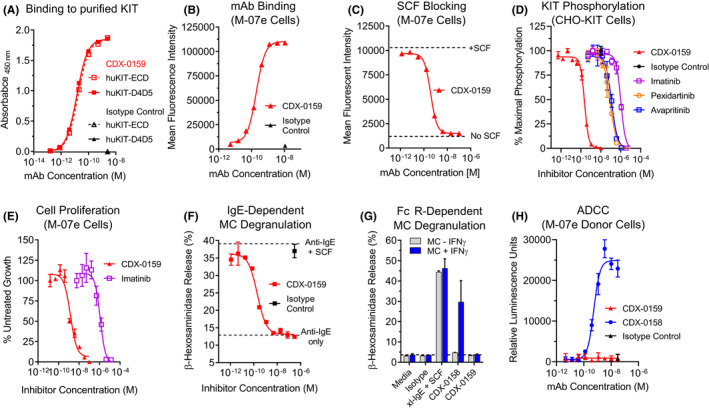
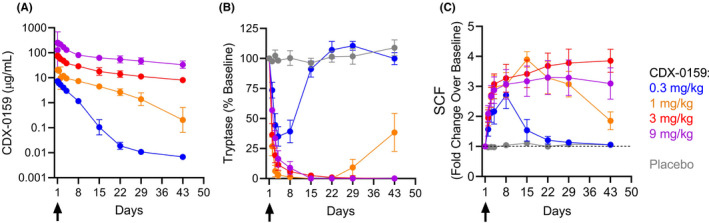
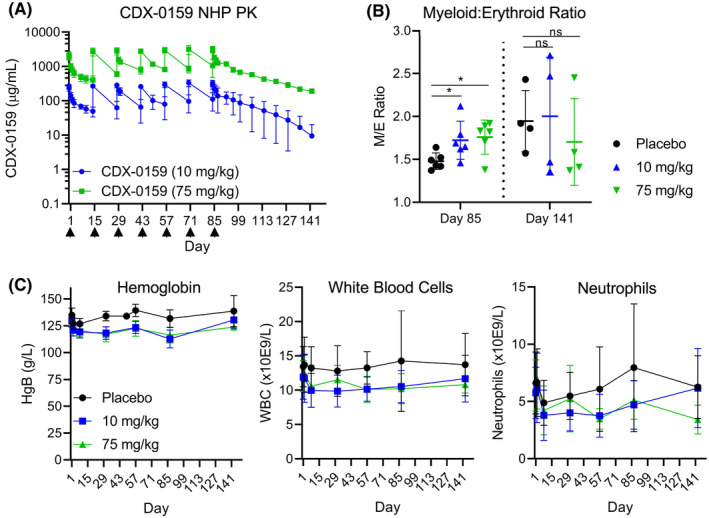
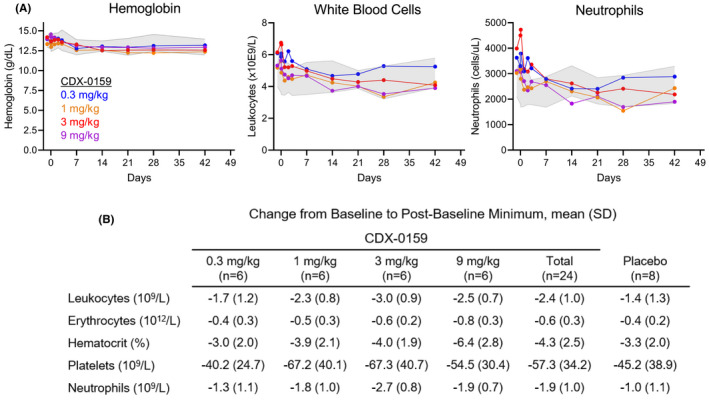
CDX-0159 inhibits SCF-dependent KIT activation in vitro. Fc modifications in CDX-0159 led to elimination of effector function and reduced serum clearance. In cynomolgus macaques, multiple high doses were safely administered without a significant impact on hematology, a potential concern for KIT inhibitors. A single dose of CDX-0159 in healthy human subjects was generally well tolerated and demonstrated long antibody exposure. Importantly, CDX-0159 led to dose-dependent, profound suppression of plasma tryptase, a MC-specific protease associated with tissue MC burden, indicative of systemic MC suppression or ablation.
CDX-0159 administration leads to systemic mast cell ablation and may represent a safe and novel approach to treat mast cell-driven disorders.
肥大细胞(MC)是强大的炎症免疫哨兵细胞,当被激活时会引发许多过敏、炎症和瘙痒性疾病。针对 MC 的治疗方法已在几种疾病中获得批准,但许多患者的获益有限,这表明需要采用更广泛抑制 MC 活性的方法。MC 依赖 KIT 受体及其配体干细胞因子(SCF)来分化、成熟和存活。本文描述了 CDX-0159,一种强力抑制人类健康志愿者 MC 的抗 KIT 单克隆抗体。
使用表达 KIT 的永生化细胞和原代人肥大细胞在体外测试 CDX-0159 介导的 KIT 抑制作用。在符合良好实验室规范(GLP)的 13 周食蟹猴研究中评估 CDX-0159 的安全性和药代动力学。进行了一项单次递增剂量(0.3、1、3 和 9mg/kg)、双盲安慰剂对照的 1a 期人类健康志愿者研究(n=32),以评估 CDX-0159 的安全性、药代动力学和药效学。
CDX-0159 抑制体外 SCF 依赖性 KIT 激活。CDX-0159 的 Fc 修饰导致效应功能丧失和血清清除率降低。在食蟹猴中,多次给予高剂量药物安全,对血液学无显著影响,这是 KIT 抑制剂的一个潜在问题。在健康人体受试者中单次给予 CDX-0159 通常耐受良好,且抗体暴露时间长。重要的是,CDX-0159 导致血浆类胰蛋白酶呈剂量依赖性显著抑制,这是一种与组织 MC 负荷相关的 MC 特异性蛋白酶,表明存在全身 MC 抑制或消融。
CDX-0159 的给药导致系统性肥大细胞消融,可能代表一种安全且新颖的治疗肥大细胞驱动疾病的方法。