Tan Tao, Das Bipul, Soni Ravi, Fejes Mate, Yang Hongxu, Ranjan Sohan, Szabo Daniel Attila, Melapudi Vikram, Shriram K S, Agrawal Utkarsh, Rusko Laszlo, Herczeg Zita, Darazs Barbara, Tegzes Pal, Ferenczi Lehel, Mullick Rakesh, Avinash Gopal
GE Healthcare, The Netherlands.
GE Healthcare, India.
Neurocomputing (Amst). 2022 May 7;485:36-46. doi: 10.1016/j.neucom.2022.02.040. Epub 2022 Feb 16.
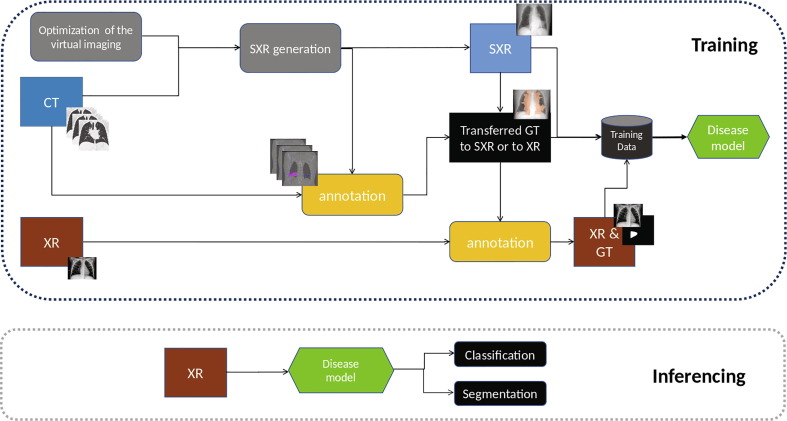
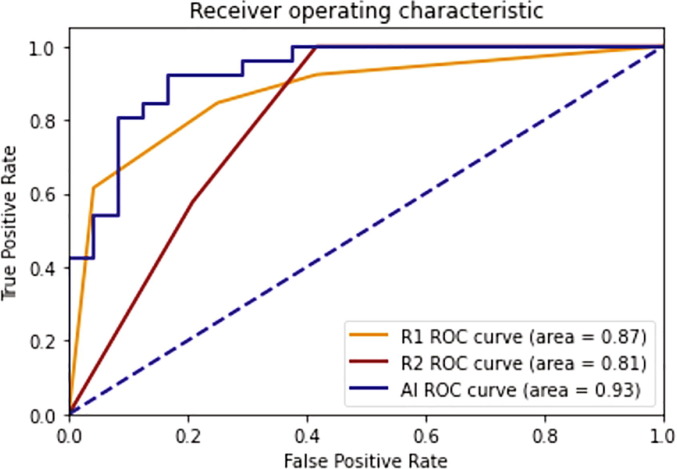
The front-line imaging modalities computed tomography (CT) and X-ray play important roles for triaging COVID patients. Thoracic CT has been accepted to have higher sensitivity than a chest X-ray for COVID diagnosis. Considering the limited access to resources (both hardware and trained personnel) and issues related to decontamination, CT may not be ideal for triaging suspected subjects. Artificial intelligence (AI) assisted X-ray based application for triaging and monitoring require experienced radiologists to identify COVID patients in a timely manner with the additional ability to delineate and quantify the disease region is seen as a promising solution for widespread clinical use. Our proposed solution differs from existing solutions presented by industry and academic communities. We demonstrate a functional AI model to triage by classifying and segmenting a single chest X-ray image, while the AI model is trained using both X-ray and CT data. We report on how such a multi-modal training process improves the solution compared to single modality (X-ray only) training. The multi-modal solution increases the AUC (area under the receiver operating characteristic curve) from 0.89 to 0.93 for a binary classification between COVID-19 and non-COVID-19 cases. It also positively impacts the Dice coefficient (0.59 to 0.62) for localizing the COVID-19 pathology. To compare the performance of experienced readers to the AI model, a reader study is also conducted. The AI model showed good consistency with respect to radiologists. The DICE score between two radiologists on the COVID group was 0.53 while the AI had a DICE value of 0.52 and 0.55 when compared to the segmentation done by the two radiologists separately. From a classification perspective, the AUCs of two readers was 0.87 and 0.81 while the AUC of the AI is 0.93 based on the reader study dataset. We also conducted a generalization study by comparing our method to the-state-art methods on independent datasets. The results show better performance from the proposed method. Leveraging multi-modal information for the development benefits the single-modal inferencing.
一线成像方式计算机断层扫描(CT)和X射线在对新冠患者进行分流时发挥着重要作用。胸部CT在新冠诊断方面的敏感性已被认为高于胸部X射线。考虑到资源获取有限(包括硬件和训练有素的人员)以及与消毒相关的问题,CT可能并非对疑似病例进行分流的理想选择。基于人工智能(AI)辅助的X射线应用进行分流和监测,需要经验丰富的放射科医生及时识别新冠患者,同时具备描绘和量化疾病区域的额外能力,这被视为广泛临床应用的一个有前景的解决方案。我们提出的解决方案与行业和学术界提出的现有解决方案不同。我们展示了一个通过对单张胸部X射线图像进行分类和分割来进行分流的功能化AI模型,而该AI模型是使用X射线和CT数据进行训练的。我们报告了与单模态(仅X射线)训练相比,这种多模态训练过程如何改进该解决方案。对于新冠病毒感染(COVID - 19)病例和非COVID - 19病例之间的二分类,多模态解决方案将受试者工作特征曲线下面积(AUC)从0.89提高到了0.93。它对定位COVID - 19病变的骰子系数也有积极影响(从0.59提高到0.62)。为了比较经验丰富的阅片者与AI模型的性能,还进行了一项阅片者研究。AI模型与放射科医生表现出良好的一致性。在新冠组中,两位放射科医生之间的骰子系数为0.53,而与两位放射科医生分别进行的分割相比,AI的骰子值为0.52和0.55。从分类角度来看,基于阅片者研究数据集,两位阅片者的AUC分别为0.87和0.81,而AI的AUC为0.93。我们还通过在独立数据集上与最先进的方法进行比较,进行了一项泛化研究。结果表明所提出的方法性能更好。利用多模态信息进行开发有利于单模态推理。