Department of Cardiology and Institute of Vascular Medicine, Peking University Third Hospital, NHC Key Laboratory of Cardiovascular Molecular Biology and Regulatory Peptides, Key Laboratory of Molecular Cardiovascular Science, Ministry of Education, Beijing Key Laboratory of Cardiovascular Receptors Research, Beijing, China.
Department of Cardiovascular Disease, Peking University Third Hospital, Yan'an Branch, Yan'an, China.
J Interv Cardiol. 2022 Feb 2;2022:6361398. doi: 10.1155/2022/6361398. eCollection 2022.
To evaluate the correlation between the TIMI frame count, IMR, and CFR in coronary microvascular disease (slow flow phenomenon).
TFC and IMR were recorded in the nitroglycerin and ATP administration states, and the relationship between TFC, IMR, and CFR in specific states was analyzed.
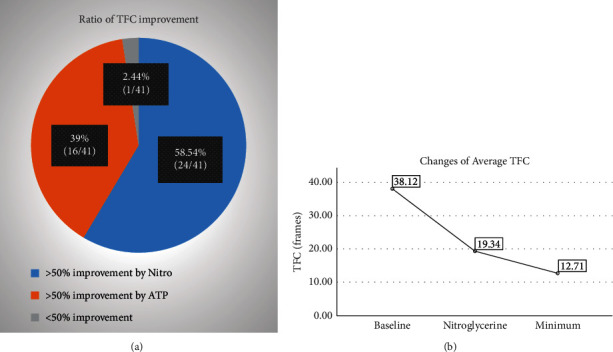
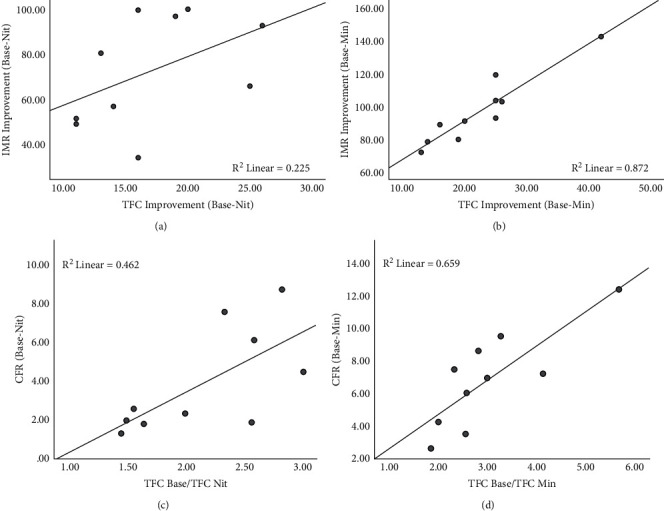
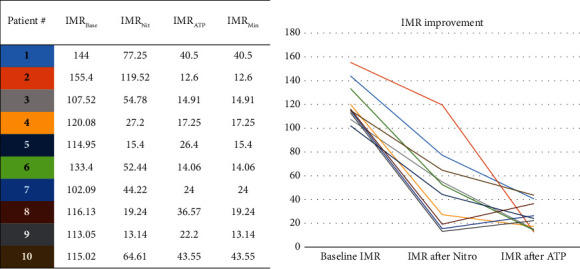
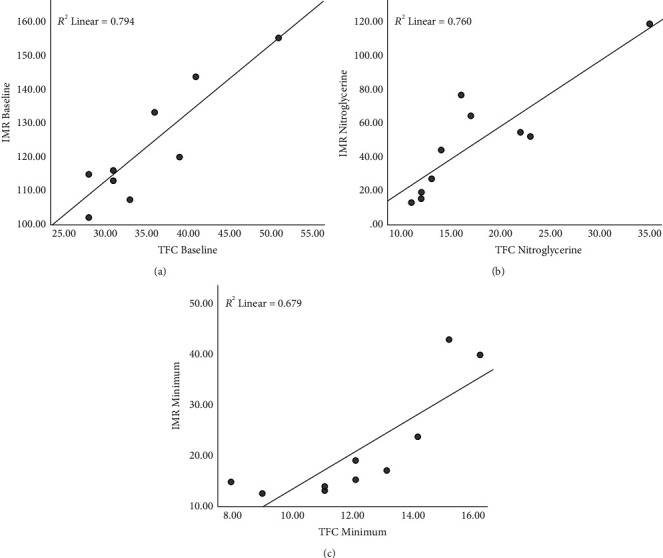
A total of 41 patients with baseline TFC >25 frames on coronary angiography were enrolled, and nitroglycerin reduced TFC by 50% from baseline in 24 (58.54%) patients; 16 of the remaining 17 patients were able to achieve a 50% reduction in TFC by further intracoronary ATP injection. 10 patients were further tested for IMR, and the results showed significant correlations between baseline TFC and IMR ( = 0.775, =0.008), TFC and IMR after nitroglycerin ( = 0.875, =0.001), and the minimal TFC and IMR that could be obtained with nitroglycerin or ATP administration ( = 0.890, =0.001). There was also a significant correlation between the proportional improvement in TFC and CFR before and after nitroglycerin injection ( = 0.685, =0.029). In addition, we observed a lower IMR measured after nitroglycerin than after ATP in three patients, suggesting that CMD may be dominated by NO-sensitive vascular such as prearterioles and that an extensive analysis of the target site of CMD may be achieved by stepwise drug administration.
Induction of TFC in different states by a stepwise drug approach may serve as a potential primary screening method for coronary microcirculatory dysfunction, thereby reducing the need for further IMR or CFR testing.
评估 TIMI 帧数、IMR 和冠状动脉微血管疾病(慢血流现象)中的 CFR 之间的相关性。
在给予硝酸甘油和三磷酸腺苷(ATP)时记录 TFC 和 IMR,并分析特定状态下 TFC、IMR 和 CFR 之间的关系。
共纳入 41 例冠状动脉造影基线 TFC>25 帧的患者,24 例(58.54%)患者给予硝酸甘油后 TFC较基线降低 50%;其余 17 例患者中的 16 例进一步经冠状动脉内给予 ATP 后可使 TFC降低 50%。进一步对 10 例患者检测 IMR,结果显示基线 TFC 与 IMR 显著相关(r=0.775,P=0.008),硝酸甘油后 TFC 与 IMR 显著相关(r=0.875,P=0.001),且 TFC 与使用硝酸甘油或 ATP 可获得的最小 IMR 显著相关(r=0.890,P=0.001)。硝酸甘油注射前后 TFC 与 CFR 比值的改善程度也显著相关(r=0.685,P=0.029)。此外,我们观察到在 3 例患者中,硝酸甘油后 IMR 低于 ATP 后 IMR,提示 CMD 可能主要由 NO 敏感的血管(如前小动脉)介导,通过逐步药物给药可对 CMD 的靶部位进行广泛分析。
通过逐步药物诱导不同状态的 TFC 可能成为冠状动脉微血管功能障碍的潜在初步筛查方法,从而减少对进一步 IMR 或 CFR 检测的需求。