De Luca Mariarosaria, Crisci Giulia, Armentaro Giuseppe, Cicco Sebastiano, Talerico Giovanni, Bobbio Emanuele, Lanzafame Lorena, Green Christopher G, McLellan Abbie G, Debiec Radek, Caferra Paolo, Scicali Roberto, Cannatà Antonio, Israr Muhammad Zubair, Heaney Liam M, Salzano Andrea
Department of Translational Medical Sciences, Federico II University, 80131 Naples, Italy.
Italian Clinical Outcome Research and Reporting Program (I-CORRP), 80131 Naples, Italy.
Life (Basel). 2023 Dec 24;14(1):30. doi: 10.3390/life14010030.
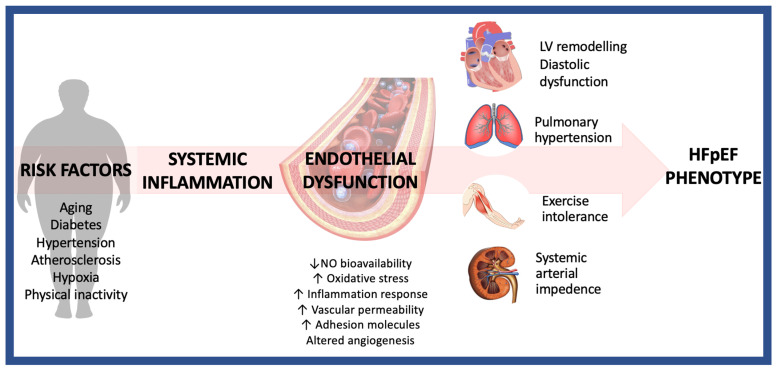
Heart failure (HF) is a clinical syndrome consisting of typical symptoms and signs due to structural and/or functional abnormalities of the heart, resulting in elevated intracardiac pressures and/or inadequate cardiac output. The vascular system plays a crucial role in the development and progression of HF regardless of ejection fraction, with endothelial dysfunction (ED) as one of the principal features of HF. The main ED manifestations (i.e., impaired endothelium-dependent vasodilation, increased oxidative stress, chronic inflammation, leukocyte adhesion, and endothelial cell senescence) affect the systemic and pulmonary haemodynamic and the renal and coronary circulation. The present review is aimed to discuss the contribution of ED to HF pathophysiology-in particular, HF with preserved ejection fraction-ED role in HF patients, and the possible effects of pharmacological and non-pharmacological approaches. For this purpose, relevant data from a literature search (PubMed, Scopus, EMBASE, and Medline) were reviewed. As a result, ED, assessed via venous occlusion plethysmography or flow-mediated dilation, was shown to be independently associated with poor outcomes in HF patients (e.g., mortality, cardiovascular events, and hospitalization due to worsening HF). In addition, SGLT2 inhibitors, endothelin antagonists, endothelial nitric oxide synthase cofactors, antioxidants, and exercise training were shown to positively modulate ED in HF. Despite the need for future research to better clarify the role of the vascular endothelium in HF, ED represents an interesting and promising potential therapeutic target.
心力衰竭(HF)是一种临床综合征,由心脏结构和/或功能异常导致典型症状和体征,进而引起心腔内压力升高和/或心输出量不足。无论射血分数如何,血管系统在HF的发生和发展中都起着关键作用,内皮功能障碍(ED)是HF的主要特征之一。主要的ED表现(即内皮依赖性血管舒张受损、氧化应激增加、慢性炎症、白细胞黏附以及内皮细胞衰老)会影响体循环和肺循环以及肾循环和冠状动脉循环。本综述旨在探讨ED对HF病理生理学的影响,特别是对射血分数保留的HF——ED在HF患者中的作用,以及药物和非药物治疗方法可能产生的影响。为此,对文献检索(PubMed、Scopus、EMBASE和Medline)中的相关数据进行了综述。结果表明,通过静脉阻塞体积描记法或血流介导的血管舒张评估的ED与HF患者的不良预后(如死亡率、心血管事件以及因HF恶化导致的住院)独立相关。此外,钠-葡萄糖协同转运蛋白2(SGLT2)抑制剂、内皮素拮抗剂、内皮型一氧化氮合酶辅助因子、抗氧化剂以及运动训练已被证明可对HF中的ED产生积极调节作用。尽管未来需要开展更多研究以更好地阐明血管内皮在HF中的作用,但ED仍是一个有趣且有前景的潜在治疗靶点。