Siddiqui Maheen F, Pinti Paola, Lloyd-Fox Sarah, Jones Emily J H, Brigadoi Sabrina, Collins-Jones Liam, Tachtsidis Ilias, Johnson Mark H, Elwell Clare E
Centre for Brain and Cognitive Development, Birkbeck College, University of London, London, United Kingdom.
Department of Psychology, University of Cambridge, Cambridge, United Kingdom.
Front Hum Neurosci. 2022 Feb 4;15:780076. doi: 10.3389/fnhum.2021.780076. eCollection 2021.
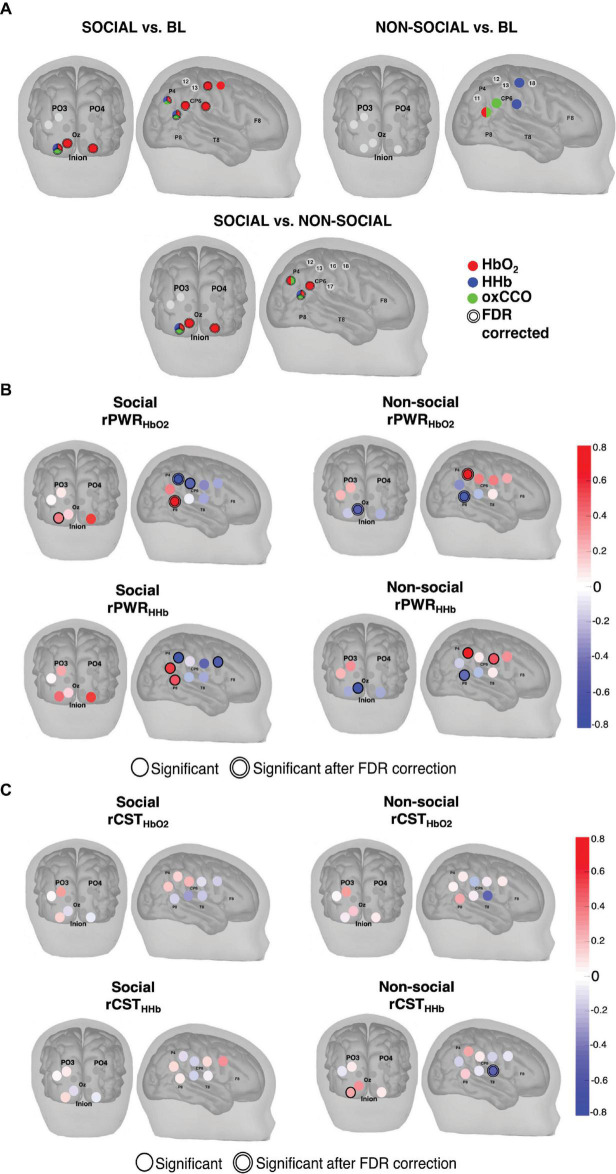
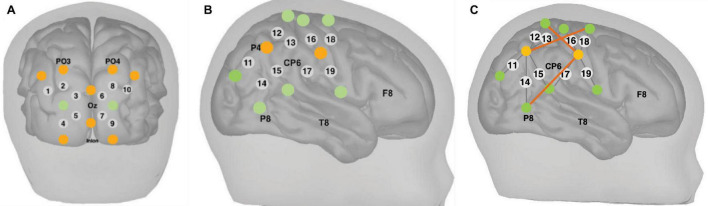
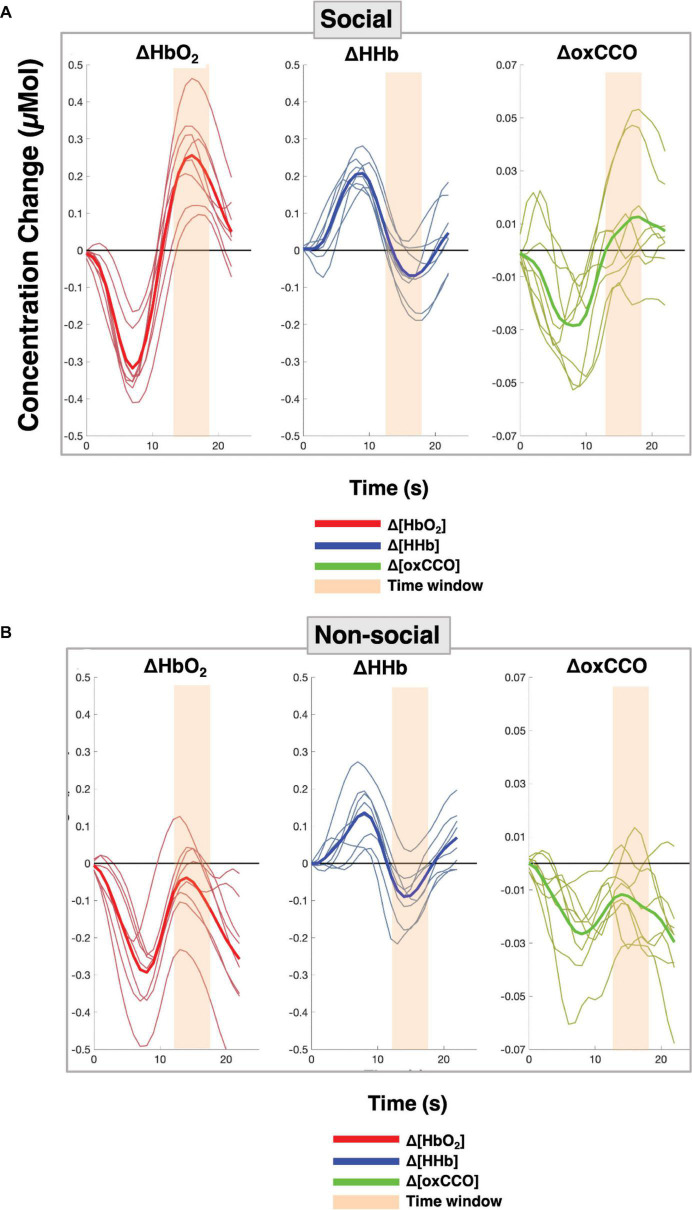
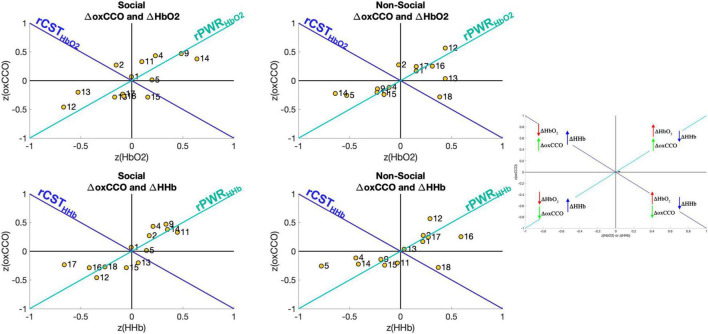
Metabolic pathways underlying brain function remain largely unexplored during neurodevelopment, predominantly due to the lack of feasible techniques for use with awake infants. Broadband near-infrared spectroscopy (bNIRS) provides the opportunity to explore the relationship between cerebral energy metabolism and blood oxygenation/haemodynamics through the measurement of changes in the oxidation state of mitochondrial respiratory chain enzyme cytochrome-c-oxidase (ΔoxCCO) alongside haemodynamic changes. We used a bNIRS system to measure ΔoxCCO and haemodynamics during functional activation in a group of 42 typically developing infants aged between 4 and 7 months. bNIRS measurements were made over the right hemisphere over temporal, parietal and central cortical regions, in response to social and non-social visual and auditory stimuli. Both ΔoxCCO and Δ[HbO] displayed larger activation for the social condition in comparison to the non-social condition. Integration of haemodynamic and metabolic signals revealed networks of stimulus-selective cortical regions that were not apparent from analysis of the individual bNIRS signals. These results provide the first spatially resolved measures of cerebral metabolic activity alongside haemodynamics during functional activation in infants. Measuring synchronised changes in metabolism and haemodynamics have the potential for uncovering the development of cortical specialisation in early infancy.
在神经发育过程中,大脑功能背后的代谢途径在很大程度上仍未得到探索,主要原因是缺乏适用于清醒婴儿的可行技术。宽带近红外光谱技术(bNIRS)通过测量线粒体呼吸链酶细胞色素c氧化酶(ΔoxCCO)氧化状态的变化以及血流动力学变化,提供了探索脑能量代谢与血氧合/血流动力学之间关系的机会。我们使用bNIRS系统,对42名年龄在4至7个月的正常发育婴儿在功能激活期间的ΔoxCCO和血流动力学进行了测量。在颞叶、顶叶和中央皮质区域的右侧半球进行bNIRS测量,以响应社交和非社交视觉及听觉刺激。与非社交条件相比,社交条件下的ΔoxCCO和Δ[HbO]均表现出更大的激活。血流动力学和代谢信号的整合揭示了刺激选择性皮质区域网络,这在对单个bNIRS信号的分析中并不明显。这些结果首次提供了婴儿功能激活期间脑代谢活动与血流动力学的空间分辨测量。测量代谢和血流动力学的同步变化有可能揭示婴儿早期皮质特化的发展情况。