Chen Jing, Zhuang Yuan-Dong, Zhang Qiang, Liu Shuang, Zhuang Bing-Bo, Wang Chun-Hua, Liang Ri-Sheng
Fujian Medical University Union Hospital, Fuzhou, Fujian, China.
Fujian Medical University Union Hospital, Fuzhou, China.
PeerJ. 2022 Feb 15;10:e12942. doi: 10.7717/peerj.12942. eCollection 2022.
Glioblastoma is the most common and fatal primary malignant tumor in the central nervous system, and the prognosis is poor. Currently, there are no effective treatments for glioblastoma. Cordycepin is a natural active substance with significant anticancer activity and doxorubicin is a broad-spectrum anticancer drug. Cordycepin administered with doxorubicin is a potential drug combination for the treatment of glioblastoma. However, the mechanism of action for this drug combination has not yet been elucidated.
To explore the complex mechanism of cordycepin combined with doxorubicin against glioblastoma using network pharmacology and biological verification.
We used an MTT assay, colony formation assay, and scratch healing to detect the growth, proliferation, and migration of LN-229, U251 and T98G cells. Putative targets and the potential mechanism of action for the drug combination in glioblastoma were obtained through online databases, network construction, and enrichment analyses. We verified the expression of EMT-related genes and identified important therapeutic targets by western blot.
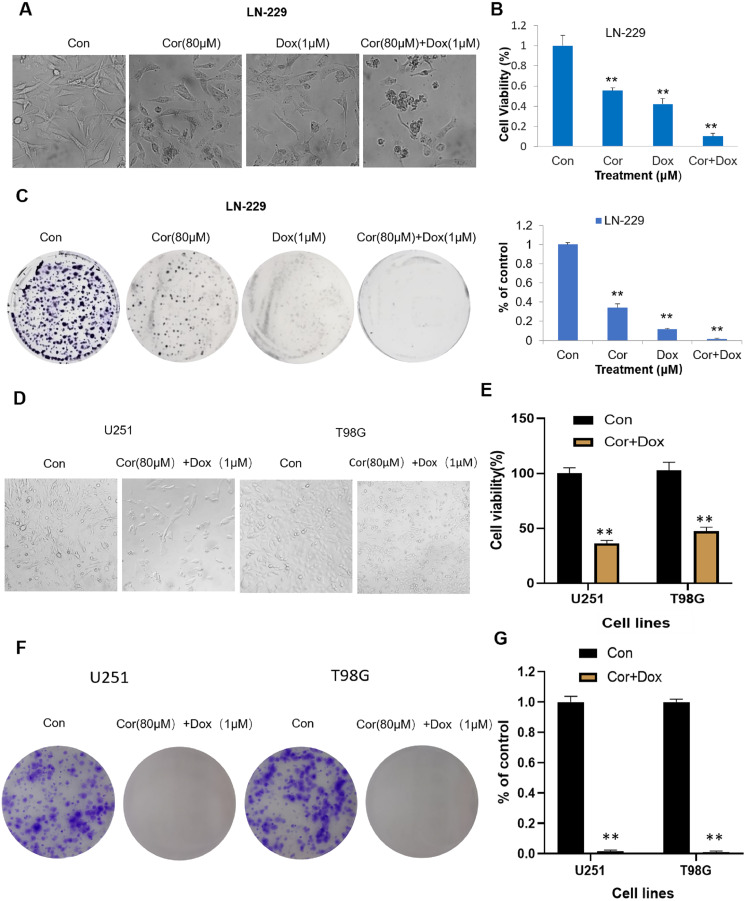
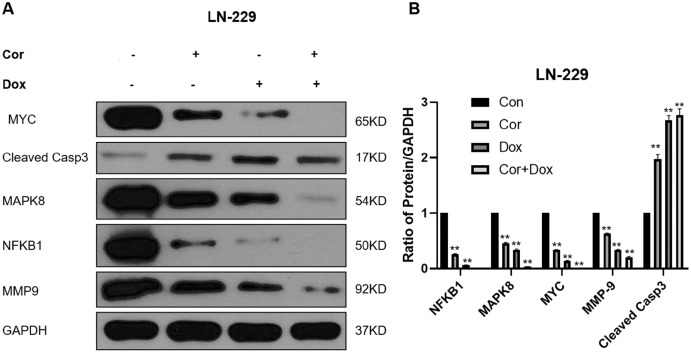
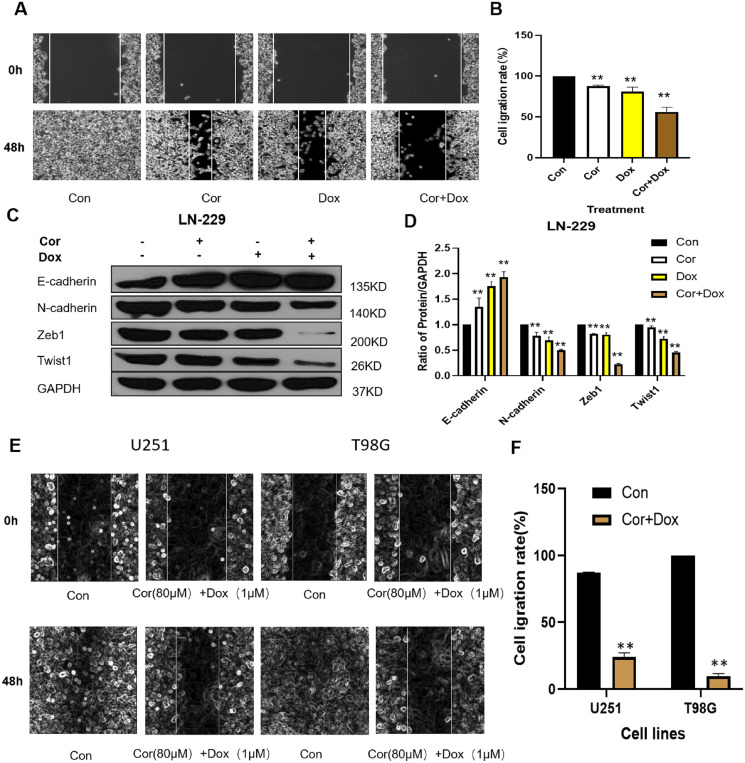
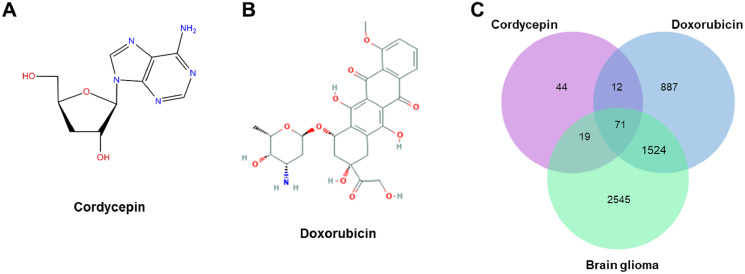
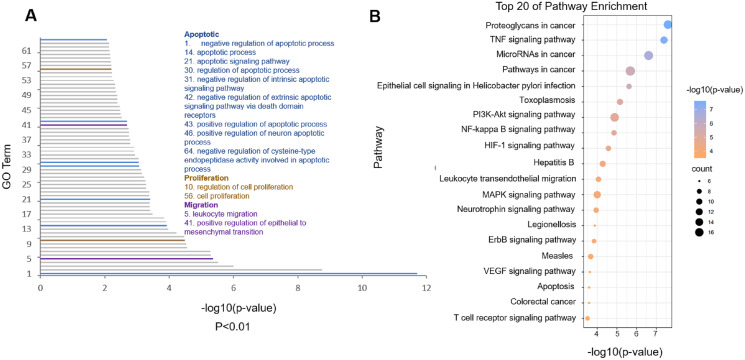
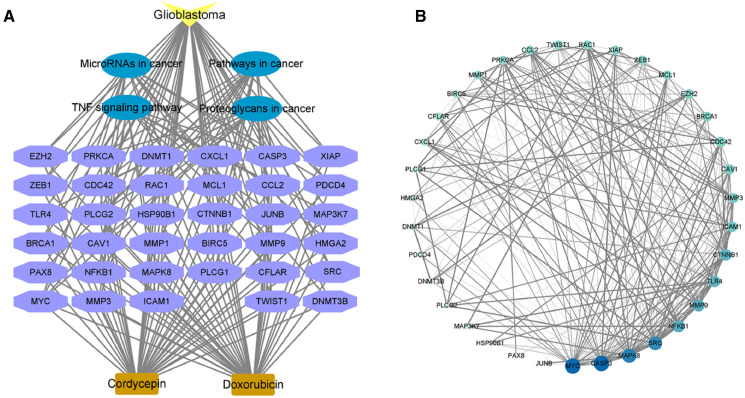
In this study, the combination of doxorubicin and cordycepin was found to significantly inhibit cell proliferation and migration and can induce apoptosis. These effects are better together than with either drug alone. The drug combination inhibited EMT by upregulating the expression of E-cadherin protein and downregulating the expression of N-cadherin, ZEB1, and Twist1 proteins. There were 71 potential targets for the drug combination in glioblastoma, and Kyoto Encyclopedia of Genes and Genome analysis suggested that the anticancer process may be mediated by proteoglycans in cancer, the tumor necrosis factor signaling pathway, microRNA in cancer, pathways in cancer, and other pathways. To study the molecular mechanism of anticancer activity, we detected the expression of target proteins with downregulated expression of NFKB1, MAPK8, MYC, and MMP-9 proteins and upregulated expression of cleaved caspase 3 that promoted the apoptosis of LN-229 cells.
This study shows that the drug combination of doxorubicin and cordycepin effectively inhibits the growth and proliferation of LN-229 cells through multiple targets and multiple pathways, and the combination inhibits cell invasion and migration by regulating the EMT switch of tumor cells. Our findings provide new ideas about, and a theoretical basis for, the treatment of glioblastoma.
胶质母细胞瘤是中枢神经系统中最常见且致命的原发性恶性肿瘤,预后较差。目前,对于胶质母细胞瘤尚无有效的治疗方法。虫草素是一种具有显著抗癌活性的天然活性物质,阿霉素是一种广谱抗癌药物。虫草素与阿霉素联合使用是治疗胶质母细胞瘤的一种潜在药物组合。然而,这种药物组合的作用机制尚未阐明。
利用网络药理学和生物学验证来探索虫草素联合阿霉素抗胶质母细胞瘤的复杂机制。
我们采用MTT法、集落形成试验和划痕愈合试验来检测LN-229、U251和T98G细胞的生长、增殖和迁移情况。通过在线数据库、网络构建和富集分析获得胶质母细胞瘤中该药物组合的潜在靶点和潜在作用机制。我们通过蛋白质印迹法验证上皮-间质转化(EMT)相关基因的表达并确定重要的治疗靶点。
在本研究中,发现阿霉素与虫草素联合使用可显著抑制细胞增殖和迁移,并能诱导细胞凋亡。这些效果联合使用比单独使用任何一种药物都更好。该药物组合通过上调E-钙黏蛋白的表达和下调N-钙黏蛋白、锌指蛋白E盒结合蛋白1(ZEB1)和 Twist1蛋白的表达来抑制EMT。胶质母细胞瘤中该药物组合有71个潜在靶点,京都基因与基因组百科全书分析表明抗癌过程可能由癌症中的蛋白聚糖、肿瘤坏死因子信号通路、癌症中的微小RNA、癌症通路及其他通路介导。为研究抗癌活性的分子机制,我们检测了下调表达的核因子κB亚基1(NFKB1)、丝裂原活化蛋白激酶8(MAPK8)、原癌基因MYC和基质金属蛋白酶9(MMP-9)蛋白以及上调表达的裂解型半胱天冬酶3促进LN-229细胞凋亡的靶蛋白表达情况。
本研究表明,阿霉素与虫草素的药物组合通过多个靶点和多条途径有效抑制LN-229细胞的生长和增殖,且该组合通过调节肿瘤细胞的EMT转换来抑制细胞侵袭和迁移。我们的研究结果为胶质母细胞瘤的治疗提供了新思路和理论依据。