Department of Medicine, Division of Infectious Diseases, Washington University School of Medicine in St. Louis, St. Louis, MO, United States.
Department of Pathology and Immunology, Washington University School of Medicine in St. Louis, St. Louis, MO, United States.
Front Cell Infect Microbiol. 2022 Feb 2;12:804175. doi: 10.3389/fcimb.2022.804175. eCollection 2022.
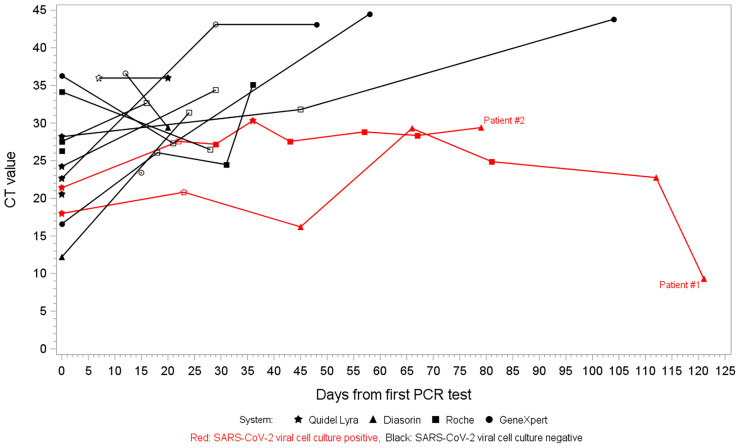
Immunocompromised adults can have prolonged acute respiratory syndrome coronavirus 2 (SARS-CoV-2) positive RT-PCR results, long after the initial diagnosis of coronavirus disease 2019 (COVID-19). This study aimed to determine if SARS-CoV-2 virus can be recovered in viral cell culture from immunocompromised adults with persistently positive SARS-CoV-2 RT-PCR tests. We obtained 20 remnant SARS-CoV-2 PCR positive nasopharyngeal swabs from 20 immunocompromised adults with a positive RT-PCR test ≥14 days after the initial positive test. The patients' 2 test samples underwent SARS-CoV-2 antigen testing, and culture with Vero-hACE2-TMPRSS2 cells. Viral RNA and cultivable virus were recovered from the cultured cells after qRT-PCR and plaque assays. Of 20 patients, 10 (50%) had a solid organ transplant and 5 (25%) had a hematologic malignancy. For most patients, RT-PCR Ct values increased over time. There were 2 patients with positive viral cell cultures; one patient had chronic lymphocytic leukemia treated with venetoclax and obinutuzumab who had a low viral titer of 27 PFU/mL. The second patient had marginal zone lymphoma treated with bendamustine and rituximab who had a high viral titer of 2 x 10 PFU/mL. Most samples collected ≥7 days after an initial positive SARS-CoV-2 RT-PCR had negative viral cell cultures. The 2 patients with positive viral cell cultures had hematologic malignancies treated with chemotherapy and B cell depleting therapy. One patient had a high concentration titer of cultivable virus. Further data are needed to determine risk factors for persistent viral shedding and methods to prevent SARS-CoV-2 transmission from immunocompromised hosts.
免疫功能低下的成年人在最初诊断为 2019 年冠状病毒病(COVID-19)后很长时间内,急性严重呼吸系统综合征冠状病毒 2(SARS-CoV-2)的 RT-PCR 检测结果仍呈阳性。本研究旨在确定 SARS-CoV-2 病毒是否可以从持续 SARS-CoV-2 RT-PCR 检测呈阳性的免疫功能低下成年人的病毒细胞培养物中恢复。我们从 20 名免疫功能低下的成年人中获得了 20 份剩余的 SARS-CoV-2 PCR 阳性鼻咽拭子,这些患者的 RT-PCR 检测呈阳性,且至少在最初阳性检测后 14 天。对患者的 2 份检测样本进行了 SARS-CoV-2 抗原检测和 Vero-hACE2-TMPRSS2 细胞培养。通过 qRT-PCR 和噬斑试验从培养的细胞中回收病毒 RNA 和可培养病毒。20 名患者中,10 名(50%)有实体器官移植,5 名(25%)有血液恶性肿瘤。对于大多数患者,RT-PCR Ct 值随时间推移而增加。有 2 名患者的病毒细胞培养呈阳性;一名患有慢性淋巴细胞白血病,接受维奈托克和奥滨尤妥珠单抗治疗,病毒滴度低,为 27 PFU/mL。第二名患者患有边缘区淋巴瘤,接受苯达莫司汀和利妥昔单抗治疗,病毒滴度高,为 2×10 PFU/mL。大多数在最初 SARS-CoV-2 RT-PCR 检测呈阳性后≥7 天采集的样本进行病毒细胞培养均为阴性。2 名病毒细胞培养呈阳性的患者均患有血液恶性肿瘤,接受化疗和 B 细胞耗竭治疗。一名患者有高浓度的可培养病毒。需要进一步的数据来确定持续性病毒脱落的危险因素和预防 SARS-CoV-2 从免疫功能低下宿主传播的方法。