Department of Virology and Parasitology, Fujita Health University School of Medicine, Toyoake, Aichi, Japan.
Department of Infectious Diseases, Fujita Health University School of Medicine, Toyoake, Aichi, Japan
mSphere. 2021 May 19;6(3):e00019-21. doi: 10.1128/mSphere.00019-21.
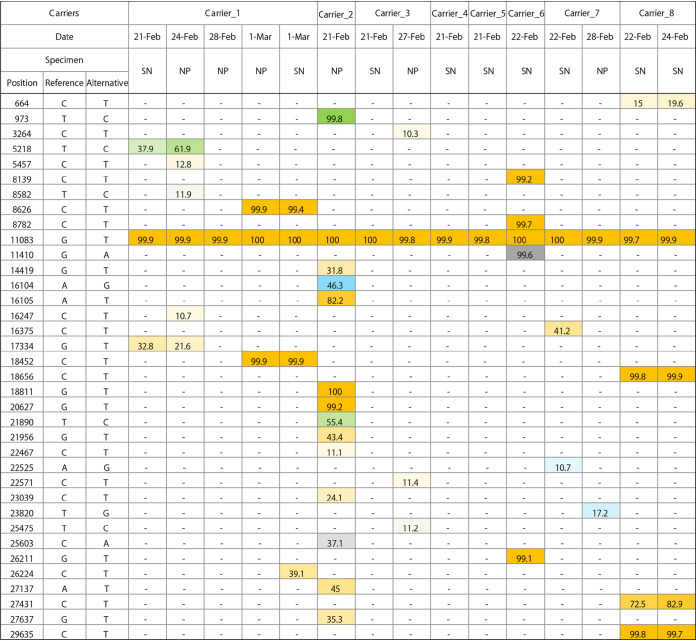
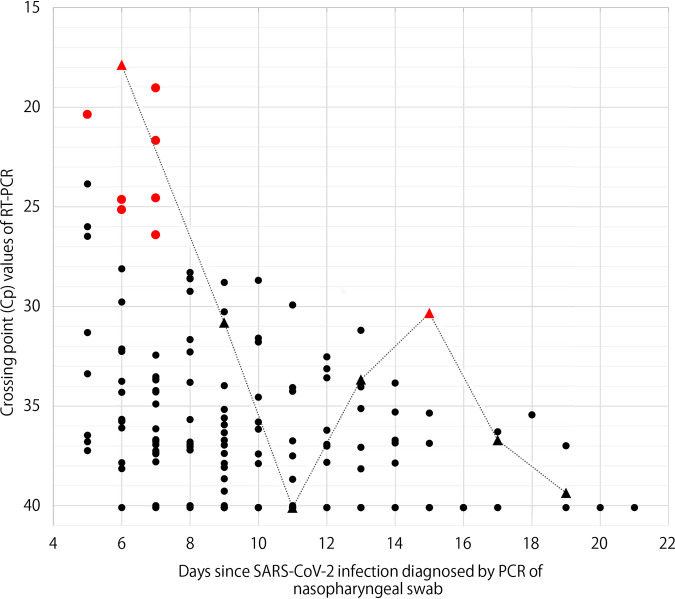
Information regarding the infectivity of severe acute respiratory syndrome coronavirus 2 (SARS-CoV-2) in asymptomatic carriers is scarce. In order to determine the duration of infectivity and its correlation with reverse transcription-PCR (RT-PCR) results and time since initial positive PCR test in this population, we evaluated SARS-CoV-2 cell infectivity in nasopharyngeal samples longitudinally obtained from asymptomatic carriers who disembarked from a cruise ship during a COVID-19 outbreak. Of 166 nasopharyngeal samples collected from 39 asymptomatic carriers every 48 h until two consecutive negative PCR test results were obtained, SARS-CoV-2 was successfully isolated from 9 PCR-positive samples which were obtained from 7 persons (18%; 7/39). Viable viruses were isolated predominantly within 7 days after the initial positive PCR test, except for one person who shed viable virus until day 15. The median crossing point (Cp) value of RT-PCR of culture-positive samples was 24.6 (interquartile range [IQR], 20.4 to 25.8; range, 17.9 to 30.3), and Cp values were significantly associated with isolation of viable virus (odds ratio, 0.496; 95% confidence interval [CI], 0.329 to 0.747; value, 0.001), which was consistent with existing data for symptomatic patients. Genome sequence analysis of SARS-CoV-2 samples consecutively obtained from a person who shed viable virus for 15 days identified the emergence of two novel single nucleotide variants (C8626T transition and C18452T transition) in the sample collected on day 15, with the latter corresponding to an amino acid substitution in nonstructural protein 14. The impact of these mutations on prolonged viable-virus shedding is unclear. These findings underscore the potential role of asymptomatic carriers in transmission. A growing number of studies suggest the potential role of asymptomatic SARS-CoV-2 carriers as a major driver of the COVID-19 pandemic; however, virological assessment of asymptomatic infection has largely been limited to reverse transcription-PCR (RT-PCR), which can be persistently positive without necessarily indicating the presence of viable virus (e.g., replication-competent virus). Here, we evaluated the infectivity of asymptomatic SARS-CoV-2 carriers by detecting SARS-CoV-2-induced cytopathic effects on Vero cells using longitudinally obtained nasopharyngeal samples from asymptomatic carriers. We show that asymptomatic carriers can shed viable virus until 7 days after the initial positive PCR test, with one outlier shedding until day 15. The crossing point (Cp) value of RT-PCR was the leading predictive factor for virus viability. These findings provide additional insights into the role of asymptomatic carriers as a source of transmission and highlight the importance of universal source control measures, along with isolation policy for asymptomatic carriers.
关于无症状感染者中严重急性呼吸综合征冠状病毒 2(SARS-CoV-2)的传染性的信息很少。为了确定无症状感染者的传染性及其与逆转录-PCR(RT-PCR)结果和初始阳性 PCR 检测后时间的相关性,我们纵向评估了从一艘在 COVID-19 疫情期间下船的游轮上无症状乘客中获得的鼻咽样本中的 SARS-CoV-2 细胞感染力。在 166 名从 39 名无症状乘客中每 48 小时收集一次的鼻咽样本中,直到连续两次获得阴性 PCR 检测结果,从 7 名患者(18%;7/39)的 9 个 PCR 阳性样本中成功分离出 SARS-CoV-2。活病毒主要在初始阳性 PCR 检测后 7 天内分离出来,但有 1 名患者直到第 15 天仍有活病毒排出。培养阳性样本的 RT-PCR 的中位交叉点(Cp)值为 24.6(四分位距 [IQR],20.4 至 25.8;范围,17.9 至 30.3),Cp 值与分离活病毒显著相关(比值比,0.496;95%置信区间 [CI],0.329 至 0.747;P 值,0.001),这与有症状患者的现有数据一致。对连续 15 天排出活病毒的患者的 SARS-CoV-2 样本进行的基因组序列分析发现,在第 15 天采集的样本中出现了两个新的单核苷酸变异(C8626T 转换和 C18452T 转换),后者对应于非结构蛋白 14 中的一个氨基酸取代。这些突变对延长活病毒排出的影响尚不清楚。这些发现强调了无症状感染者在传播中的潜在作用。越来越多的研究表明,无症状 SARS-CoV-2 携带者可能是 COVID-19 大流行的主要驱动因素;然而,对无症状感染的病毒学评估在很大程度上仅限于逆转录-PCR(RT-PCR),即使没有必要表明存在活病毒,RT-PCR 也可以持续呈阳性(例如,具有复制能力的病毒)。在这里,我们通过使用从无症状携带者中纵向获得的鼻咽样本,检测 SARS-CoV-2 对 Vero 细胞引起的细胞病变效应,评估无症状 SARS-CoV-2 携带者的传染性。我们表明,无症状携带者在初始阳性 PCR 检测后 7 天内可排出活病毒,1 名患者的排出时间延长至第 15 天。RT-PCR 的 Cp 值是病毒活力的主要预测因子。这些发现为无症状携带者作为传播源的作用提供了更多的见解,并强调了普遍的源头控制措施以及对无症状携带者的隔离政策的重要性。