Max Von Pettenkofer Institute and Gene Center, Virology, National Reference Center for Retroviruses, LMU München, Feodor-Lynen-Str. 23, 81377, Munich, Germany.
German Center for Infection Research (DZIF), Partner Site, Munich, Germany.
Med Microbiol Immunol. 2022 Jun;211(2-3):105-117. doi: 10.1007/s00430-022-00730-z. Epub 2022 Feb 20.
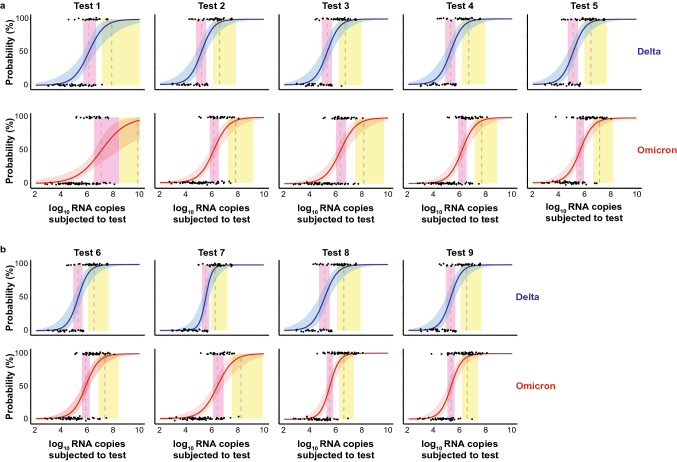
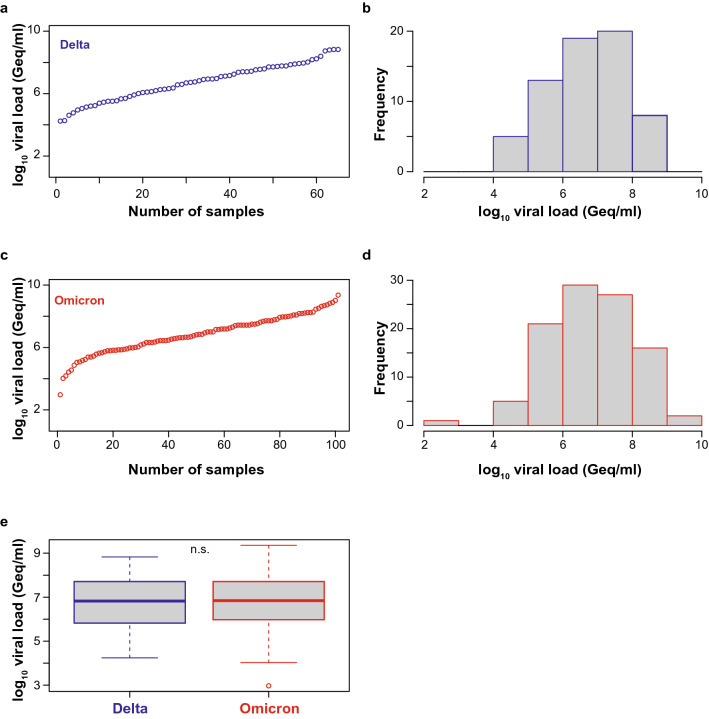
Since autumn 2020, rapid antigen tests (RATs) have been implemented in several countries as an important pillar of the national testing strategy to rapidly screen for infections on site during the SARS-CoV-2 pandemic. The current surge in infection rates around the globe is driven by the variant of concern (VoC) omicron (B.1.1.529). Here, we evaluated the performance of nine SARS-CoV-2 RATs in a single-centre laboratory study. We examined a total of 115 SARS-CoV-2 PCR-negative and 166 SARS-CoV-2 PCR-positive respiratory swab samples (101 omicron, 65 delta (B.1.617.2)) collected from October 2021 until January 2022 as well as cell culture-expanded clinical isolates of both VoCs. In an assessment of the analytical sensitivity in clinical specimen, the 50% limit of detection (LoD50) ranged from 1.77 × 10 to 7.03 × 10 RNA copies subjected to the RAT for omicron compared to 1.32 × 10 to 2.05 × 10 for delta. To score positive in these point-of-care tests, up to 10-fold (LoD50) or 101-fold (LoD95) higher virus loads were required for omicron- compared to delta-containing samples. The rates of true positive test results for omicron samples in the highest virus load category (Ct values < 25) ranged between 31.4 and 77.8%, while they dropped to 0-8.3% for samples with intermediate Ct values (25-30). Of note, testing of expanded virus stocks suggested a comparable RAT sensitivity of both VoCs, questioning the predictive value of this type of in vitro-studies for clinical performance. Given their importance for national test strategies in the current omicron wave, awareness must be increased for the reduced detection rate of omicron infections by RATs and a short list of suitable RATs that fulfill the minimal requirements of performance should be rapidly disclosed.
自 2020 年秋季以来,快速抗原检测(RAT)已在多个国家实施,作为国家检测策略的重要支柱,以在 SARS-CoV-2 大流行期间现场快速筛查感染。目前,全球感染率的激增是由关注变体(VOC)奥密克戎(B.1.1.529)驱动的。在这里,我们在一项单中心实验室研究中评估了九种 SARS-CoV-2 RAT 的性能。我们共检测了 115 份 SARS-CoV-2 PCR 阴性和 166 份 SARS-CoV-2 PCR 阳性呼吸道拭子样本(101 份奥密克戎,65 份 delta(B.1.617.2)),这些样本于 2021 年 10 月至 2022 年 1 月采集,以及两种 VOC 的细胞培养扩增临床分离株。在评估临床标本中的分析灵敏度时,奥密克戎的 50%检测限(LoD50)范围为 1.77×10 至 7.03×10 RNA 拷贝,而 delta 的 LoD50 范围为 1.32×10 至 2.05×10。在这些即时检测中,奥密克戎样本的病毒载量需要高出 10 倍(LoD50)或 101 倍(LoD95)才能呈阳性,而 delta 样本则需要高出 10 倍(LoD50)或 101 倍(LoD95)。奥密克戎样本在最高病毒载量类别(Ct 值<25)中的真阳性检测结果率在 31.4%至 77.8%之间,而在 Ct 值为 25-30 的中等样本中,这一比例下降至 0-8.3%。值得注意的是,扩展病毒库存的检测表明两种 VOC 的 RAT 敏感性相当,这对这种体外研究对临床性能的预测价值提出了质疑。鉴于它们在当前奥密克戎浪潮中对国家检测策略的重要性,必须提高对 RAT 检测奥密克戎感染率降低的认识,并且应该迅速公布一份满足性能最低要求的合适 RAT 短名单。