Department of Medicine, Cumming School of Medicine - University of Calgary, Calgary, Canada; Department of Community Health Sciences, O'Brien Institute for Public Health, Cumming School of Medicine, University of Calgary, Calgary, Canada.
Department of Community Health Sciences, O'Brien Institute for Public Health, Cumming School of Medicine, University of Calgary, Calgary, Canada.
Clin Microbiol Infect. 2022 Jun;28(6):773-778. doi: 10.1016/j.cmi.2022.02.004. Epub 2022 Feb 19.
Migrant populations in high-income countries have faced myriad health and social inequities during the COVID-19 pandemic. Migrants often work in frontline essential services that expose them to COVID-19. Migrant workers in meat processing plants have endured large COVID-19 outbreaks across multiple countries.
We examine current scientific evidence around COVID-19 transmission, outcomes, and prevention for migrant workers and highlight meat processing plants as an example.
We performed a series of PubMed searches between January 1, 2020 and January 12, 2022.
Migrant workers in high-income countries often work in occupations at high risk for COVID-19 transmission, contract COVID-19 at higher rates, and experience worse outcomes than native-born counterparts. For example, meat processing plants represent almost ideal environments for rapid and large-scale SARS-CoV-2 viral transmission; often, large migrant workforces confined to small workspaces perform physically demanding work in noisy environments that require shouting to communicate, increasing workers' respiratory rates and the quantity of aerosolized droplets expelled and thus increasing viral transmission risk. Although enhanced vaccination outreach programs remain an important equity approach for migrant worker safety, they alone are insufficient. The emergence and rapid spread of multiple increasingly transmissible SARS-CoV-2 variants of concern with variable vaccine escape properties, including Omicron in November 2021, highlight the importance of improved infection prevention and control strategies to protect migrant workers. Across countries, strategies such as improving ventilation and mask quality in many high-risk occupational settings are already required by employment law. Universal mandatory vaccination program should also be considered.
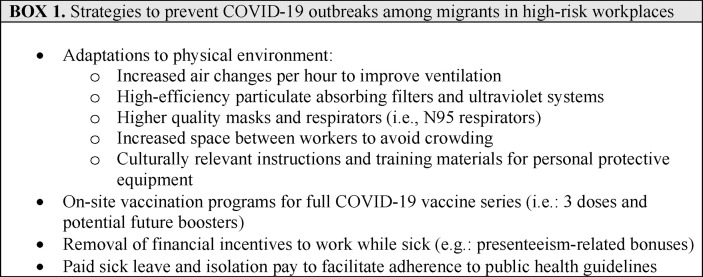
COVID-19 transmission prevention for migrant workers requires an aggressive multicomponent plan that includes (a) improved on-site ventilation and infection prevention and control strategies; (b) improved social supports such as paid sick leave; (c) mobile vaccination clinics and community engagement to overcome vaccine hesitancy and barriers; and (d) consideration of universal mandatory vaccination programs.
在 COVID-19 大流行期间,高收入国家的移民人口面临着众多健康和社会不平等问题。移民经常从事一线必要服务工作,使他们面临 COVID-19 的风险。在多个国家,肉类加工厂的移民工人经历了大规模的 COVID-19 疫情爆发。
我们检查了围绕 COVID-19 传播、结果和预防的当前科学证据,并以肉类加工厂为例进行了重点介绍。
我们在 2020 年 1 月 1 日至 2022 年 1 月 12 日期间进行了一系列 PubMed 搜索。
高收入国家的移民工人经常从事高风险的 COVID-19 传播职业,感染 COVID-19 的比例更高,并且比本地出生的同行经历更差的结果。例如,肉类加工厂代表了 SARS-CoV-2 病毒快速大规模传播的几乎理想环境;通常,大量移民工人被限制在小工作空间内,在嘈杂的环境中从事体力劳动,需要大声呼喊来交流,从而增加工人的呼吸频率和排出的气溶胶飞沫量,从而增加病毒传播的风险。尽管加强疫苗接种外联计划仍然是保障移民工人安全的重要公平措施,但仅凭这些措施是不够的。越来越多的具有不同疫苗逃逸特性的令人关注的 SARS-CoV-2 变体的出现和快速传播,包括 2021 年 11 月的奥密克戎,突显了改进感染预防和控制策略以保护移民工人的重要性。在各国,改善许多高风险职业环境中的通风和口罩质量等策略已经被雇佣法所要求。还应考虑实施普遍强制性疫苗接种计划。
预防移民工人的 COVID-19 传播需要采取多方面的综合计划,包括:(a)改善现场通风和感染预防控制策略;(b)改善社会支持,如带薪病假;(c)流动疫苗接种诊所和社区参与,以克服疫苗犹豫和障碍;(d)考虑实施普遍强制性疫苗接种计划。