Department of Clinical Experimental Research, Glostrup Research Institute, Rigshospitalet, Glostrup, Denmark.
Department of Biology, University of Copenhagen, Copenhagen, Denmark.
J Headache Pain. 2022 Feb 21;23(1):30. doi: 10.1186/s10194-022-01399-8.
Based on the current understanding of the role of neuropeptide signalling in migraine, we explored the therapeutic potential of a specific cannabinoid agonist. The aim of the present study was to examine the effect of the synthetic endocannabinoid (eCB) analogue, arachidonyl-2'-chloroethylamide (ACEA), on calcitonin gene-related peptide (CGRP) release in the dura and trigeminal ganglion (TG), as cannabinoids are known to activate G-coupled cannabinoid receptors type 1 (CB1), resulting in neuronal inhibition.
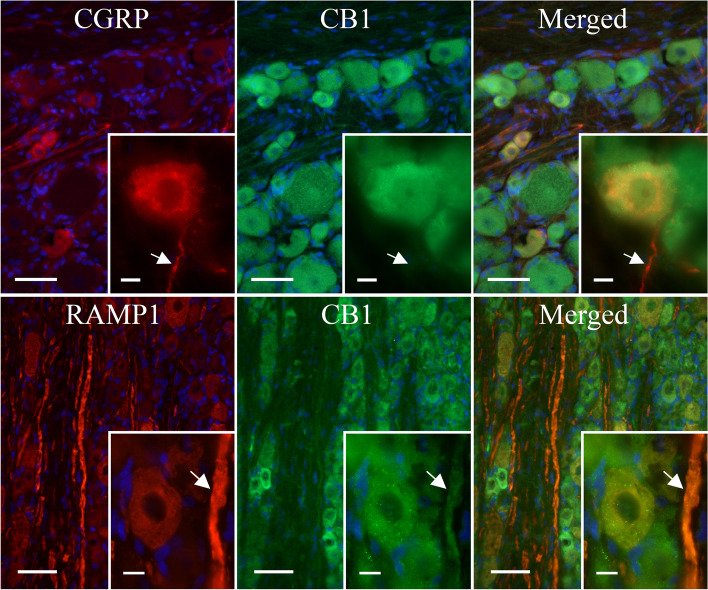
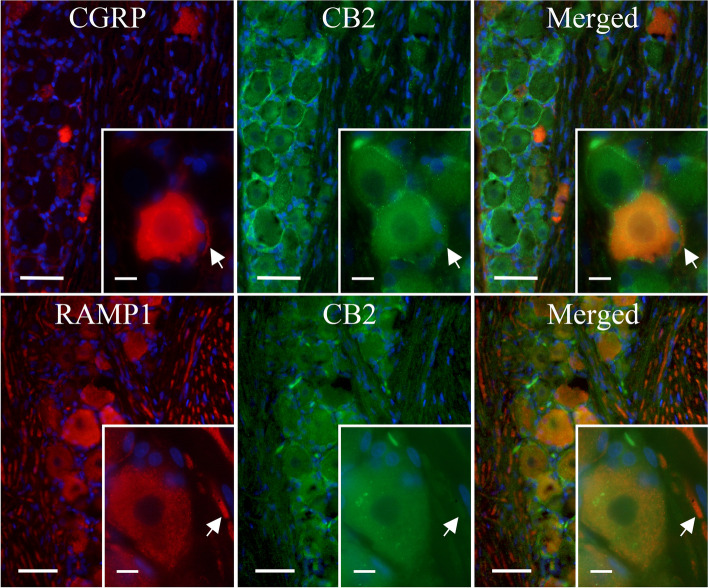
The experiments were performed using the hemi-skull model and dissected TGs from male Sprague-Dawley rats. CGRP release was induced by either 60 mM K (for depolarization-induced stimulation) or 100 nM capsaicin (for transient receptor potential vanilloid 1 (TRPV1) -induced stimulation) and measured using an enzyme-linked immunosorbent assay. The analysis of CGRP release data was combined with immunohistochemistry in order to study the cellular localization of CB1, cannabinoid receptor type 2 (CB2), CGRP and receptor activity modifying protein 1 (RAMP1), a subunit of the functional CGRP receptor, in the TG.
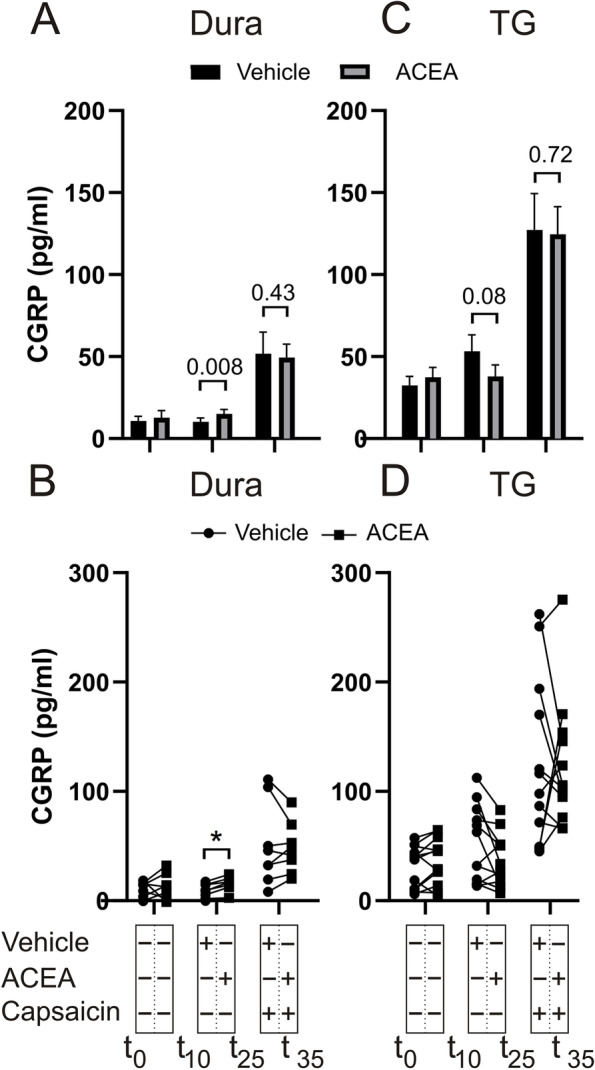
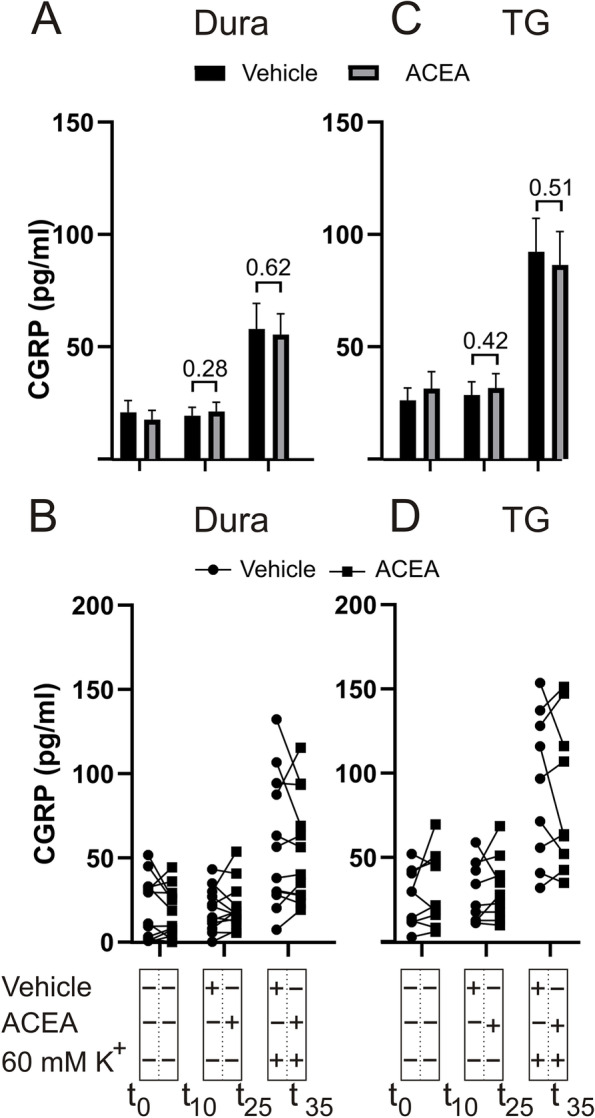
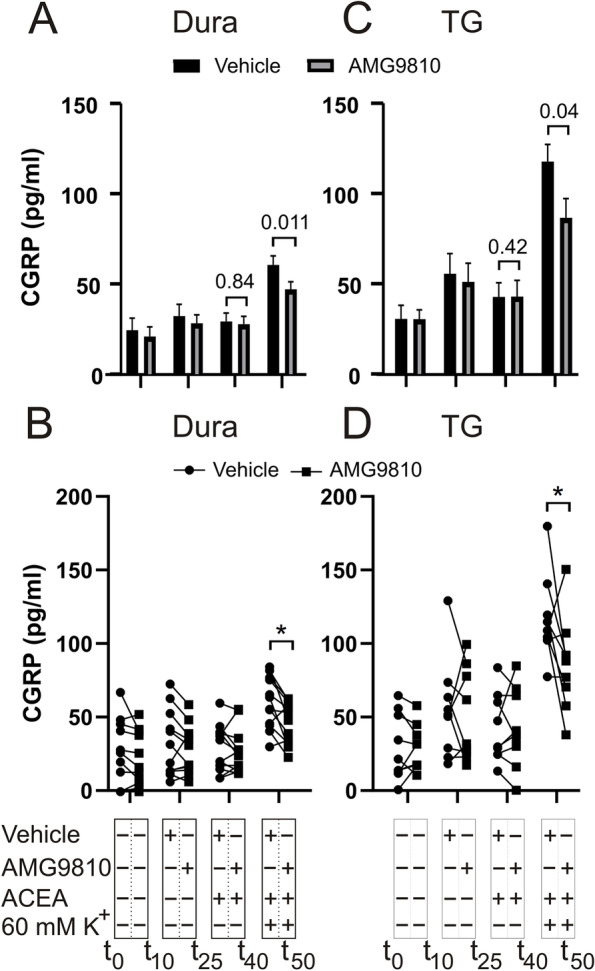
CB1 was predominantly expressed in neuronal somas in which colocalization with CGRP was observed. Furthermore, CB1 exhibited colocalization with RAMP1 in neuronal Aδ-fibres but was not clearly expressed in the CGRP-immunoreactive C-fibres. CB2 was mainly expressed in satellite glial cells and did not show substantial colocalization with either CGRP or RAMP1. Without stimulation, 140 nM ACEA per se caused a significant increase in CGRP release in the dura but not TG, compared to vehicle. Furthermore, 140 nM ACEA did not significantly modify neither K- nor capsaicin-induced CGRP release. However, when the TRPV1 blocker AMG9810 (1 mM) was coapplied with ACEA, K-induced CGRP release was significantly attenuated in the TG and dura.
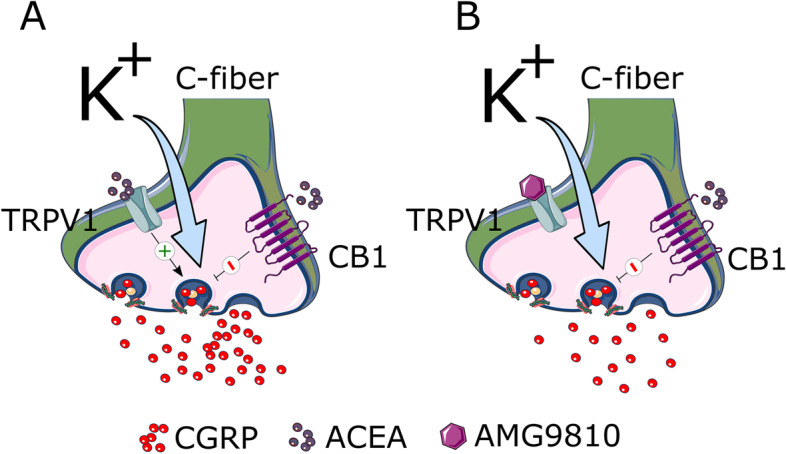
Results from the present study indicate that ACEA per se does not exhibit antimigraine potential due to its dual agonistic properties, resulting in activation of both CB1 and TRPV1, and thereby inhibition and stimulation of CGRP release, respectively.
基于神经肽信号在偏头痛中作用的现有认识,我们探索了一种特定大麻素激动剂的治疗潜力。本研究的目的是检查合成内源性大麻素(eCB)类似物,花生四烯酰-2'-氯乙基酰胺(ACEA)对硬脑膜和三叉神经节(TG)中降钙素基因相关肽(CGRP)释放的影响,因为大麻素有已知激活 G 偶联大麻素受体 1(CB1),导致神经元抑制。
使用半颅骨模型和分离的雄性 Sprague-Dawley 大鼠 TG 进行实验。CGRP 释放由 60mM K(用于去极化刺激)或 100nM 辣椒素(用于瞬时受体电位香草素 1(TRPV1)诱导刺激)诱导,并使用酶联免疫吸附试验测量。为了研究 TG 中 CB1、大麻素受体 2(CB2)、CGRP 和受体活性修饰蛋白 1(RAMP1)的细胞定位,将 CGRP 释放数据分析与免疫组织化学相结合,RAMP1 是功能性 CGRP 受体的一个亚基。
CB1 主要表达在神经元体中,在其中观察到与 CGRP 的共定位。此外,CB1 在神经元 Aδ-纤维中与 RAMP1 共定位,但在 CGRP 免疫反应性 C-纤维中不明显表达。CB2 主要表达在卫星神经胶质细胞中,与 CGRP 或 RAMP1 均无明显共定位。在没有刺激的情况下,与载体相比,140nM ACEA 本身就会导致硬脑膜中 CGRP 释放显著增加,但在 TG 中则不会。此外,140nM ACEA 对 K-或辣椒素诱导的 CGRP 释放没有显著影响。然而,当 TRPV1 阻断剂 AMG9810(1mM)与 ACEA 共同应用时,TG 和硬脑膜中的 K 诱导的 CGRP 释放明显减弱。
本研究结果表明,ACEA 本身由于其双重激动特性,既激活 CB1 又激活 TRPV1,从而分别抑制和刺激 CGRP 释放,因此不具有抗偏头痛潜力。