From the Univ. Lille (P.V.), UMR Inserm U1172, CHU Lille, FHU Precise, France; Neurology Department (L.B.-R.), Hospital Arnau de Vilanova de Lleida, Spain; Mellen Center for Multiple Sclerosis (R.J.F.), Neurological Institute, Cleveland Clinic, OH; Experimental and Clinical Research Center and NeuroCure Clinical Research Center (F.P.), Max Delbrueck Center for Molecular Medicine and Charité Universitaetsmedizin Berlin, corporate member of Freie Universität Berlin, Humboldt-Universität zu Berlin, and Berlin Institute of Health, Germany; Neurology Department (L.R.-T.), Dr Josep Trueta University Hospital, Girona; Neurodegeneration and Neuroinflammation Research Group (L.R.-T.), IDIBGI, Salt; Medical Science Department (L.R.-T.), University of Girona, Spain; Neurology Department (M.S.), Jena University Hospital, Germany; AB Science (A.M., C.M., O.H.), Paris, France; Imagine Institute (O.H.), INSERM UMR 1163, Laboratory of Cellular and Molecular Mechanisms of Hematological Disorders and Therapeutic Implication, Hôpital Necker, Paris, France; and MA LEK AM Maciejowscy SC Centrum Terapii SM (M.M.), Katowice, Poland.
Neurol Neuroimmunol Neuroinflamm. 2022 Feb 21;9(3). doi: 10.1212/NXI.0000000000001148. Print 2022 May.
Masitinib is a selective tyrosine kinase inhibitor, targeting innate immune cells (mast cells and microglia) that are involved in the pathophysiology of progressive multiple sclerosis (MS). Study AB07002 assessed oral masitinib in patients with progressive MS who were progressing but not clinically active.
This randomized, double-blind, 2 parallel-group, placebo-controlled trial assessing 2 dose levels of masitinib vs equivalent placebo was conducted at 116 hospital clinics and specialized MS centers in 20 countries. Randomization (2:1) with minimization was performed centrally using an automated system. Patients, physicians, and outcome assessors remained masked to treatment group allocation. Patients with primary progressive MS (PPMS) or nonactive secondary progressive MS (nSPMS) without relapse for ≥2 years, aged 18-75 years, with baseline Expanded Disability Status Scale (EDSS) 2.0-6.0, and regardless of time from onset were treated for 96 weeks. The primary end point was overall EDSS change from baseline using repeated measures (generalized estimating equation, timeframe W12-W96, measured every 12 weeks), with positive values indicating increased clinical deterioration. Efficacy and safety were assessed in all randomly assigned and treated patients.
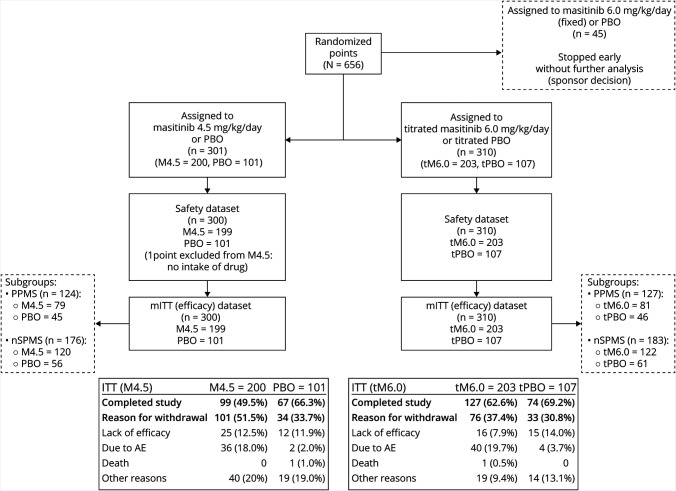
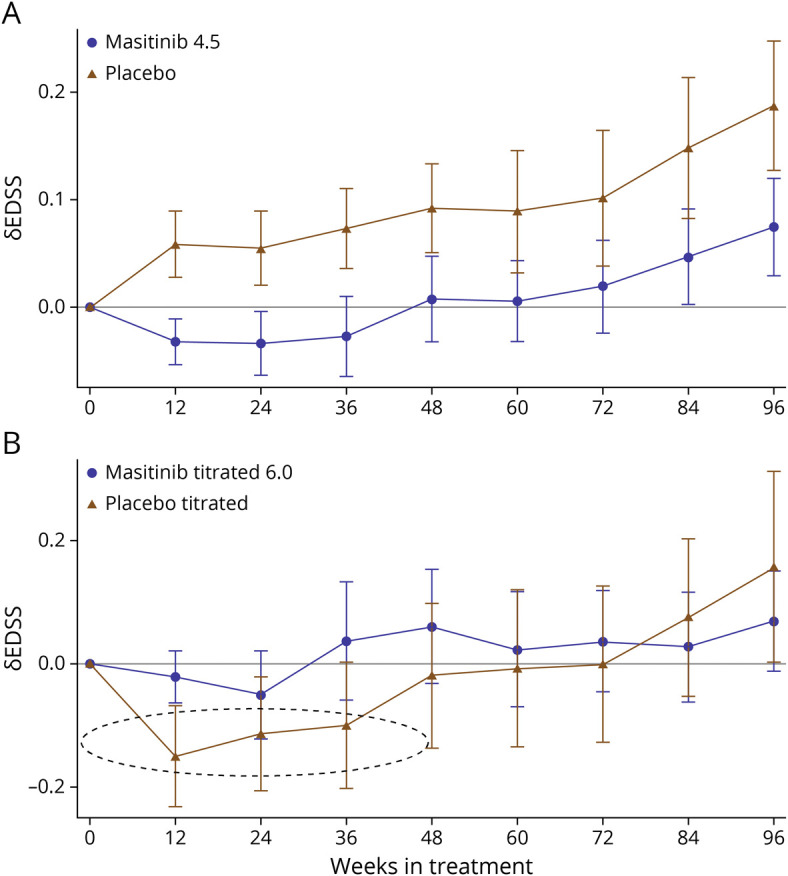
A total of 611 patients were randomized; 301 in the masitinib 4.5 mg/kg/d parallel group and 310 in the uptitrated masitinib 6.0 mg/kg/d parallel group. Masitinib (4.5 mg/kg/d) (n = 199) showed significant benefit over placebo (n = 101) according to the primary end point, 0.001 vs 0.098, respectively, with a between-group difference of -0.097 (97% CI -0.192 to -0.002); = 0.0256. Safety was consistent with masitinib's known profile (diarrhea, nausea, rash, and hematologic events), with no elevated risk of infection. Efficacy results from the independent uptitrated masitinib 6.0 mg/kg/d parallel group were inconclusive, and no new safety signal was observed.
Masitinib (4.5 mg/kg/d) can benefit people with PPMS and nSPMS. A confirmatory phase 3 study will be initiated to substantiate these data.
The first participant was randomized to study AB07002 on August 25, 2011. The trial was registered with the European Clinical Trials Database (#EudraCT 2010-021219-17) on July 1, 2011 (clinicaltrialsregister.eu/ctr-search/trial/2010-021219-17/ES) and with ClinicalTrials.gov (#NCT01433497) on September 14, 2011 (clinicaltrials.gov/ct2/show/NCT01433497).
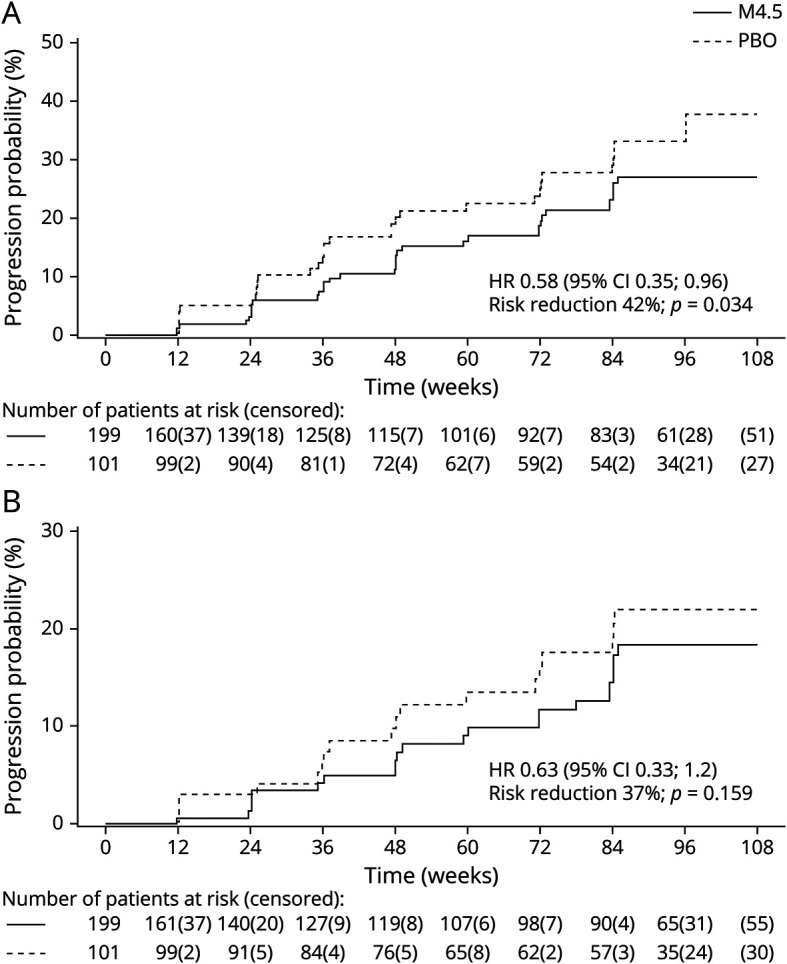
This study provides Class II evidence that masitinib 4.5 mg/kg/d decreased progression of disability, measured by the EDSS, in adults with PPMS or patients with nSPMS (with no exacerbations in the last 2 years).
马替尼是一种选择性酪氨酸激酶抑制剂,针对的是参与进行性多发性硬化症(MS)病理生理学的固有免疫细胞(肥大细胞和小神经胶质细胞)。AB07002 研究评估了进展性 MS 患者口服马替尼的情况,这些患者正在进展但没有临床活动。
这项随机、双盲、2 平行组、安慰剂对照试验在 20 个国家的 116 家医院诊所和专门的 MS 中心进行,评估了 2 种马替尼剂量水平与等效安慰剂的疗效。使用自动化系统进行中央随机分组(2:1)和最小化。患者、医生和结果评估者对治疗组分配保持盲态。患有原发性进展性 MS(PPMS)或无复发 2 年以上的非活跃性继发性进展性 MS(nSPMS)、年龄在 18-75 岁之间、基线扩展残疾状况量表(EDSS)为 2.0-6.0、且不论发病时间如何的患者,接受 96 周的治疗。主要终点是使用重复测量(广义估计方程,时间框架 W12-W96,每 12 周测量一次)从基线评估总体 EDSS 变化,正值表示临床恶化增加。在所有随机分配和治疗的患者中评估疗效和安全性。
共有 611 名患者被随机分配;4.5mg/kg/d 马替尼平行组 301 例,上调剂量 6.0mg/kg/d 马替尼平行组 310 例。与安慰剂(n=101)相比,马替尼(4.5mg/kg/d)(n=199)显示出显著的益处,分别为 0.001 和 0.098,组间差异为-0.097(97%CI-0.192 至-0.002); = 0.0256。安全性与马替尼已知的特征一致(腹泻、恶心、皮疹和血液事件),没有感染风险增加。独立上调剂量的 6.0mg/kg/d 马替尼平行组的疗效结果不确定,没有观察到新的安全性信号。
马替尼(4.5mg/kg/d)可以使 PPMS 和 nSPMS 患者受益。将启动一项确证性的 3 期研究来证实这些数据。
第一名参与者于 2011 年 8 月 25 日被随机分配到 AB07002 研究中。该试验于 2011 年 7 月 1 日在欧洲临床试验数据库(#EudraCT 2010-021219-17)注册,于 2011 年 9 月 14 日在 ClinicalTrials.gov(#NCT01433497)注册(clinicaltrialsregister.eu/ctr-search/trial/2010-021219-17/ES)。
这项研究提供了 II 级证据,表明马替尼 4.5mg/kg/d 降低了进展性多发性硬化症(PPMS)患者或无恶化 2 年以上的非活跃性继发性进展性多发性硬化症(nSPMS)患者的残疾进展,用 EDSS 测量。