Department of Biostatistics & Health Informatics, Institute of Psychiatry, Psychology and Neuroscience, King's College London, 16 De Crespigny Park, London, SE5 8AF, UK.
Department of Behavioural Science and Health, Institute of Epidemiology and Health Care, University College London, 1-19 Torrington Place, London, WC1E 7HB, UK.
BMC Med. 2022 Feb 23;20(1):62. doi: 10.1186/s12916-022-02279-3.
Attention deficit hyperactivity disorder (ADHD) is a highly heritable, neurodevelopmental disorder known to associate with more than double the risk of death compared with people without ADHD. Because most research on ADHD has focused on children and adolescents, among whom death rates are relatively low, the impact of a high polygenic predisposition to ADHD on accelerating mortality risk in older adults is unknown. Thus, the aim of the study was to investigate if a high polygenetic predisposition to ADHD exacerbates the risk of all-cause mortality in older adults from the general population in the UK.
Utilising data from the English Longitudinal Study of Ageing, which is an ongoing multidisciplinary study of the English population aged ≥ 50 years, polygenetic scores for ADHD were calculated using summary statistics for (1) ADHD (PGS-ADHD) and (2) chronic obstructive pulmonary disease and younger age of giving first birth, which were shown to have a strong genetic correlation with ADHD using the multi-trait analysis of genome-wide association summary statistics; this polygenic score was referred to as PGS-ADHD. All-cause mortality was ascertained from the National Health Service central register that captures all deaths occurring in the UK.
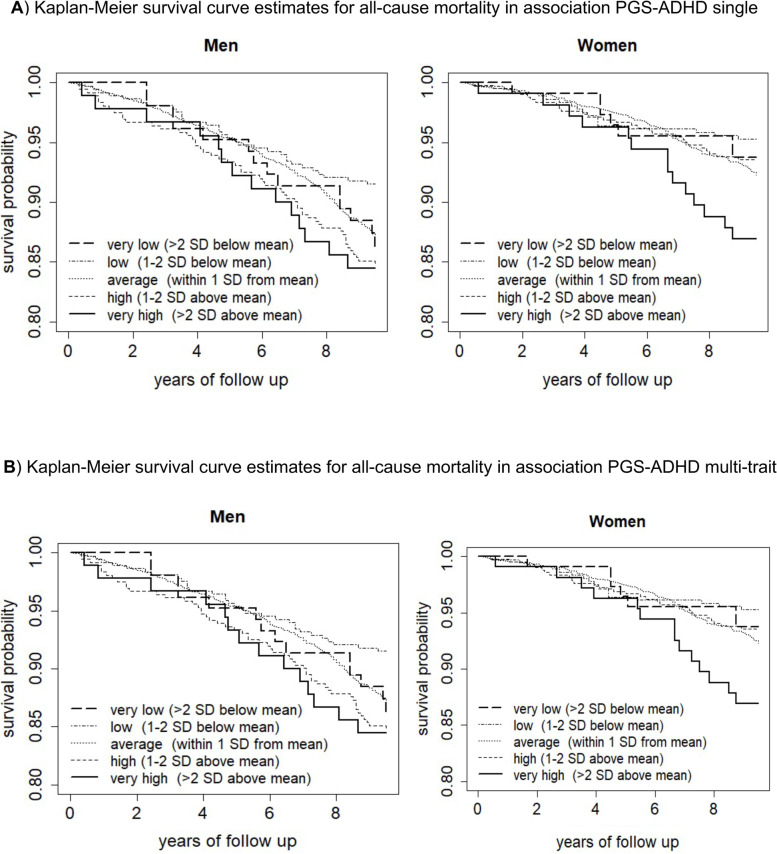
The sample comprised 7133 participants with a mean age of 64.7 years (SD = 9.5, range = 50-101); of these, 1778 (24.9%) died during a period of 11.2 years. PGS-ADHD was associated with a greater risk of all-cause mortality (hazard ratio [HR] = 1.06, 95% CI = 1.02-1.12, p = 0.010); further analyses showed this relationship was significant in men (HR = 1.07, 95% CI = 1.00-1.14, p = 0.043). Risk of all-cause mortality increased by an approximate 11% for one standard deviation increase in PGS-ADHD (HR = 1.11, 95% CI = 1.06-1.16, p < 0.001). When the model was run separately for men and women, the association between PGS-ADHD and an increased risk of all-cause mortality was significant in men (HR = 1.10, 95% CI = 1.03-1.18, p = 0.003) and women (HR = 1.11, 95% CI = 1.04-1.19, p = 0.003).
A high polygenetic predisposition to ADHD is a risk factor for all-cause mortality in older adults. This risk is better captured when incorporating genetic information from correlated traits.
注意力缺陷多动障碍(ADHD)是一种高度遗传性的神经发育障碍,已知与 ADHD 相比,其死亡风险增加了一倍以上。由于大多数 ADHD 研究都集中在儿童和青少年身上,而这些人群的死亡率相对较低,因此,高多基因易患 ADHD 是否会加速老年人群的死亡率尚不清楚。因此,本研究旨在调查在英国一般人群中,高多基因易患 ADHD 是否会加剧老年人的全因死亡率。
利用英国老龄化纵向研究的数据,这是一项对≥50 岁的英国人口进行的多学科研究,使用 ADHD 的汇总统计数据计算多基因 ADHD 评分(PGS-ADHD),并使用全基因组关联汇总统计数据进行多特征分析,计算出慢性阻塞性肺疾病和首次生育年龄较小,这与 ADHD 具有很强的遗传相关性;该多基因评分称为 PGS-ADHD。全因死亡率通过国家卫生服务中心登记处确定,该登记处涵盖了英国所有的死亡人数。
样本包括 7133 名平均年龄为 64.7 岁(标准差=9.5,范围=50-101)的参与者;其中,1778 人(24.9%)在 11.2 年的时间内死亡。PGS-ADHD 与全因死亡率的风险增加相关(风险比[HR] = 1.06,95%置信区间[CI] = 1.02-1.12,p = 0.010);进一步的分析表明,这种关系在男性中是显著的(HR = 1.07,95% CI = 1.00-1.14,p = 0.043)。PGS-ADHD 每增加一个标准差,全因死亡率的风险增加约 11%(HR = 1.11,95% CI = 1.06-1.16,p < 0.001)。当分别对男性和女性进行模型运行时,PGS-ADHD 与全因死亡率风险增加之间的关联在男性(HR = 1.10,95% CI = 1.03-1.18,p = 0.003)和女性(HR = 1.11,95% CI = 1.04-1.19,p = 0.003)中均有显著意义。
高多基因易患 ADHD 是老年人群全因死亡率的一个危险因素。当纳入与 ADHD 相关的遗传信息时,这种风险可以更好地捕捉到。