
表象和运动规划具有共同的神经机制。
Shared mechanisms underlie mental imagery and motor planning.
机构信息
Technion, Israel Institute of Technology, Haifa, 3200003, Israel.
出版信息
Sci Rep. 2022 Feb 22;12(1):2947. doi: 10.1038/s41598-022-06800-9.
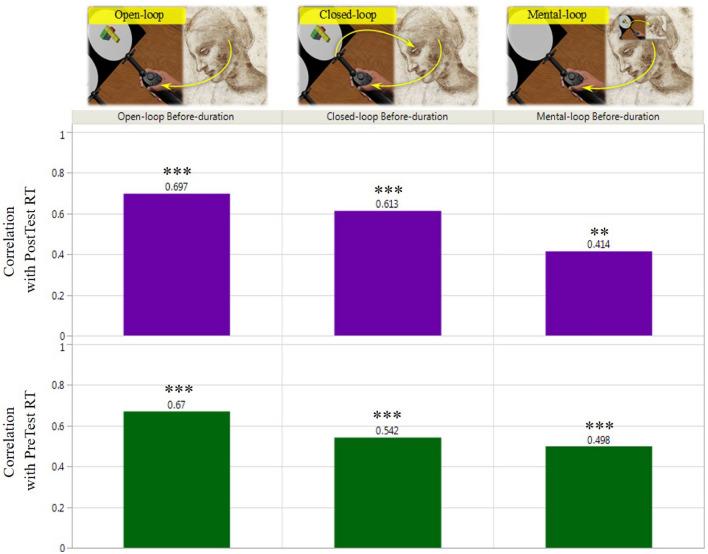
Many studies have associated mental imagery with motor control mechanisms by showing mutually active brain areas and functions, as well as similar temporal patterns of imagining and executing the same motor actions. One of the main conjectured mutual mechanisms is the Cerebellar forward-model, commonly believed to generate sensory predictions as part of both motor control and mental imagery processes. Nevertheless, trials to associate one's overall individual mental and motor capacities have shown only mild and inconsistent correlations, hence challenging the mutual mechanism assumption. We hypothesized that one cause to this inconsistency is the forward-model's dominance in the motor-planning stage only when adapting to novel sensorimotor environments, while the inverse-model is gradually taking the lead along the adaptation, and therefore biasing most attempts to measure motor-mental overlapping functions and correlate these measurements under regular circumstances. Our current study aimed to tackle and explore this gap using immersive virtual embodiment, by applying an experience of a fundamental sensorimotor conflict, thereby manipulating the sensory prediction mechanism, and presumably forcing an increased involvement of the forward-model in the motor planning stage throughout the experiment. In the study, two groups of subjects (n = 48) performed mental and manual rotation within an immersive, motion-captured, virtual reality environment, while the sensorimotor dynamics of only the test group were altered by physical-virtual speed re-mapping making the virtual hand move twice as fast as the physical hand controlling it. Individual mental imagery capacities were assessed before and after three blocks of manual-rotation, where motor planning durations were measured as the time until motion onset. The results show that virtual sensorimotor alteration extremely increases the correlation of mental imagery and motor planning (r = 0.9, p < .0001) and leads to higher mental imagery performance improvement following the physical blocks. We particularly show that virtual embodiment manipulation affects the motor planning stage to change and functionally overlap with imagery mechanisms, rather than the other way around, which supports our conjecture of an increased sensory-prediction forward-model involvement. Our results shed new light on the embodied nature of mental imagery, support the view of the predictive forward-model as a key mechanism mutually underlying motor control and imagery, and suggest virtual sensorimotor alteration as a novel methodology to increase physical-mental convergence. These findings also suggest the applicability of using existing motion-tracked virtual environments for continuous cognitive evaluation and treatment, through kinematic analysis of ongoing natural motor behaviors.
许多研究通过显示相互活跃的大脑区域和功能,以及想象和执行相同运动动作的相似时间模式,将心理意象与运动控制机制联系起来。其中一个主要推测的相互机制是小脑前向模型,通常被认为是生成感觉预测的一部分,作为运动控制和心理意象过程的一部分。然而,将一个人的整体心理和运动能力联系起来的试验只显示出轻微和不一致的相关性,因此挑战了相互机制的假设。我们假设,造成这种不一致的一个原因是,前向模型在适应新的感觉运动环境时仅在运动规划阶段占主导地位,而反向模型则逐渐占据主导地位,并因此偏向于大多数试图测量运动-心理重叠功能并在常规情况下相关联的尝试。我们目前的研究旨在通过沉浸式虚拟体现来解决和探索这一差距,通过应用基本感觉运动冲突的体验,从而操纵感觉预测机制,并可能迫使前向模型在整个实验过程中更多地参与运动规划阶段。在研究中,两组受试者(n=48)在沉浸式、运动捕捉的虚拟现实环境中进行心理和手动旋转,而只有测试组的感觉运动动力学通过物理-虚拟速度重新映射来改变,使得虚拟手的移动速度是控制它的物理手的两倍。在手动旋转的三个块之前和之后评估个体心理意象能力,其中运动规划持续时间测量为运动开始前的时间。结果表明,虚拟感觉运动改变极大地增加了心理意象和运动规划的相关性(r=0.9,p<.0001),并在物理块之后导致心理意象表现的改善。我们特别表明,虚拟体现操纵会影响运动规划阶段以改变并与意象机制功能重叠,而不是相反,这支持了我们的假设,即增加感觉预测前向模型的参与。我们的结果为心理意象的体现性质提供了新的见解,支持了预测前向模型作为运动控制和意象相互基础的关键机制的观点,并提出了虚拟感觉运动改变作为增加身体-心理收敛的新方法。这些发现还表明,通过对正在进行的自然运动行为的运动学分析,使用现有的运动跟踪虚拟环境进行连续认知评估和治疗的适用性。





 Zotero 插件