Department of Radiation Oncology, Washington University School of Medicine, St. Louis, Missouri.
Department of Radiation Oncology, Yonsei University College of Medicine, Seoul, Republic of Korea.
J Appl Clin Med Phys. 2022 Apr;23(4):e13535. doi: 10.1002/acm2.13535. Epub 2022 Feb 23.
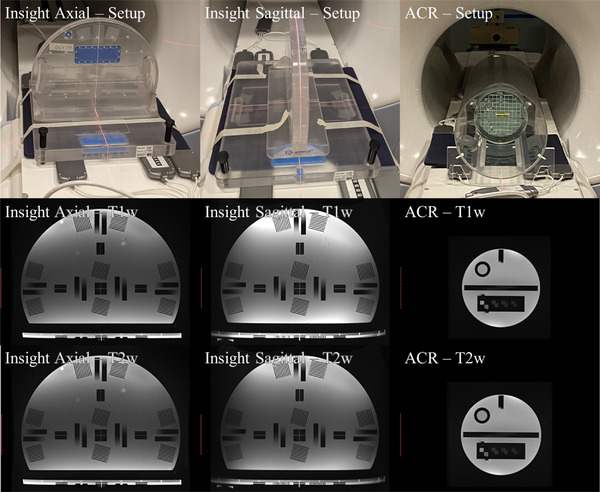
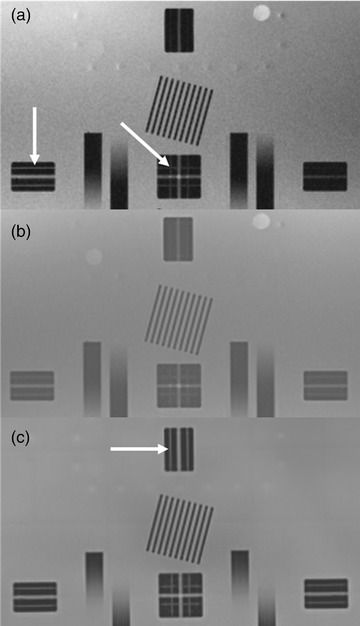
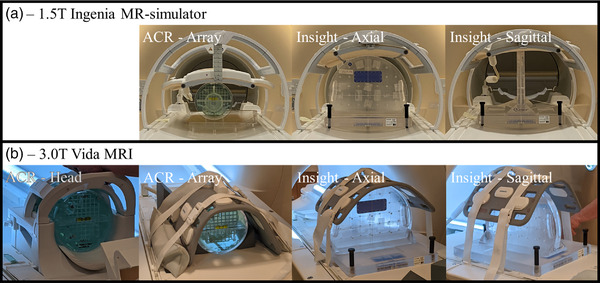
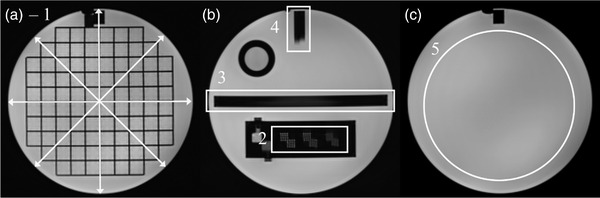
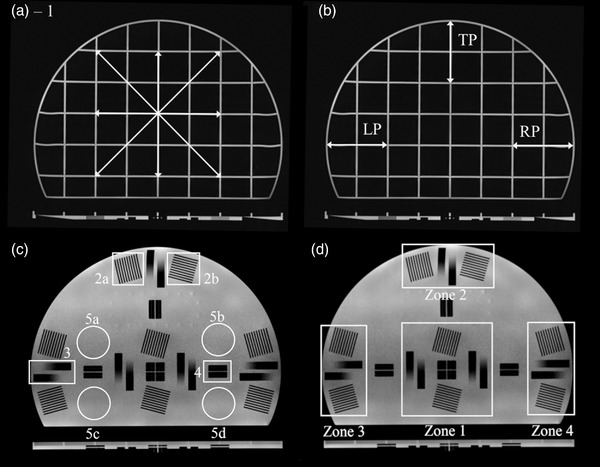
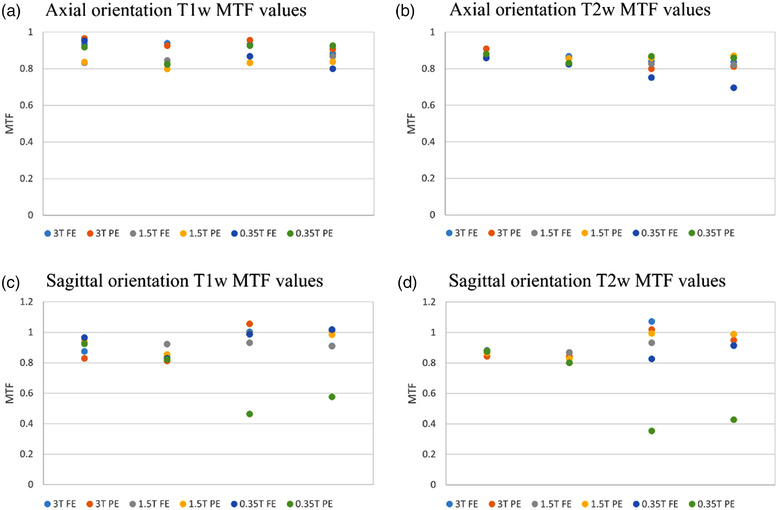
Consistent quality assurance (QA) programs are vital to MR-guided radiotherapy (MRgRT), for ensuring treatment is delivered accurately and the onboard MRI system is providing the expected image quality. However, daily imaging QA with a dedicated phantom is not common at many MRgRT centers, especially with large phantoms that cover a field of view (FOV), similar to the human torso. This work presents the first clinical experience with a purpose-built phantom for large FOV daily and periodic comprehensive quality assurance (QUASAR™ MRgRT Insight Phantom (beta)) from Modus Medical Devices Inc. (Modus QA) on an MRgRT system. A monthly American College of Radiology (ACR) QA phantom was also imaged for reference. Both phantoms were imaged on a 0.35T MR-Linac, a 1.5T Philips wide bore MRI, and a 3.0T Siemens MRI, with T1-weighted and T2-weighted acquisitions. The Insight phantom was imaged in axial and sagittal orientations. Image quality tests including geometric accuracy, spatial resolution accuracy, slice thickness accuracy, slice position accuracy, and image intensity uniformity were performed on each phantom, following their respective instruction manuals. The geometric distortion test showed similar distortions of -1.7 mm and -1.9 mm across a 190 mm and a 283 mm lengths for the ACR and MRgRT Insight phantoms, respectively. The MRgRT Insight phantom utilized a modulation transform function (MTF) for spatial resolution evaluation, which showed decreased performance on the lower B strength MRIs, as expected, and could provide a good daily indicator of machine performance. Both the Insight and ACR phantoms showed a match with scan parameters for slice thickness analysis. During the imaging and analysis of this novel MRgRT Insight phantom the authors found setup to be straightforward allowing for easy acquisition each day, and useful image analysis parameters for tracking MRI performance.
一致的质量保证 (QA) 计划对于磁共振引导放射治疗 (MRgRT) 至关重要,可确保治疗的准确性,并确保车载 MRI 系统提供预期的图像质量。然而,在许多 MRgRT 中心,并非每天都使用专用模体进行成像 QA,尤其是对于覆盖视野 (FOV) 较大的模体,例如人体躯干。这项工作介绍了 Modus Medical Devices Inc. (Modus QA) 为大型 FOV 日常和定期综合质量保证 (QUASAR™MRgRT Insight Phantom (beta)) 而专门设计的模体在 MRgRT 系统中的首次临床经验。还对每月的美国放射学院 (ACR) QA 模体进行了成像,作为参考。两个模体都在 0.35T MR-Linac、1.5T Philips 宽孔径 MRI 和 3.0T Siemens MRI 上进行了成像,采集 T1 加权和 T2 加权图像。Insight 模体以轴位和矢状位进行成像。根据各自的说明书,对每个模体进行了图像质量测试,包括几何精度、空间分辨率精度、层厚精度、层位置精度和图像强度均匀性。几何变形测试显示,ACR 和 MRgRT Insight 模体的 190mm 和 283mm 长度的变形分别为-1.7mm 和-1.9mm。MRgRT Insight 模体使用调制传递函数 (MTF) 进行空间分辨率评估,在较低的 B 强度 MRI 上性能下降,这是预期的结果,并且可以提供机器性能的良好日常指标。Insight 和 ACR 模体在层厚分析的扫描参数方面均具有一致性。在对这种新型 MRgRT Insight 模体进行成像和分析的过程中,作者发现该模体易于设置,每天都可以轻松采集,并且具有用于跟踪 MRI 性能的有用图像分析参数。