Division of Infectious Diseases, Department of Medicine, School of Medicine, Johns Hopkins University School of Medicine, Baltimore, Maryland, USA.
Department of Chemistry, Johns Hopkins University, Baltimore, Maryland, USA.
mSphere. 2022 Feb 23;7(1):e0003922. doi: 10.1128/msphere.00039-22.
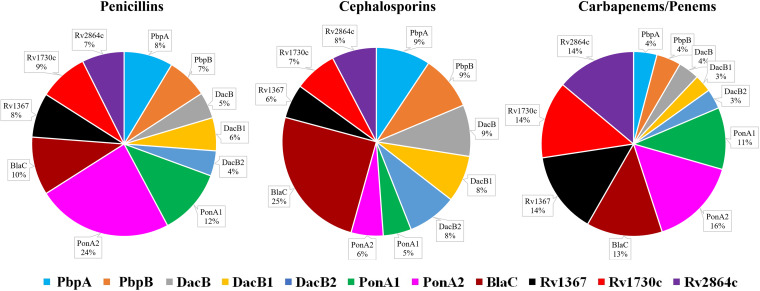
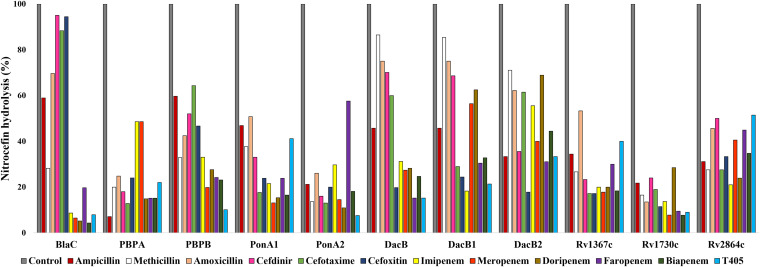
Penicillin binding proteins (PBPs) have been extensively studied due to their importance to the physiology of bacterial cell wall peptidoglycan and as targets of the most widely used class of antibiotics, the β-lactams. The existing paradigm asserts that PBPs catalyze the final step of peptidoglycan biosynthesis, and β-lactams inhibit their activities. According to this paradigm, a distinct enzyme class, β-lactamases, exists to inactivate β-lactams. This paradigm has been the basis for how bacterial diseases are treated with β-lactams. We tested whether this historical view accurately reflects the relationship between β-lactams and the PBPs and the β-lactamase, BlaC, of Mycobacterium tuberculosis. BlaC was the major inactivator of the cephalosporin subclass of β-lactams. However, the PBPs PonA1 and PonA2 inactivated penicillins and carbapenems more effectively than BlaC. These findings demonstrate that select M. tuberculosis PBPs are effective at inactivating several β-lactams. Lesser-known PBPs, DacB, DacB1, DacB2, and Rv2864c, a putative PBP, were comparably more resistant to inhibition by all β-lactam subclasses. Additionally, Rv1730c exhibited low affinity to most β-lactams. Based on these findings, we conclude that in M. tuberculosis, BlaC is not the only source of inactivation of β-lactams. Therefore, the historical paradigm does not accurately describe the relationship between β-lactams and M. tuberculosis. M. tuberculosis, the causative agent of tuberculosis, kills more humans than any other bacterium. β-lactams are the most widely used class of antibiotics to treat bacterial infections. Unlike in the historical model that describes the relationship between β-lactams and M. tuberculosis, we find that M. tuberculosis penicillin binding proteins are able to inactivate select β-lactams with high efficiency.
青霉素结合蛋白(PBPs)因其对细菌细胞壁肽聚糖的生理学重要性以及作为最广泛使用的抗生素类别的β-内酰胺类抗生素的靶标而被广泛研究。现有的范例断言,PBPs 催化肽聚糖生物合成的最后一步,而β-内酰胺类抗生素抑制其活性。根据这一范例,存在一个独特的酶类,β-内酰胺酶,来使β-内酰胺类抗生素失活。这一范例一直是用β-内酰胺类抗生素治疗细菌疾病的基础。我们测试了这种历史观点是否准确反映了β-内酰胺类抗生素与 PBPs 和结核分枝杆菌的β-内酰胺酶 BlaC 之间的关系。BlaC 是头孢菌素亚类β-内酰胺类抗生素的主要失活剂。然而,PonA1 和 PonA2 这两种 PBPs 比 BlaC 更有效地使青霉素和碳青霉烯类失活。这些发现表明,结核分枝杆菌中的某些 PBP 能够有效地使几种β-内酰胺类抗生素失活。不太知名的 PBPs,DacB、DacB1、DacB2 和 Rv2864c(一种假定的 PBP)对所有β-内酰胺子类的抑制更具抗性。此外,Rv1730c 对大多数β-内酰胺类抗生素的亲和力较低。基于这些发现,我们得出结论,在结核分枝杆菌中,BlaC 不是β-内酰胺类抗生素失活的唯一来源。因此,历史范例不能准确描述β-内酰胺类抗生素与结核分枝杆菌之间的关系。
结核分枝杆菌是结核病的病原体,比任何其他细菌导致的人类死亡都多。β-内酰胺类抗生素是治疗细菌感染最广泛使用的抗生素类别。与描述β-内酰胺类抗生素与结核分枝杆菌之间关系的历史模型不同,我们发现结核分枝杆菌青霉素结合蛋白能够高效地使某些β-内酰胺类抗生素失活。