Silva Ana Valesca Fernandes Gilson, Menezes Diego, Moreira Filipe Romero Rebello, Torres Octávio Alcântara, Fonseca Paula Luize Camargos, Moreira Rennan Garcias, Alves Hugo José, Alves Vivian Ribeiro, Amaral Tânia Maria de Resende, Coelho Adriano Neves, Saraiva Duarte Júlia Maria, da Rocha Augusto Viana, de Almeida Luiz Gonzaga Paula, de Araújo João Locke Ferreira, de Oliveira Hilton Soares, de Oliveira Nova Jersey Cláudio, Zolini Camila, de Sousa Jôsy Hubner, de Souza Elizângela Gonçalves, de Souza Rafael Marques, Ferreira Luciana de Lima, Lehmkuhl Gerber Alexandra, Guimarães Ana Paula de Campos, Maia Paulo Henrique Silva, Marim Fernanda Martins, Miguita Lucyene, Monteiro Cristiane Campos, Neto Tuffi Saliba, Pugêdo Fabrícia Soares Freire, Queiroz Daniel Costa, Queiroz Damares Nigia Alborguetti Cuzzuol, Resende-Moreira Luciana Cunha, Santos Franciele Martins, Souza Erika Fernanda Carlos, Voloch Carolina Moreira, Vasconcelos Ana Tereza, de Aguiar Renato Santana, de Souza Renan Pedra
Escola de Saúde Pública de Betim, Betim, Brazil.
Programa de Pós Graduação em Genética, Departamento de Genética, Ecologia e Evolução, Instituto de Ciências Biológicas, Universidade Federal de Minas Gerais, Belo Horizonte, Brazil.
Front Microbiol. 2022 Feb 7;13:799713. doi: 10.3389/fmicb.2022.799713. eCollection 2022.
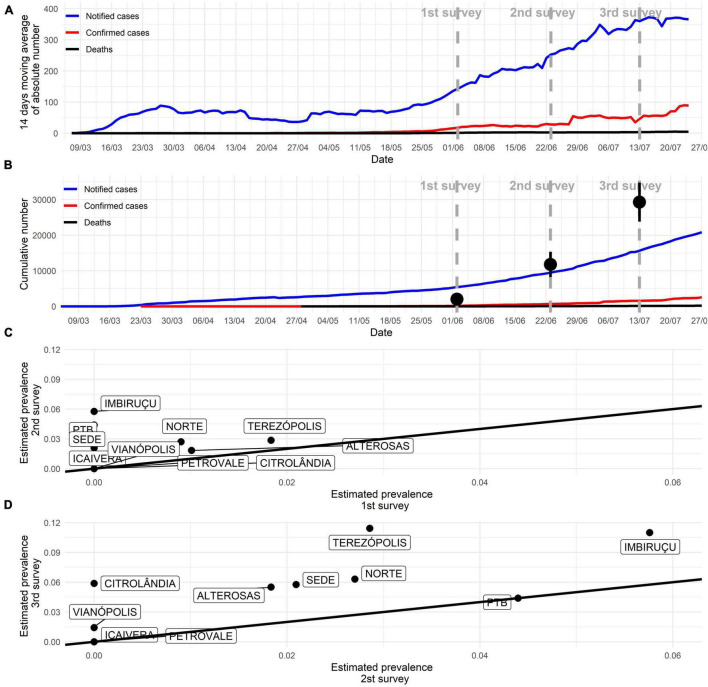
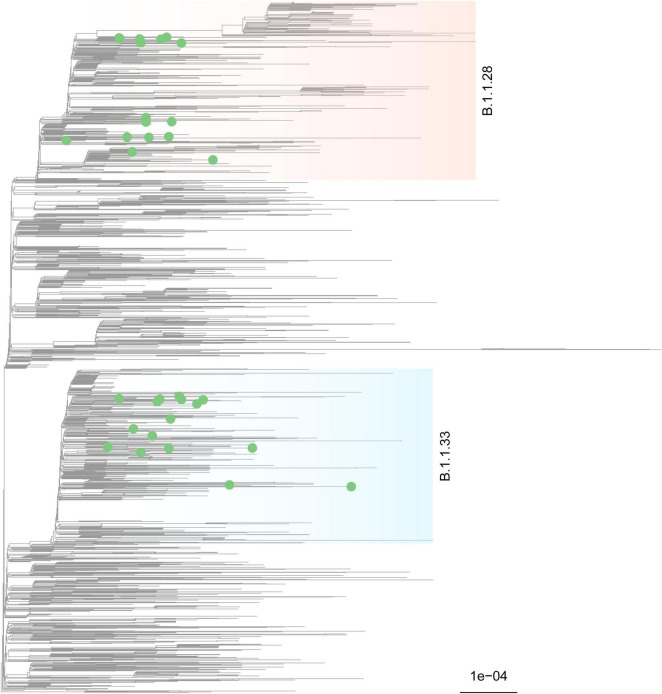
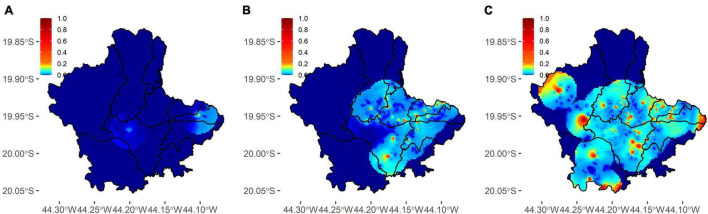
The COVID-19 pandemic has created an unprecedented need for epidemiological monitoring using diverse strategies. We conducted a project combining prevalence, seroprevalence, and genomic surveillance approaches to describe the initial pandemic stages in Betim City, Brazil. We collected 3239 subjects in a population-based age-, sex- and neighborhood-stratified, household, prospective; cross-sectional study divided into three surveys 21 days apart sampling the same geographical area. In the first survey, overall prevalence (participants positive in serological or molecular tests) reached 0.46% (90% CI 0.12-0.80%), followed by 2.69% (90% CI 1.88-3.49%) in the second survey and 6.67% (90% CI 5.42-7.92%) in the third. The underreporting reached 11, 19.6, and 20.4 times in each survey. We observed increased odds to test positive in females compared to males (OR 1.88 95% CI 1.25-2.82), while the single best predictor for positivity was ageusia/anosmia (OR 8.12, 95% CI 4.72-13.98). Thirty-five SARS-CoV-2 genomes were sequenced, of which 18 were classified as lineage B.1.1.28, while 17 were B.1.1.33. Multiple independent viral introductions were observed. Integration of multiple epidemiological strategies was able to adequately describe COVID-19 dispersion in the city. Presented results have helped local government authorities to guide pandemic management.
新冠疫情使得采用多种策略进行流行病学监测的需求达到了前所未有的程度。我们开展了一个项目,结合患病率、血清学患病率和基因组监测方法,来描述巴西贝廷市疫情初期阶段的情况。我们在一项基于人群的、按年龄、性别和邻里分层的家庭前瞻性横断面研究中收集了3239名受试者,该研究分为三次调查,每次间隔21天,对同一地理区域进行采样。在第一次调查中,总体患病率(血清学或分子检测呈阳性的参与者)达到0.46%(90%置信区间0.12 - 0.80%),第二次调查为2.69%(90%置信区间1.88 - 3.49%),第三次调查为6.67%(90%置信区间5.42 - 7.92%)。每次调查中的漏报率分别达到了11倍、19.6倍和20.4倍。我们观察到女性检测呈阳性的几率高于男性(比值比1.88,95%置信区间1.25 - 2.82),而检测呈阳性的最佳单一预测因素是嗅觉减退/嗅觉丧失(比值比8.12,95%置信区间4.72 - 13.98)。对35个新冠病毒基因组进行了测序,其中18个被归类为B.1.1.28谱系,17个为B.1.1.33谱系。观察到多次独立的病毒引入情况。多种流行病学策略的整合能够充分描述该市新冠病毒的传播情况。所呈现的结果有助于当地政府当局指导疫情管理。