Zhao Ying, Jiang Hui-Ling, Shi Yu, Zhang Wei, Zhang Lei-Xiao, Hou Yu-Jun, Yang Zuo-Qin, He Bao-Yu, Liang Fan-Rong, Zheng Qian-Hua
Acupuncture and Tuina School of Chengdu University of Traditional Chinese Medicine, Chengdu, Sichuan 610075, China.
Department of Chongqing Beibei Traditional Chinese Medical Hospital, Chongqing, China.
Evid Based Complement Alternat Med. 2022 Feb 14;2022:2497430. doi: 10.1155/2022/2497430. eCollection 2022.
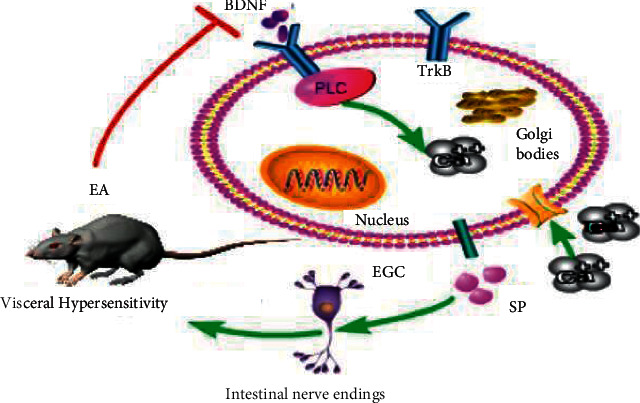
To determine whether electroacupuncture (EA) could alleviate visceral hypersensitivity in diarrhea-predominant irritable bowel syndrome (IBS-D) rats by inhibiting EGCs activity via the BDNF/TrkB signaling pathway.
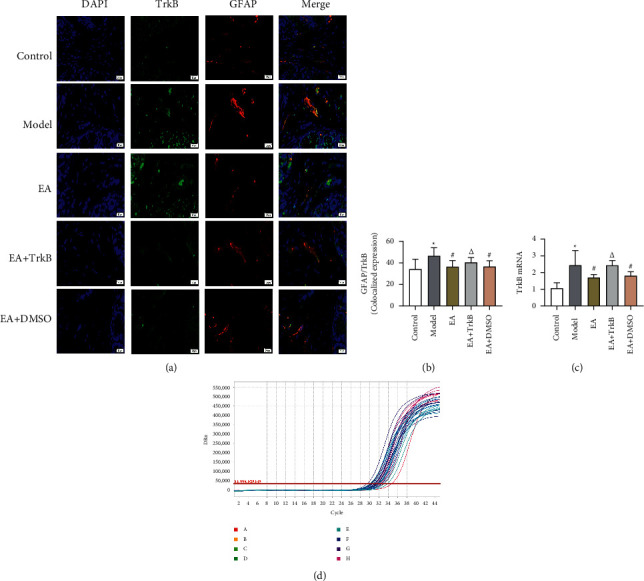
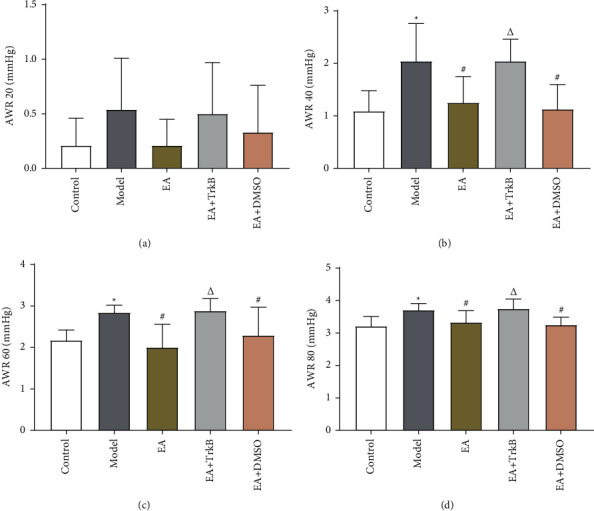
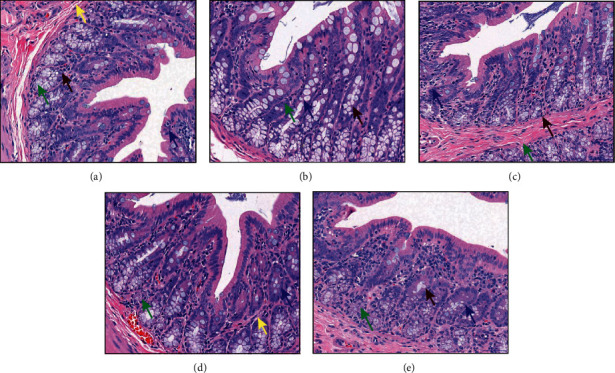
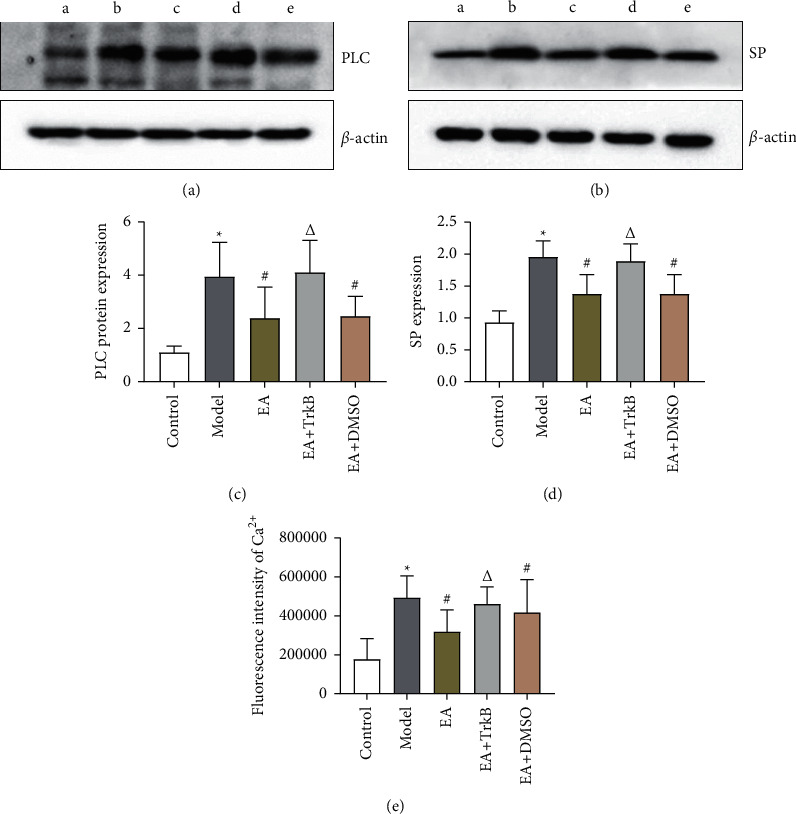
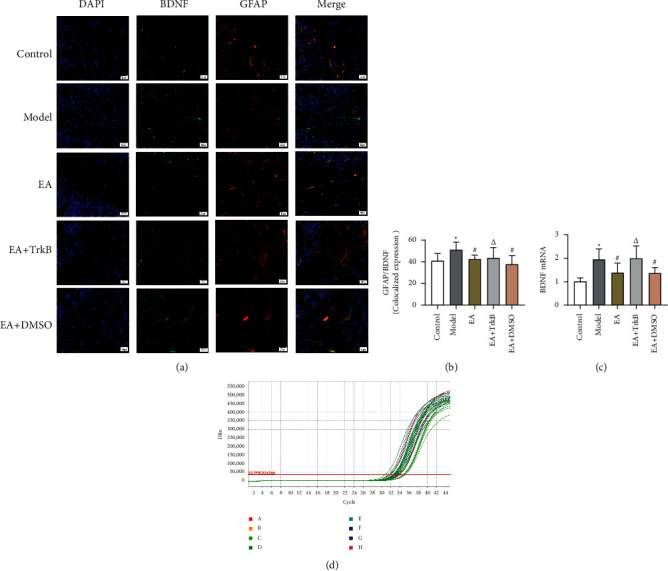
Sprague Dawley rats were randomly divided to a control group ( = 8) and a model preparation group ( = 32), which received Senna solution by gavage and CUMS (chronic unpredictable mild stress) for 14 consecutive days and was further divided to a Model group, an EA group (only electroacupuncture), an EA + TrkB agonist group (electroacupuncture and TrkB), and an EA + DMSO group (electroacupuncture and DMSO, = 8 for each). Rats in the three EA groups were acupunctured at ST25, ST36, and LR3 for 20 min every day for 14 days. Abdominal withdrawal reflex (AWR) was used to quantify visceral sensitivity; reverse transcription polymerase chain reaction (RT-PCR) and double immunofluorescent staining were used to detect the colocalized expression of GFAP/BDNF and GFAP/TrkB. Western Blot (WB) was used to detect the expression of PLC and SP in the colon. Flow cytometry was used to detect the expression of Ca.
EA effectively alleviated visceral hypersensitivity in IBS-D rats ( < 0.05). Compared to the control group, the expression of BDNF, TrkB, PLC, SP, and Ca and the colocalized expression of GFAP/BDNF and GFAP/TrkB increased in the Model group ( < 0.05), while all these parameters decreased in the EA group following EA intervention ( < 0.05). In addition, no significant difference was found between the EA + TrkB agonist group and the control group ( > 0.05).
EA alleviates visceral hypersensitivity of IBS-D rats possibly by inhibiting the activity of EGCs through the BDNF/TrkB-PLC-Ca signaling pathway in the colon.
探讨电针(EA)是否可通过BDNF/TrkB信号通路抑制肠嗜铬细胞(EGCs)活性,从而缓解腹泻型肠易激综合征(IBS-D)大鼠的内脏高敏感性。
将Sprague Dawley大鼠随机分为对照组(n = 8)和模型制备组(n = 32),模型制备组连续14天灌胃给予番泻叶溶液并进行慢性不可预测温和应激(CUMS),之后进一步分为模型组、电针组(仅电针)、电针+TrkB激动剂组(电针和TrkB)和电针+二甲基亚砜组(电针和二甲基亚砜,每组n = 8)。三个电针组大鼠每天针刺天枢(ST25)、足三里(ST36)和太冲(LR3)20分钟,共14天。采用腹部回撤反射(AWR)量化内脏敏感性;采用逆转录聚合酶链反应(RT-PCR)和双免疫荧光染色检测胶质纤维酸性蛋白(GFAP)/脑源性神经营养因子(BDNF)和GFAP/酪氨酸激酶受体B(TrkB)的共定位表达。采用蛋白质免疫印迹法(WB)检测结肠中磷脂酶C(PLC)和P物质(SP)的表达。采用流式细胞术检测钙(Ca)的表达。
电针有效缓解了IBS-D大鼠的内脏高敏感性(P < 0.05)。与对照组相比,模型组中BDNF、TrkB、PLC、SP和Ca的表达以及GFAP/BDNF和GFAP/TrkB的共定位表达增加(P < 0.05),而电针干预后电针组的所有这些参数均降低(P < 0.05)。此外,电针+TrkB激动剂组与对照组之间未发现显著差异(P > 0.05)。
电针可能通过结肠中BDNF/TrkB-PLC-Ca信号通路抑制EGCs活性,从而缓解IBS-D大鼠的内脏高敏感性。