Banat's University of Agricultural Sciences and Veterinary Medicine "King Michael I of Romania" from Timisoara, Timișoara, Romania.
Facultad de Ciencias de la Salud, Universidad Arturo Prat, Avda Arturo Prat 2120, Iquique 1110939, Chile.
Oxid Med Cell Longev. 2022 Feb 14;2022:8214821. doi: 10.1155/2022/8214821. eCollection 2022.
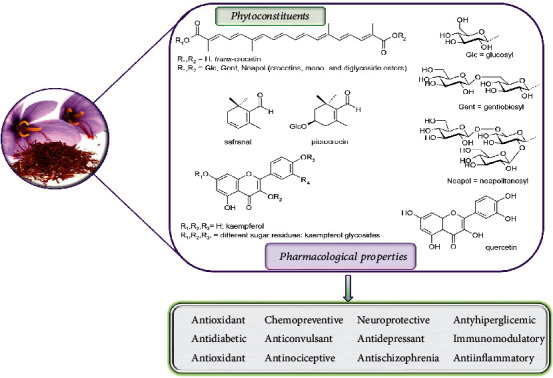
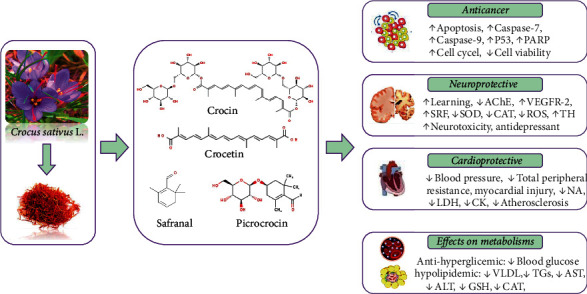
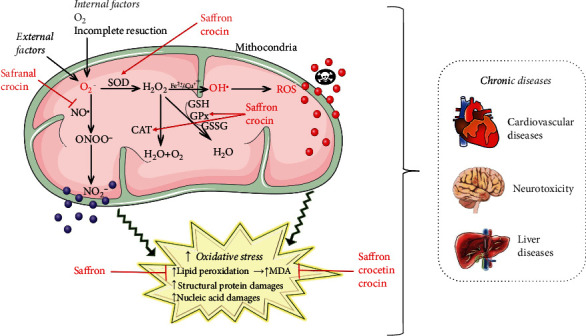
species are mainly distributed in North Africa, Southern and Central Europe, and Western Asia, used in gardens and parks as ornamental plants, while L. (saffron) is the only species that is cultivated for edible purpose. The use of saffron is very ancient; besides the use as a spice, saffron has long been known also for its medical and coloring qualities. Due to its distinctive flavor and color, it is used as a spice, which imparts food preservative activity owing to its antimicrobial and antioxidant activity. This updated review discusses the biological properties of L. and its phytoconstituents, their pharmacological activities, signaling pathways, and molecular targets, therefore highlighting it as a potential herbal medicine. Clinical studies regarding its pharmacologic potential in clinical therapeutics and toxicity studies were also reviewed. For this updated review, a search was performed in the PubMed, Science, and Google Scholar databases using keywords related to L. and the biological properties of its phytoconstituents. From this search, only the relevant works were selected. The phytochemistry of the most important bioactive compounds in L. such as crocin, crocetin, picrocrocin, and safranal and also dozens of other compounds was studied and identified by various physicochemical methods. Isolated compounds and various extracts have proven their pharmacological efficacy at the molecular level and signaling pathways both and . In addition, toxicity studies and clinical trials were analyzed. The research results highlighted the various pharmacological potentials such as antimicrobial, antioxidant, cytotoxic, cardioprotective, neuroprotective, antidepressant, hypolipidemic, and antihyperglycemic properties and protector of retinal lesions. Due to its antioxidant and antimicrobial properties, saffron has proven effective as a natural food preservative. Starting from the traditional uses for the treatment of several diseases, the bioactive compounds of L. have proven their effectiveness in modern pharmacological research. However, pharmacological studies are needed in the future to identify new mechanisms of action, pharmacokinetic studies, new pharmaceutical formulations for target transport, and possible interaction with allopathic drugs.
物种主要分布于北非、南欧和中欧、西亚,被用作花园和公园的观赏植物,而 L.(藏红花)是唯一一种用于食用目的的物种。藏红花的使用非常古老;除了用作香料外,藏红花因其药用和染色品质而久负盛名。由于其独特的风味和颜色,它被用作香料,由于其抗菌和抗氧化活性,赋予了食物防腐活性。这篇更新的综述讨论了 L.及其植物成分的生物学特性、它们的药理活性、信号通路和分子靶点,因此突出了它作为一种潜在的草药。还综述了关于其在临床治疗学中的药理潜力和毒性研究的临床研究。为了进行这次更新的综述,在 PubMed、Science 和 Google Scholar 数据库中使用与 L.及其植物成分的生物学特性相关的关键词进行了搜索。从这次搜索中,只选择了相关的作品。L. 中最重要的生物活性化合物,如藏红花酸、藏红花素、西红花苦素和藏红花醛,以及数十种其他化合物的植物化学已通过各种物理化学方法进行了研究和鉴定。分离的化合物和各种提取物已在分子水平和信号通路中证明了它们的药理功效,无论是 还是 。此外,还分析了毒性研究和临床试验。研究结果突出了各种药理学潜力,如抗菌、抗氧化、细胞毒性、心脏保护、神经保护、抗抑郁、降血脂和抗高血糖特性以及视网膜病变保护。由于其抗氧化和抗菌特性,藏红花已被证明是一种有效的天然食品防腐剂。从用于治疗几种疾病的传统用途开始,L. 的生物活性化合物已在现代药理学研究中证明了其有效性。然而,未来还需要进行药理学研究,以确定新的作用机制、药代动力学研究、针对目标运输的新药物制剂以及与对抗疗法药物的可能相互作用。