Pierre Valérie C, Wilharm Randall K
Department of Chemistry, University of Minnesota, Minneapolis, MN, United States.
Front Chem. 2022 Feb 7;10:821020. doi: 10.3389/fchem.2022.821020. eCollection 2022.
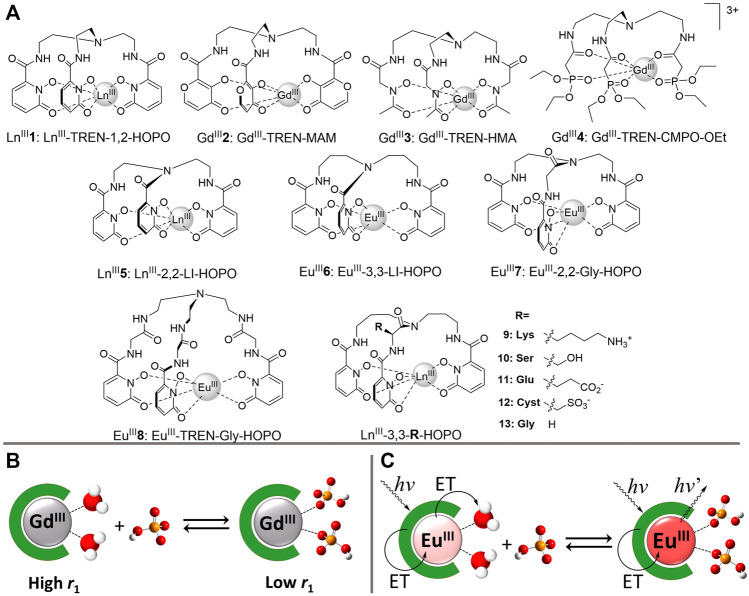
Phosphate is an anion of both environmental and medical significance. The increase in phosphate levels in surface waters due primarily to run-offs from fertilized agricultural fields causes widespread eutrophication and increasingly large dead-zones. Hyperphosphatemia, a condition in which blood phosphate levels are elevated, is a primary cause of increased mortality and morbidity in chronic or advanced kidney disease. Resolving both of these issues require, in part, new technology that could selectively sequester phosphate in water at neutral pH. The high hydration energy of phosphate, which prevents organic receptors from functioning in water with sufficient affinity, can be overcome via coordination to a hard metal ion. The hardness, oxophilicity and lability of lanthanide ions make them excellent candidates for the design of high affinity phosphate receptors. In this perspective, we discuss how the principles of lanthanide coordination chemistry can be exploited to design sensitive and selective receptors for phosphate. Unlike many supramolecular systems, these hosts do not recognize their anionic guests via directed electrostatic and hydrogen bonding interactions. Instead, the selectivity of our fluxional receptors is governed entirely by acid-base chemistry and electrostatic forces. Parameters that affect the affinity and selectivity of the receptors include the basicities of the coordinating ligand and of the targeted anion, the acidity of the lanthanide ion, and the geometry of the ligand. Uniquely, their affinity for phosphate can be readily tuned by orders of magnitude either by peripheral interactions or by the lanthanide ion itself without affecting their exquisite selectivity over competing anions such as bicarbonate and chloride.
磷酸盐是一种在环境和医学方面都具有重要意义的阴离子。地表水中磷酸盐水平的升高主要是由于施肥农田的径流所致,这会导致广泛的富营养化以及越来越大的死水区。高磷血症是一种血液中磷酸盐水平升高的病症,是慢性或晚期肾病患者死亡率和发病率增加的主要原因。要解决这两个问题,部分需要能够在中性pH值下选择性地螯合水中磷酸盐的新技术。磷酸盐的高水合能会阻止有机受体在水中以足够的亲和力发挥作用,而通过与硬金属离子配位可以克服这一问题。镧系离子的硬度、亲氧性和配位活性使其成为设计高亲和力磷酸盐受体的理想选择。从这个角度出发,我们讨论如何利用镧系配位化学原理来设计对磷酸盐敏感且选择性高的受体。与许多超分子体系不同,这些主体不是通过定向静电和氢键相互作用来识别其阴离子客体的。相反,我们的动态受体的选择性完全由酸碱化学和静电力决定。影响受体亲和力和选择性的参数包括配位配体和目标阴离子的碱性、镧系离子的酸度以及配体的几何形状。独特的是,它们对磷酸盐的亲和力可以通过外围相互作用或镧系离子本身轻松调整几个数量级,而不会影响它们对碳酸氢根和氯离子等竞争性阴离子的高选择性。