Cadour Farah, Thuny Franck, Sourdon Joevin
Aix-Marseille Université, CNRS, CRMBM, Marseille, France.
APHM, Hôpital Universitaire Timone, CEMEREM, Marseille, France.
Front Cardiovasc Med. 2022 Feb 7;9:813883. doi: 10.3389/fcvm.2022.813883. eCollection 2022.
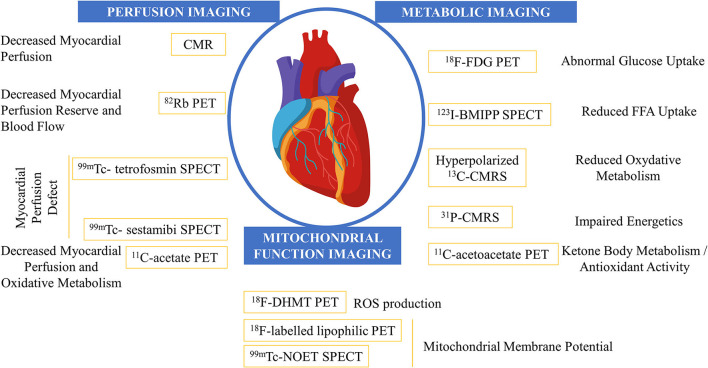
Cardio-oncology requires a good knowledge of the cardiotoxicity of anticancer drugs, their mechanisms, and their diagnosis for better management. Anthracyclines, anti-vascular endothelial growth factor (VEGF), alkylating agents, antimetabolites, anti-human epidermal growth factor receptor (HER), and receptor tyrosine kinase inhibitors (RTKi) are therapeutics whose cardiotoxicity involves several mechanisms at the cellular and subcellular levels. Current guidelines for anticancer drugs cardiotoxicity are essentially based on monitoring left ventricle ejection fraction (LVEF). However, knowledge of microvascular and metabolic dysfunction allows for better imaging assessment before overt LVEF impairment. Early detection of anticancer drug-related cardiotoxicity would therefore advance the prevention and patient care. In this review, we provide a comprehensive overview of the cardiotoxic effects of anticancer drugs and describe myocardial perfusion, metabolic, and mitochondrial function imaging approaches to detect them before over LVEF impairment.
心脏肿瘤学需要对抗癌药物的心脏毒性、其机制及其诊断有充分的了解,以便更好地进行管理。蒽环类药物、抗血管内皮生长因子(VEGF)、烷化剂、抗代谢物、抗人表皮生长因子受体(HER)和受体酪氨酸激酶抑制剂(RTKi)等治疗药物,其心脏毒性在细胞和亚细胞水平涉及多种机制。目前关于抗癌药物心脏毒性的指南主要基于监测左心室射血分数(LVEF)。然而,了解微血管和代谢功能障碍有助于在LVEF明显受损之前进行更好的成像评估。因此,早期发现抗癌药物相关的心脏毒性将推动预防工作和患者护理。在本综述中,我们全面概述了抗癌药物的心脏毒性作用,并描述了在LVEF受损之前检测这些毒性的心肌灌注、代谢和线粒体功能成像方法。