Department of Pediatrics, Amalia Childrens Hospital, Radboud University Medical Center, Nijmegen, The Netherlands.
Department of Laboratory Medicine, Radboud Institute for Molecular Life Sciences (RIMLS), Radboud University Medical Center, Nijmegen, The Netherlands.
Rev Endocr Metab Disord. 2022 Jun;23(3):631-645. doi: 10.1007/s11154-022-09717-w. Epub 2022 Feb 23.
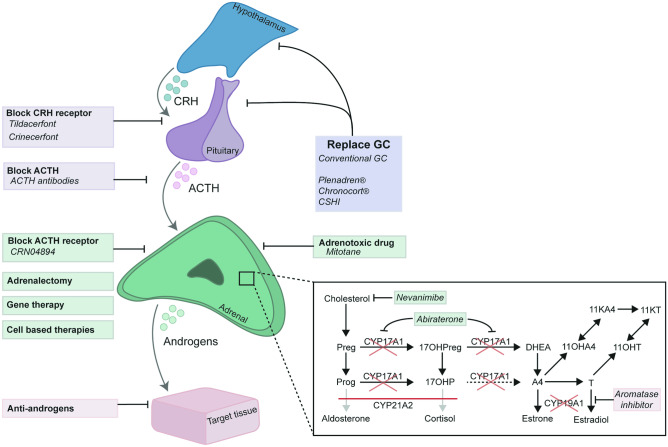
Patients with classic congenital adrenal hyperplasia due to 21-hydroxylase deficiency (21OHD) need life-long medical treatment to replace the lacking glucocorticoids and potentially lacking mineralocorticoids and to lower elevated adrenal androgens. Long-term complications are common, including gonadal dysfunction, infertility, and cardiovascular and metabolic co-morbidity with reduced quality of life. These complications can be attributed to the exposure of supraphysiological dosages of glucocorticoids and the longstanding exposure to elevated adrenal androgens. Development of novel therapies is necessary to address the chronic glucocorticoid overexposure, lack of circadian rhythm in glucocorticoid replacement, and inefficient glucocorticoid delivery with concomitant periods of hyperandrogenism. In this review we aim to give an overview about the current treatment regimens and its limitations and describe novel therapies especially evaluated for 21OHD patients.
由于 21-羟化酶缺乏症(21OHD)导致的经典先天性肾上腺皮质增生症患者需要终身接受医疗治疗以替代缺乏的糖皮质激素和潜在缺乏的盐皮质激素,并降低升高的肾上腺雄激素。长期并发症很常见,包括性腺功能障碍、不育以及心血管和代谢合并症,降低了生活质量。这些并发症可能归因于超生理剂量的糖皮质激素暴露和长期暴露于升高的肾上腺雄激素。需要开发新的治疗方法来解决慢性糖皮质激素过度暴露、糖皮质激素替代缺乏昼夜节律以及糖皮质激素输送效率低下伴高雄激素血症的问题。在这篇综述中,我们旨在概述当前的治疗方案及其局限性,并描述专门针对 21OHD 患者评估的新疗法。