Biometrix Technology, Inc., 2-2 Bio Venture Plaza 56, Chuncheon 24232, Korea.
Institute of Applied Chemistry and Department of Chemistry, Hallym University, Chuncheon 200702, Korea.
Biosensors (Basel). 2022 Feb 16;12(2):127. doi: 10.3390/bios12020127.
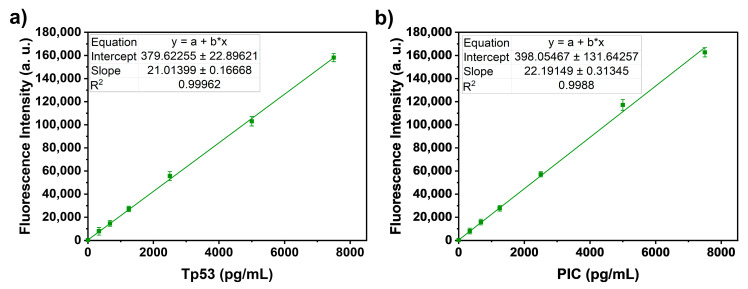
Lung cancer is a leading cause of death worldwide, claiming nearly 1.80 million lives in 2020. Screening with low-dose computed tomography (LDCT) reduces lung cancer mortality by about 20% compared to standard chest X-rays among current or heavy smokers. However, several reports indicate that LDCT has a high false-positive rate. In this regard, methods based on biomarker detection offer excellent potential for developing noninvasive cancer diagnostic tests to complement LDCT for detecting stage 0∼IV lung cancers. Herein, we have developed a method for detecting and quantifying a p53-anti-p53 autoantibody complex and the total p53 antigen (wild and mutant). The LOD for detecting Tp53 and PIC were 7.41 pg/mL and 5.74 pg/mL, respectively. The detection ranges for both biomarkers were 0-7500 pg/mL. The known interfering agents in immunoassays such as biotin, bilirubin, intra-lipid, and hemoglobin did not detect Tp53 and PIC, even at levels that were several folds higher levels than their normal levels. Furthermore, the present study provides a unique report on this preliminary investigation using the PIC/Tp53 ratio to detect stage I-IV lung cancers. The presented method detects lung cancers with 81.6% sensitivity and 93.3% specificity. These results indicate that the presented method has high applicability for the identification of lung cancer patients from the healthy population.
肺癌是全球主要的死亡原因之一,2020 年导致近 180 万人死亡。与标准胸部 X 射线相比,低剂量计算机断层扫描 (LDCT) 筛查可使当前或重度吸烟者的肺癌死亡率降低约 20%。然而,有几项报告表明 LDCT 的假阳性率很高。在这方面,基于生物标志物检测的方法为开发非侵入性癌症诊断测试提供了极好的潜力,以补充 LDCT 检测 0∼IV 期肺癌。在此,我们开发了一种检测和定量 p53-抗 p53 自身抗体复合物和总 p53 抗原(野生型和突变型)的方法。检测 Tp53 和 PIC 的 LOD 分别为 7.41pg/mL 和 5.74pg/mL。两种生物标志物的检测范围均为 0-7500pg/mL。免疫测定中的已知干扰剂,如生物素、胆红素、内脂质和血红蛋白,即使在比其正常水平高几倍的水平,也无法检测到 Tp53 和 PIC。此外,本研究使用 PIC/Tp53 比值初步调查提供了关于这种独特的报告,用于检测 I-IV 期肺癌。所提出的方法对肺癌的检测灵敏度为 81.6%,特异性为 93.3%。这些结果表明,所提出的方法在从健康人群中识别肺癌患者方面具有很高的适用性。