• 文献检索
  • 文档翻译
  • 深度研究
  • 学术资讯
  • Suppr Zotero 插件Zotero 插件
  • 邀请有礼
  • 套餐&价格
  • 历史记录
应用&插件
Suppr Zotero 插件Zotero 插件浏览器插件Mac 客户端Windows 客户端微信小程序
定价
高级版会员购买积分包购买API积分包
服务
文献检索文档翻译深度研究API 文档MCP 服务
关于我们
关于 Suppr公司介绍联系我们用户协议隐私条款
关注我们

Suppr 超能文献

核心技术专利:CN118964589B侵权必究
粤ICP备2023148730 号-1Suppr @ 2026

文献检索

告别复杂PubMed语法,用中文像聊天一样搜索,搜遍4000万医学文献。AI智能推荐,让科研检索更轻松。

立即免费搜索

文件翻译

保留排版,准确专业,支持PDF/Word/PPT等文件格式,支持 12+语言互译。

免费翻译文档

深度研究

AI帮你快速写综述,25分钟生成高质量综述,智能提取关键信息,辅助科研写作。

立即免费体验

upfront 肽受体放射性核素治疗与肠胰神经内分泌肿瘤患者无进展生存的关系。

Association of Upfront Peptide Receptor Radionuclide Therapy With Progression-Free Survival Among Patients With Enteropancreatic Neuroendocrine Tumors.

机构信息

Department of Medical Oncology, Fondazione IRCCS Istituto Nazionale dei Tumori di Milano, European Neuroendocrine Tumor Society (ENETS) Center of Excellence, Milan, Italy.

Oncologia Clinica e Sperimentale Sarcomi e Tumori Rari, Istituto Nazionale Tumori IRCCS, Fondazione G. Pascale, Naples, Italy.

出版信息

JAMA Netw Open. 2022 Feb 1;5(2):e220290. doi: 10.1001/jamanetworkopen.2022.0290.

DOI:10.1001/jamanetworkopen.2022.0290
PMID:35201309
原文链接:https://pmc.ncbi.nlm.nih.gov/articles/PMC8874344/
Abstract

IMPORTANCE

Data about the optimal timing for the initiation of peptide receptor radionuclide therapy (PRRT) for advanced, well-differentiated enteropancreatic neuroendocrine tumors are lacking.

OBJECTIVE

To evaluate the association of upfront PRRT vs upfront chemotherapy or targeted therapy with progression-free survival (PFS) among patients with advanced enteropancreatic neuroendocrine tumors who experienced disease progression after treatment with somatostatin analogues (SSAs).

DESIGN, SETTING, AND PARTICIPANTS: This retrospective, multicenter cohort study analyzed the clinical records from 25 Italian oncology centers for patients aged 18 years or older who had unresectable, locally advanced or metastatic, well-differentiated, grades 1 to 3 enteropancreatic neuroendocrine tumors and received either PRRT or chemotherapy or targeted therapy after experiencing disease progression after treatment with SSAs between January 24, 2000, and July 1, 2020. Propensity score matching was done to minimize the selection bias.

EXPOSURES

Upfront PRRT or upfront chemotherapy or targeted therapy.

MAIN OUTCOMES AND MEASURES

The main outcome was the difference in PFS among patients who received upfront PRRT vs among those who received upfront chemotherapy or targeted therapy. A secondary outcome was the difference in overall survival between these groups. Hazard ratios (HRs) were fitted in a multivariable Cox proportional hazards regression model to adjust for relevant factors associated with PFS and were corrected for interaction with these factors.

RESULTS

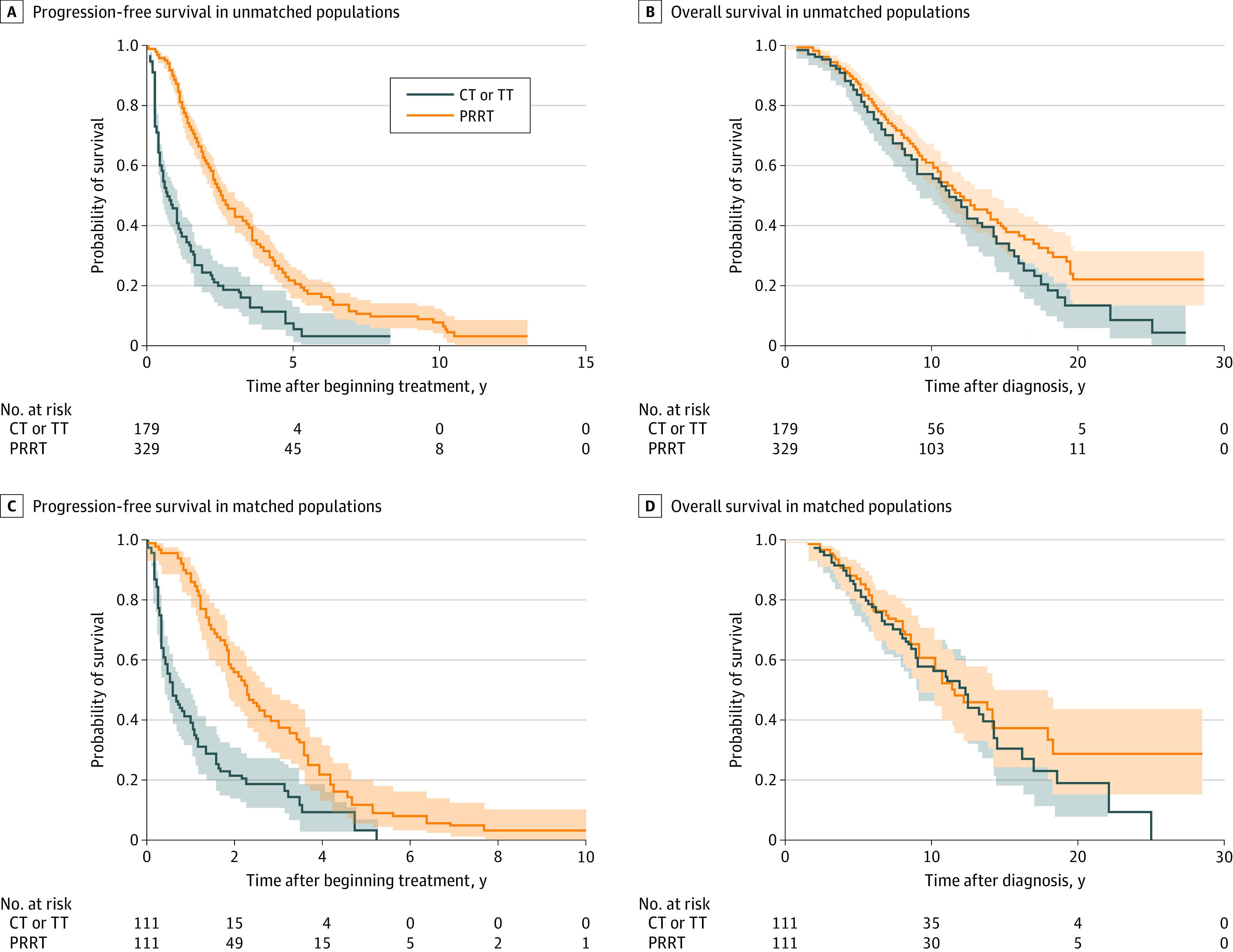
Of 508 evaluated patients (mean ([SD] age, 55.7 [0.5] years; 278 [54.7%] were male), 329 (64.8%) received upfront PRRT and 179 (35.2%) received upfront chemotherapy or targeted therapy. The matched group included 222 patients (124 [55.9%] male; mean [SD] age, 56.1 [0.8] years), with 111 in each treatment group. Median PFS was longer in the PRRT group than in the chemotherapy or targeted therapy group in the unmatched (2.5 years [95% CI, 2.3-3.0 years] vs 0.7 years [95% CI, 0.5-1.0 years]; HR, 0.35 [95% CI, 0.28-0.44; P < .001]) and matched (2.2 years [95% CI, 1.8-2.8 years] vs 0.6 years [95% CI, 0.4-1.0 years]; HR, 0.37 [95% CI, 0.27-0.51; P < .001]) populations. No significant differences were shown in median overall survival between the PRRT and chemotherapy or targeted therapy groups in the unmatched (12.0 years [95% CI, 10.7-14.1 years] vs 11.6 years [95% CI, 9.1-13.4 years]; HR, 0.81 [95% CI, 0.62-1.06; P = .11]) and matched (12.2 years [95% CI, 9.1-14.2 years] vs 11.5 years [95% CI, 9.2-17.9 years]; HR, 0.83 [95% CI, 0.56-1.24; P = .36]) populations. The use of upfront PRRT was independently associated with improved PFS (HR, 0.37; 95% CI, 0.26-0.51; P < .001) in multivariable analysis. After adjustment of values for interaction, upfront PRRT was associated with longer PFS regardless of tumor functional status (functioning: adjusted HR [aHR], 0.39 [95% CI, 0.27-0.57]; nonfunctioning: aHR, 0.29 [95% CI, 0.16-0.56]), grade of 1 to 2 (grade 1: aHR, 0.21 [95% CI, 0.12-0.34]; grade 2: aHR, 0.52 [95% CI, 0.29-0.73]), and site of tumor origin (pancreatic: aHR, 0.41 [95% CI, 0.24-0.61]; intestinal: aHR, 0.19 [95% CI, 0.11-0.43]) (P < .001 for all). Conversely, the advantage was not retained in grade 3 tumors (aHR, 0.31; 95% CI, 0.12-1.37; P = .13) or in tumors with a Ki-67 proliferation index greater than 10% (aHR, 0.73; 95% CI, 0.29-1.43; P = .31).

CONCLUSIONS AND RELEVANCE

In this cohort study, treatment with upfront PRRT in patients with enteropancreatic neuroendocrine tumors who had experienced disease progression with SSA treatment was associated with significantly improved survival outcomes compared with upfront chemotherapy or targeted therapy. Further research is needed to investigate the correct strategy, timing, and optimal specific sequence of these therapeutic options.

摘要

重要性:缺乏关于肽受体放射性核素疗法 (PRRT) 在晚期、分化良好的肠胰神经内分泌肿瘤患者中的最佳起始时间的数据,这些患者在接受生长抑素类似物 (SSA) 治疗后疾病进展。

目的:评估在接受 SSA 治疗后疾病进展的晚期肠胰神经内分泌肿瘤患者中,与 upfront 化疗或靶向治疗相比, upfront PRRT 与无进展生存期 (PFS) 的相关性。

设计、地点和参与者:这项回顾性、多中心队列研究分析了来自 25 家意大利肿瘤中心的临床记录,这些患者年龄在 18 岁及以上,患有不可切除的局部晚期或转移性、分化良好、1 至 3 级的肠胰神经内分泌肿瘤,在接受 SSA 治疗后疾病进展,随后接受 PRRT 或化疗或靶向治疗。采用倾向性评分匹配来尽量减少选择偏倚。

暴露: upfront PRRT 或 upfront 化疗或靶向治疗。

主要结果和测量:主要结局是接受 upfront PRRT 的患者与接受 upfront 化疗或靶向治疗的患者之间的 PFS 差异。次要结局是这些组之间总生存期的差异。多变量 Cox 比例风险回归模型拟合了风险比 (HR),以调整与 PFS 相关的相关因素,并对与这些因素的交互作用进行了校正。

结果:在 508 例评估患者中(平均[SD]年龄 55.7[0.5]岁;278[54.7%]为男性),329 例(64.8%)接受 upfront PRRT,179 例(35.2%)接受 upfront 化疗或靶向治疗。匹配组包括 222 例患者(124[55.9%]为男性;平均[SD]年龄 56.1[0.8]岁),每组各有 111 例。未匹配组中 PRRT 组的中位 PFS 长于化疗或靶向治疗组(2.5 年[95%CI,2.3-3.0 年] vs 0.7 年[95%CI,0.5-1.0 年];HR,0.35[95%CI,0.28-0.44;P<0.001])和匹配组(2.2 年[95%CI,1.8-2.8 年] vs 0.6 年[95%CI,0.4-1.0 年];HR,0.37[95%CI,0.27-0.51;P<0.001])。在未匹配组(12.0 年[95%CI,10.7-14.1 年] vs 11.6 年[95%CI,9.1-13.4 年];HR,0.81[95%CI,0.62-1.06;P=0.11])和匹配组(12.2 年[95%CI,9.1-14.2 年] vs 11.5 年[95%CI,9.2-17.9 年];HR,0.83[95%CI,0.56-1.24;P=0.36])中,PRRT 组与化疗或靶向治疗组之间的中位总生存期无显著差异。多变量分析显示, upfront PRRT 与改善的 PFS 独立相关(HR,0.37;95%CI,0.26-0.51;P<0.001)。调整交互作用的值后,无论肿瘤功能状态如何(功能性:调整后的 HR[aHR],0.39[95%CI,0.27-0.57];非功能性:aHR,0.29[95%CI,0.16-0.56])、分级为 1 至 2 级(分级 1:aHR,0.21[95%CI,0.12-0.34];分级 2:aHR,0.52[95%CI,0.29-0.73])和肿瘤起源部位(胰腺:aHR,0.41[95%CI,0.24-0.61];肠:aHR,0.19[95%CI,0.11-0.43])(所有 P<0.001), upfront PRRT 都与更长的 PFS 相关。然而,在 3 级肿瘤(aHR,0.31;95%CI,0.12-1.37;P=0.13)或 Ki-67 增殖指数大于 10%的肿瘤(aHR,0.73;95%CI,0.29-1.43;P=0.31)中,这种优势并未保留。

结论和相关性:在这项队列研究中,与 upfront 化疗或靶向治疗相比,在接受 SSA 治疗后疾病进展的肠胰神经内分泌肿瘤患者中使用 upfront PRRT 治疗与显著改善的生存结果相关。需要进一步研究以调查这些治疗选择的正确策略、时机和最佳特定顺序。
https://cdn.ncbi.nlm.nih.gov/pmc/blobs/77b3/8874344/e1ad257ebdd6/jamanetwopen-e220290-g001.jpg

相似文献

1
Association of Upfront Peptide Receptor Radionuclide Therapy With Progression-Free Survival Among Patients With Enteropancreatic Neuroendocrine Tumors. upfront 肽受体放射性核素治疗与肠胰神经内分泌肿瘤患者无进展生存的关系。
JAMA Netw Open. 2022 Feb 1;5(2):e220290. doi: 10.1001/jamanetworkopen.2022.0290.
2
Laboratory, Clinical, and Survival Outcomes Associated With Peptide Receptor Radionuclide Therapy in Patients With Gastroenteropancreatic Neuroendocrine Tumors.与胃肠胰神经内分泌肿瘤患者的肽受体放射性核素治疗相关的实验室、临床和生存结果。
JAMA Netw Open. 2021 Mar 1;4(3):e212274. doi: 10.1001/jamanetworkopen.2021.2274.
3
Peptide receptor radionuclide therapy in gastroenteropancreatic NEN G3: a multicenter cohort study.胃肠胰神经内分泌瘤 G3 患者的肽受体放射性核素治疗:一项多中心队列研究。
Endocr Relat Cancer. 2019 Feb 1;26(2):227-239. doi: 10.1530/ERC-18-0424.
4
External Validation of a Clinical Score for Patients With Neuroendocrine Tumors Under Consideration for Peptide Receptor Radionuclide Therapy.神经内分泌肿瘤患者行肽受体放射性核素治疗的临床评分的外部验证。
JAMA Netw Open. 2022 Jan 4;5(1):e2144170. doi: 10.1001/jamanetworkopen.2021.44170.
5
The Role of Adding Somatostatin Analogues to Peptide Receptor Radionuclide Therapy as a Combination and Maintenance Therapy.添加生长抑素类似物作为联合和维持治疗在肽受体放射性核素治疗中的作用。
Clin Cancer Res. 2018 Oct 1;24(19):4672-4679. doi: 10.1158/1078-0432.CCR-18-0947. Epub 2018 Jun 27.
6
Predictors of long-term outcome in patients with well-differentiated gastroenteropancreatic neuroendocrine tumors after peptide receptor radionuclide therapy with 177Lu-octreotate.177Lu-奥曲肽肽受体放射性核素治疗后高分化胃肠胰神经内分泌肿瘤患者长期预后的预测因素
J Nucl Med. 2014 Feb;55(2):183-90. doi: 10.2967/jnumed.113.125336. Epub 2014 Jan 16.
7
In patients with well-differentiated neuroendocrine tumours, there is no apparent benefit of somatostatin analogues after disease control by peptide receptor radionuclide therapy.对于分化良好的神经内分泌肿瘤患者,在用肽受体放射性核素治疗控制疾病后,生长抑素类似物似乎没有明显获益。
Eur J Nucl Med Mol Imaging. 2022 Sep;49(11):3841-3851. doi: 10.1007/s00259-022-05792-y. Epub 2022 May 3.
8
Resection of the Primary Tumor Followed by Peptide Receptor Radionuclide Therapy as Upfront Strategy for the Treatment of G1-G2 Pancreatic Neuroendocrine Tumors with Unresectable Liver Metastases.对于伴有不可切除肝转移的G1-G2胰腺神经内分泌肿瘤,先行原发性肿瘤切除,随后进行肽受体放射性核素治疗作为一线治疗策略
Ann Surg Oncol. 2016 Dec;23(Suppl 5):981-989. doi: 10.1245/s10434-016-5550-3. Epub 2016 Sep 9.
9
Peptide receptor radionuclide therapy (PRRT) in European Neuroendocrine Tumour Society (ENETS) grade 3 (G3) neuroendocrine neoplasia (NEN) - a single-institution retrospective analysis.欧洲神经内分泌肿瘤学会(ENETS)分级 3(G3)神经内分泌肿瘤(NEN)中的肽受体放射性核素治疗(PRRT)-单机构回顾性分析。
Eur J Nucl Med Mol Imaging. 2018 Feb;45(2):262-277. doi: 10.1007/s00259-017-3821-2. Epub 2017 Sep 12.
10
Capecitabine-Temozolomide in Advanced Grade 2 and Grade 3 Neuroendocrine Neoplasms: Benefits of Chemotherapy in Neuroendocrine Neoplasms with Significant 18FDG Uptake.卡培他滨-替莫唑胺治疗高级别 2 级和 3 级神经内分泌肿瘤:具有显著 18FDG 摄取的神经内分泌肿瘤化疗获益。
Neuroendocrinology. 2021;111(10):998-1004. doi: 10.1159/000511987. Epub 2020 Oct 5.

引用本文的文献

1
Comparisons of treatment performance and therapy sequences in neuroendocrine neoplasms using progression-free survival ratios.使用无进展生存率比较神经内分泌肿瘤的治疗效果和治疗顺序。
Eur J Nucl Med Mol Imaging. 2025 Jun 21. doi: 10.1007/s00259-025-07411-y.
2
Treatment of Pancreatic Neuroendocrine Tumors: Beyond Traditional Surgery and Targeted Therapy.胰腺神经内分泌肿瘤的治疗:超越传统手术和靶向治疗
J Clin Med. 2025 May 13;14(10):3389. doi: 10.3390/jcm14103389.
3
Efficacy and Safety of Peptide Receptor Radionuclide Therapy for the Treatment of Pancreatic Neuroendocrine Tumors: A Systematic Review and Meta-Analysis of Comparative Studies.

本文引用的文献

1
Neuroendocrine and Adrenal Tumors, Version 2.2021, NCCN Clinical Practice Guidelines in Oncology.神经内分泌和肾上腺肿瘤,第2.2021版,美国国立综合癌症网络(NCCN)肿瘤学临床实践指南
J Natl Compr Canc Netw. 2021 Jul 28;19(7):839-868. doi: 10.6004/jnccn.2021.0032.
2
Gastroenteropancreatic neuroendocrine neoplasms: ESMO Clinical Practice Guidelines for diagnosis, treatment and follow-up.胃肠胰神经内分泌肿瘤:ESMO诊断、治疗及随访临床实践指南
Ann Oncol. 2020 Jul;31(7):844-860. doi: 10.1016/j.annonc.2020.03.304. Epub 2020 Apr 6.
3
NANETS/SNMMI Consensus Statement on Patient Selection and Appropriate Use of Lu-DOTATATE Peptide Receptor Radionuclide Therapy.
肽受体放射性核素治疗胰腺神经内分泌肿瘤的疗效与安全性:比较研究的系统评价与荟萃分析
Cureus. 2025 Mar 19;17(3):e80817. doi: 10.7759/cureus.80817. eCollection 2025 Mar.
4
Everolimus in the Treatment of Neuroendocrine Tumors: Lights and Shadows.依维莫司治疗神经内分泌肿瘤:亮点与阴影
Biomedicines. 2025 Feb 12;13(2):455. doi: 10.3390/biomedicines13020455.
5
Octreotide plus IBI-318 plus anlotinib in the treatment of multiple neuroendocrine metastases of unknown primary lesions: a case report.奥曲肽联合IBI-318及安罗替尼治疗原发灶不明的多发神经内分泌转移瘤:病例报告
Front Oncol. 2024 Dec 11;14:1390299. doi: 10.3389/fonc.2024.1390299. eCollection 2024.
6
Radiomics in advanced gastroenteropancreatic neuroendocrine neoplasms: Identifying responders to somatostatin analogs.晚期胃肠胰神经内分泌肿瘤的影像组学:识别对生长抑素类似物有反应者
J Neuroendocrinol. 2025 Jan;37(1):e13472. doi: 10.1111/jne.13472. Epub 2024 Nov 20.
7
Current status of peptide receptor radionuclide therapy in grade 1 and 2 gastroenteropancreatic neuroendocrine tumours.1级和2级胃肠胰神经内分泌肿瘤的肽受体放射性核素治疗现状
J Neuroendocrinol. 2025 Mar;37(3):e13469. doi: 10.1111/jne.13469. Epub 2024 Nov 20.
8
Peptide Receptor Radionuclide Therapy Improves Survival in Patients Who Progress After Resection of Gastroenteropancreatic Neuroendocrine Tumors.肽受体放射性核素治疗可改善胃肠胰神经内分泌肿瘤切除术后进展患者的生存率。
Ann Surg Oncol. 2025 Feb;32(2):1136-1148. doi: 10.1245/s10434-024-16463-7. Epub 2024 Nov 6.
9
Peptide Receptor Radionuclide Therapy and clinical associations with renal and hematological toxicities and survival in patients with neuroendocrine tumors: an analysis from two U.S. medical centers.肽受体放射性核素治疗与肾和血液学毒性及神经内分泌肿瘤患者生存的临床关联:来自美国两个医疗中心的分析。
J Cancer Res Clin Oncol. 2024 Nov 2;150(11):485. doi: 10.1007/s00432-024-06020-w.
10
Gastroenteropancreatic neuroendocrine neoplasms: epidemiology, genetics, and treatment.胃肠胰神经内分泌肿瘤:流行病学、遗传学和治疗。
Front Endocrinol (Lausanne). 2024 Sep 30;15:1424839. doi: 10.3389/fendo.2024.1424839. eCollection 2024.
NANETS/SNMMI关于Lu- DOTATATE肽受体放射性核素治疗患者选择和合理使用的共识声明。
J Nucl Med. 2020 Feb;61(2):222-227. doi: 10.2967/jnumed.119.240911.
4
Trends in the Incidence, Prevalence, and Survival Outcomes in Patients With Neuroendocrine Tumors in the United States.美国神经内分泌肿瘤患者的发病率、患病率和生存结局趋势。
JAMA Oncol. 2017 Oct 1;3(10):1335-1342. doi: 10.1001/jamaoncol.2017.0589.
5
ENETS Consensus Guidelines for the Standards of Care in Neuroendocrine Neoplasia: Peptide Receptor Radionuclide Therapy with Radiolabeled Somatostatin Analogues.ENETS神经内分泌肿瘤护理标准共识指南:放射性标记生长抑素类似物的肽受体放射性核素治疗
Neuroendocrinology. 2017;105(3):295-309. doi: 10.1159/000475526. Epub 2017 Apr 13.
6
ENETS Consensus Guidelines for the Standards of Care in Neuroendocrine Neoplasms. Systemic Therapy 2: Chemotherapy.神经内分泌肿瘤治疗标准的ENETS共识指南。全身治疗2:化疗。
Neuroendocrinology. 2017;105(3):281-294. doi: 10.1159/000473892. Epub 2017 Apr 5.
7
ENETS Consensus Guidelines for the Standards of Care in Neuroendocrine Neoplasms: Systemic Therapy - Biotherapy and Novel Targeted Agents.神经内分泌肿瘤治疗标准的ENETS共识指南:全身治疗——生物治疗与新型靶向药物
Neuroendocrinology. 2017;105(3):266-280. doi: 10.1159/000471880. Epub 2017 Mar 29.
8
Phase 3 Trial of Lu-Dotatate for Midgut Neuroendocrine Tumors.镥[177Lu]奥曲肽治疗中肠神经内分泌肿瘤的3期试验
N Engl J Med. 2017 Jan 12;376(2):125-135. doi: 10.1056/NEJMoa1607427.
9
Everolimus for the treatment of advanced, non-functional neuroendocrine tumours of the lung or gastrointestinal tract (RADIANT-4): a randomised, placebo-controlled, phase 3 study.依维莫司治疗晚期肺或胃肠道无功能性神经内分泌肿瘤(RADIANT-4):一项随机、安慰剂对照的3期研究。
Lancet. 2016 Mar 5;387(10022):968-977. doi: 10.1016/S0140-6736(15)00817-X. Epub 2015 Dec 17.
10
Exploring the rising incidence of neuroendocrine tumors: a population-based analysis of epidemiology, metastatic presentation, and outcomes.探讨神经内分泌肿瘤发病率的上升:基于人群的流行病学、转移表现和结局分析。
Cancer. 2015 Feb 15;121(4):589-97. doi: 10.1002/cncr.29099. Epub 2014 Oct 13.