Nopp Stephan, Moik Florian, Klok Frederikus A, Gattinger Dietlinde, Petrovic Milos, Vonbank Karin, Koczulla Andreas R, Ay Cihan, Zwick Ralf Harun
Clinical Division of Haematology and Haemostaseology, Department of Medicine I, Medical University of Vienna, Vienna, Austria.
Department of Medicine - Thrombosis and Hemostasis, Leiden University Medical Center, Leiden, The Netherlands.
Respiration. 2022;101(6):593-601. doi: 10.1159/000522118. Epub 2022 Feb 24.
COVID-19 survivors face the risk of long-term sequelae including fatigue, breathlessness, and functional limitations. Pulmonary rehabilitation has been recommended, although formal studies quantifying the effect of rehabilitation in COVID-19 patients are lacking.
We conducted a prospective observational cohort study including consecutive patients admitted to an outpatient pulmonary rehabilitation center due to persistent symptoms after COVID-19. The primary endpoint was change in 6-min walk distance (6MWD) after undergoing a 6-week interdisciplinary individualized pulmonary rehabilitation program. Secondary endpoints included change in the post-COVID-19 functional status (PCFS) scale, Borg dyspnea scale, Fatigue Assessment Scale, and quality of life. Further, changes in pulmonary function tests were explored.
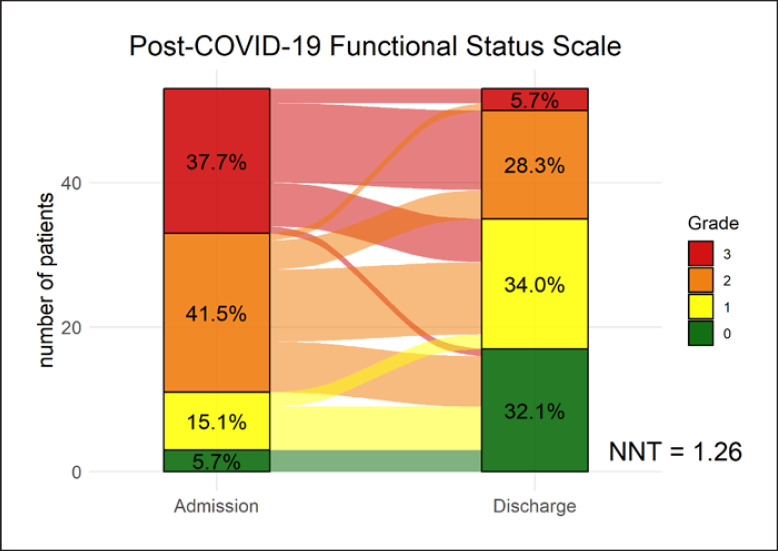
Of 64 patients undergoing rehabilitation, 58 patients (mean age 47 years, 43% women, 38% severe/critical COVID-19) were included in the per-protocol-analysis. At baseline (i.e., in mean 4.4 months after infection onset), mean 6MWD was 584.1 m (±95.0), and functional impairment was graded in median at 2 (IQR, 2-3) on the PCFS. On average, patients improved their 6MWD by 62.9 m (±48.2, p < 0.001) and reported an improvement of 1 grade on the PCFS scale. Accordingly, we observed significant improvements across secondary endpoints including presence of dyspnea (p < 0.001), fatigue (p < 0.001), and quality of life (p < 0.001). Also, pulmonary function parameters (forced expiratory volume in 1 s, lung diffusion capacity, inspiratory muscle pressure) significantly increased during rehabilitation.
In patients with long COVID, exercise capacity, functional status, dyspnea, fatigue, and quality of life improved after 6 weeks of personalized interdisciplinary pulmonary rehabilitation. Future studies are needed to establish the optimal protocol, duration, and long-term benefits as well as cost-effectiveness of rehabilitation.
新冠病毒病(COVID-19)幸存者面临长期后遗症风险,包括疲劳、呼吸急促和功能受限。尽管缺乏量化康复对COVID-19患者疗效的正式研究,但仍推荐进行肺康复治疗。
我们开展了一项前瞻性观察性队列研究,纳入因COVID-19后持续症状而入住门诊肺康复中心的连续患者。主要终点是接受为期6周的跨学科个体化肺康复计划后6分钟步行距离(6MWD)的变化。次要终点包括COVID-19后功能状态(PCFS)量表、博格呼吸困难量表、疲劳评估量表和生活质量的变化。此外,还探讨了肺功能测试的变化。
在64例接受康复治疗的患者中,58例患者(平均年龄47岁,43%为女性,38%为重症/危重症COVID-19患者)纳入符合方案分析。在基线时(即感染发病后平均4.4个月),平均6MWD为584.1米(±95.0),PCFS上功能障碍的中位数评分为2(四分位间距,2 - 3)。平均而言,患者的6MWD增加了62.9米(±48.2,p < 0.001),PCFS量表上报告改善了1级。相应地,我们观察到次要终点包括呼吸困难(p < 0.001)、疲劳(p < 0.001)和生活质量(p < 0.001)均有显著改善。此外,肺功能参数(第1秒用力呼气量、肺扩散容量、吸气肌压力)在康复期间显著增加。
在患有“长新冠”的患者中,经过6周的个性化跨学科肺康复后,运动能力、功能状态、呼吸困难、疲劳和生活质量均有所改善。需要进一步研究以确定最佳方案、持续时间、长期益处以及康复的成本效益。