Zhao Chun-Lin, Zhao Tian, Feng Jian-Yi, Chang Li-Ming, Zheng Pu-Yang, Fu Shi-Jian, Li Xiu-Ming, Yue Bi-Song, Jiang Jian-Ping, Zhu Wei
Key Laboratory of Bioresources and Ecoenvironment (Ministry of Education), College of Life Sciences, Sichuan University, Chengdu 610064, China.
CAS Key Laboratory of Mountain Ecological Restoration and Bioresource Utilization & Ecological Restoration Biodiversity Conservation Key Laboratory of Sichuan Province, Chengdu Institute of Biology, Chengdu 610041, China.
Animals (Basel). 2022 Feb 21;12(4):531. doi: 10.3390/ani12040531.
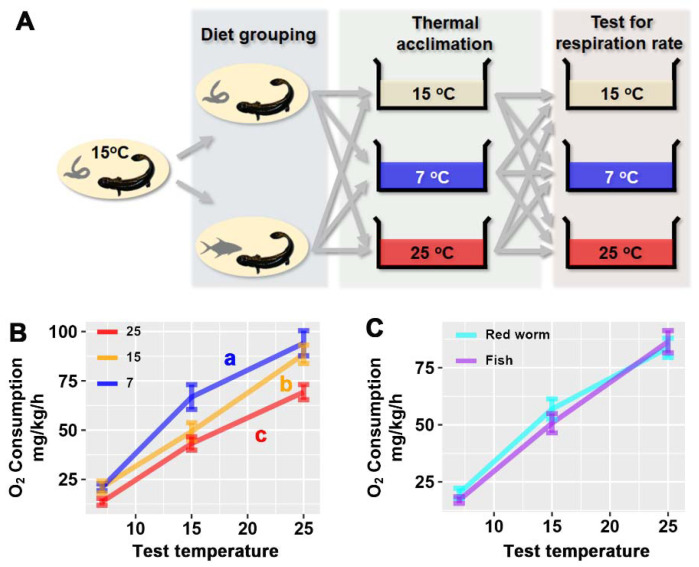
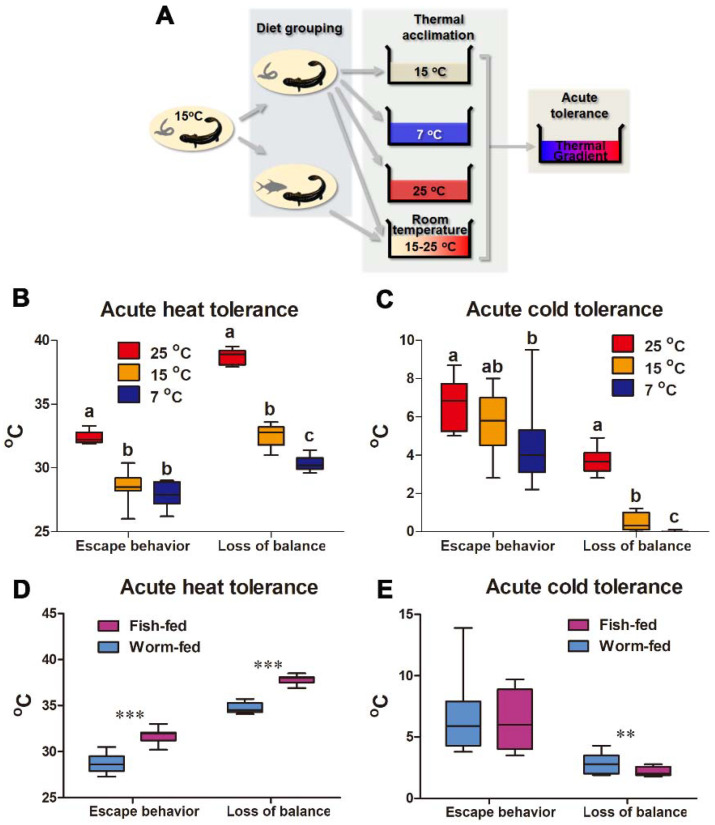
The Chinese giant salamander (), one of the largest extant amphibian species, has dramatically declined in the wild. As an ectotherm, it may be further threatened by climate change. Therefore, understanding the thermal physiology of this species should be the priority to formulate related conservation strategies. In this study, the plasticity in metabolic rate and thermal tolerance limits of larvae were studied. Specifically, the larvae were acclimated to three temperature levels (7 °C, cold stress; 15 °C, optimum; and 25 °C, heat stress) and two diet items (red worm or fish fray) for 20 days. Our results indicated that cold-acclimated larvae showed increased metabolic capacity, while warm-acclimated larvae showed a decrease in metabolic capacity. These results suggested the existence of thermal compensation. Moreover, the thermal tolerance windows of cold-acclimated and warm-acclimated larvae shifted to cooler and hotter ranges, respectively. Metabolic capacity is not affected by diet but fish-fed larvae showed superiority in both cold and heat tolerance, potentially due to the input of greater nutrient loads. Overall, our results suggested a plastic thermal tolerance of in response to temperature and diet variations. These results are meaningful in guiding the conservation of this species.
中国大鲵是现存最大的两栖动物物种之一,其在野外数量已大幅减少。作为变温动物,它可能会受到气候变化的进一步威胁。因此,了解该物种的热生理学应是制定相关保护策略的首要任务。在本研究中,对中国大鲵幼体的代谢率可塑性和热耐受极限进行了研究。具体而言,将幼体分别适应三种温度水平(7℃,冷应激;15℃,最适温度;25℃,热应激)和两种食物(红线虫或碎鱼肉),持续20天。我们的结果表明,冷适应幼体的代谢能力增强,而热适应幼体的代谢能力下降。这些结果表明存在热补偿现象。此外,冷适应和热适应幼体的热耐受窗口分别向较冷和较热的范围移动。代谢能力不受食物影响,但喂食鱼肉的幼体在耐寒和耐热方面均表现出优势,这可能是由于摄入了更多的营养物质。总体而言,我们的结果表明中国大鲵幼体对温度和食物变化具有可塑性的热耐受性。这些结果对指导该物种的保护具有重要意义。