Belvisi Daniele, Tartaglia Matteo, Borriello Giovanna, Baione Viola, Crisafulli Sebastiano Giuseppe, Zuccoli Valeria, Leodori Giorgio, Ianniello Antonio, Pasqua Gabriele, Pantano Patrizia, Berardelli Alfredo, Pozzilli Carlo, Conte Antonella
Department of Human Neurosciences, Sapienza University of Rome, 00185 Rome, Italy.
Istituto di Ricerca e Cura a Carattere Scientifico (IRCCS) Neuromed, 86077 Pozzilli, Italy.
Biomedicines. 2022 Jan 21;10(2):231. doi: 10.3390/biomedicines10020231.
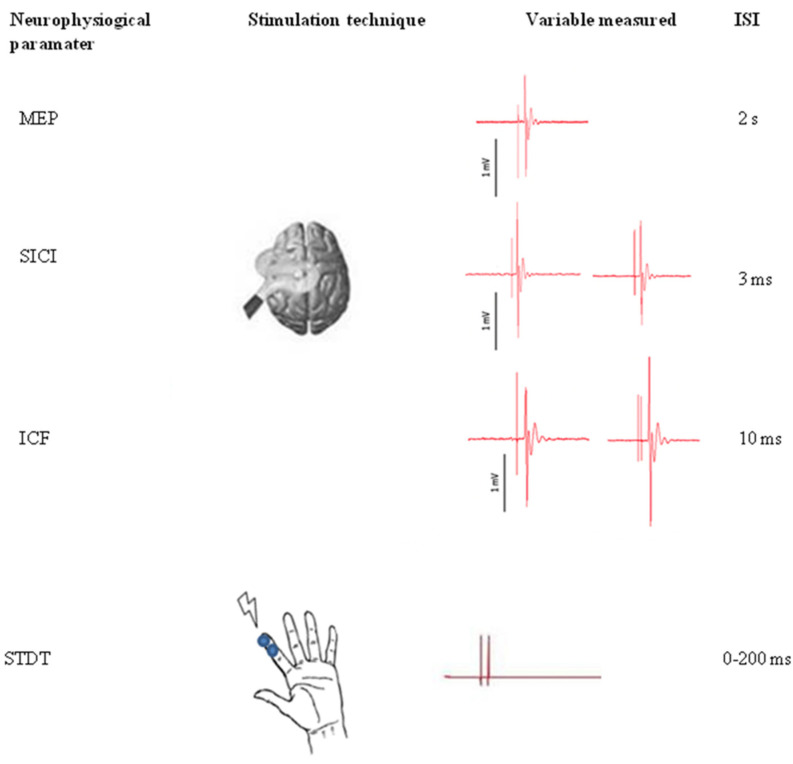
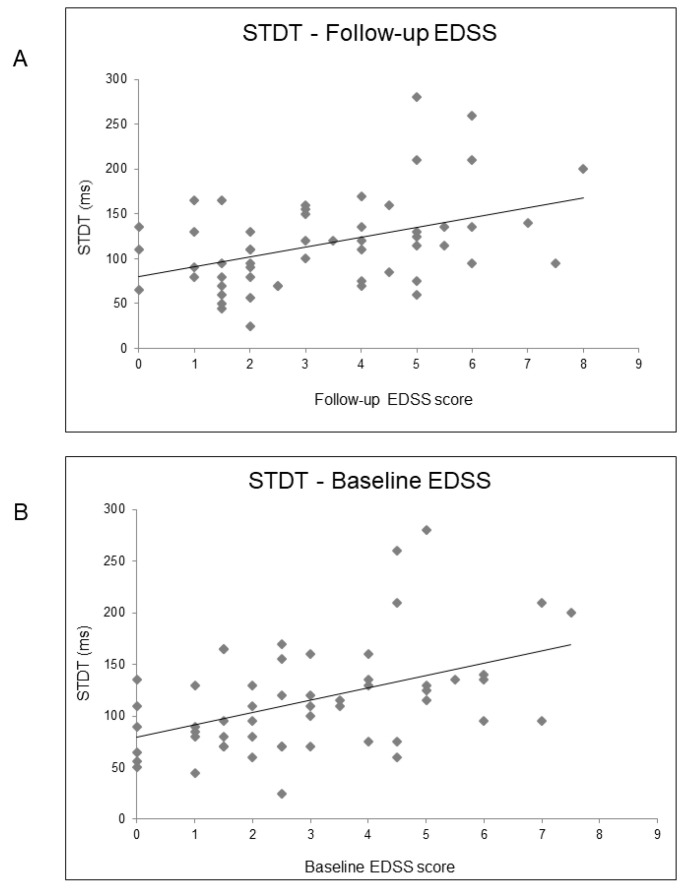
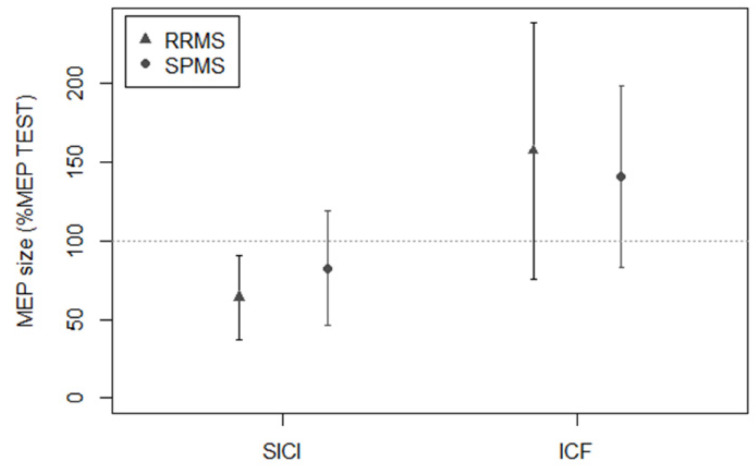
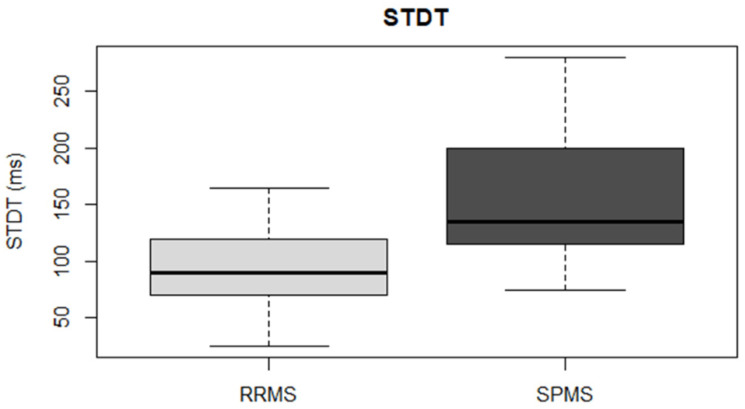
Secondary progressive multiple sclerosis (SPMS) subtype is retrospectively diagnosed, and biomarkers of the SPMS are not available. We aimed to identify possible neurophysiological markers exploring grey matter structures that could be used in clinical practice to better identify SPMS. Fifty-five people with MS and 31 healthy controls underwent a transcranial magnetic stimulation protocol to test intracortical interneuron excitability in the primary motor cortex and somatosensory temporal discrimination threshold (STDT) to test sensory function encoded in cortical and deep grey matter nuclei. A logistic regression model was used to identify a combined neurophysiological index associated with the SP subtype. We observed that short intracortical inhibition (SICI) and STDT were the only variables that differentiated the RR from the SP subtype. The logistic regression model provided a formula to compute the probability of a subject being assigned to an SP subtype based on age and combined SICI and STDT values. While only STDT correlated with disability level at baseline evaluation, both SICI and STDT were associated with disability at follow-up. SICI and STDT abnormalities reflect age-dependent grey matter neurodegenerative processes that likely play a role in SPMS pathophysiology and may represent easily accessible neurophysiological biomarkers for the SPMS subtype.
继发进展型多发性硬化(SPMS)亚型通过回顾性诊断确定,且尚无SPMS的生物标志物。我们旨在探索灰质结构,以识别可能的神经生理学标志物,用于临床实践中更好地识别SPMS。55名多发性硬化患者和31名健康对照者接受了经颅磁刺激方案,以测试初级运动皮层内的皮质中间神经元兴奋性,并进行体感时间辨别阈值(STDT)测试,以检测皮质和深部灰质核中编码的感觉功能。使用逻辑回归模型来识别与SP亚型相关的综合神经生理学指标。我们观察到,短皮质内抑制(SICI)和STDT是区分复发缓解型(RR)与SP亚型的唯一变量。逻辑回归模型提供了一个公式,可根据年龄以及SICI和STDT的综合值计算受试者被归为SP亚型的概率。虽然在基线评估时只有STDT与残疾程度相关,但在随访时SICI和STDT均与残疾相关。SICI和STDT异常反映了年龄依赖性灰质神经退行性过程,这可能在SPMS病理生理学中起作用,并且可能代表SPMS亚型易于获取的神经生理学生物标志物。