Bolt Janne W, van Kuijk Arno W, Teunissen Marcel B M, van der Coelen Dennis, Aarrass Saïda, Gerlag Daniëlle M, Tak Paul P, van de Sande Marleen G, Lebre Maria C, van Baarsen Lisa G M
Department of Rheumatology and Clinical Immunology, Amsterdam Rheumatology & Immunology Center (ARC), Amsterdam UMC, University of Amsterdam, 1105 AZ Amsterdam, The Netherlands.
Department of Rheumatology, Amsterdam Rheumatology & Immunology Center (ARC)-Reade, 1040 HG Amsterdam, The Netherlands.
Biomedicines. 2022 Jan 29;10(2):324. doi: 10.3390/biomedicines10020324.
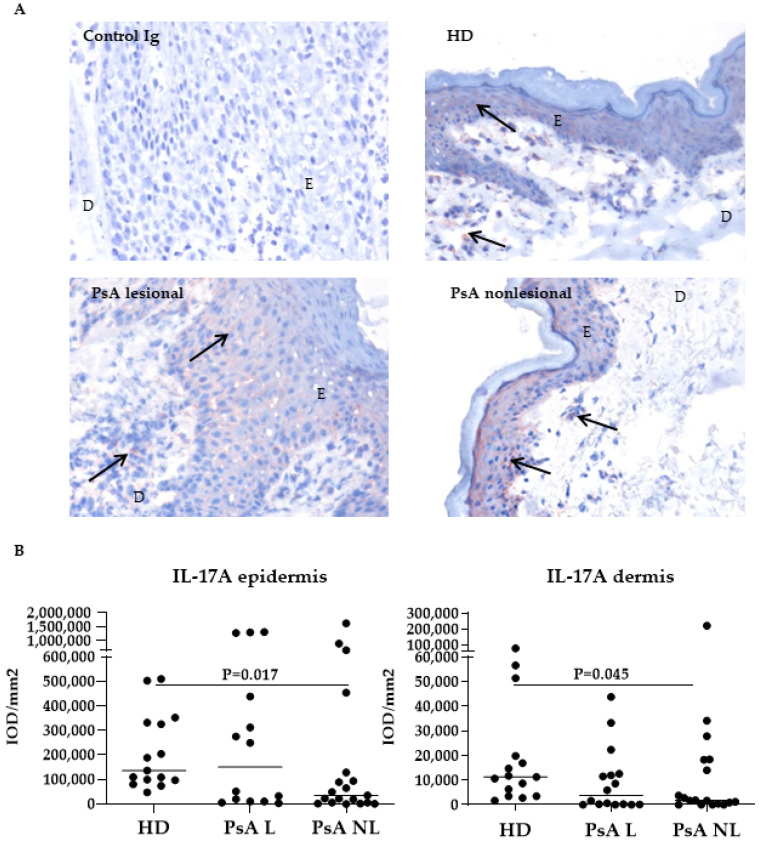
Interleukin (IL)-17 and tumor necrosis factor-alpha (TNF)-α are key players in psoriatic arthritis (PsA) pathogenesis. While both cytokines can be therapeutically targeted with beneficial clinical outcome, it is unclear whether inhibiting one cytokine will affect the other at sites of inflammation. If both act independently, this might provide a rationale for dual or combined inhibition of both cytokines. Here, we evaluated the effect of TNF blockade in PsA patients on IL-17 levels in both skin and synovial tissue biopsies. PsA patients with mild psoriatic skin lesions were randomized to receive either adalimumab or placebo for four weeks. Synovial and skin biopsies were obtained at weeks zero and four. Skin from healthy donors (HDs) was used for comparison. Expression of IL-17A, IL-17F, IL-17RA and IL-17RC was assessed by immunohistochemistry and analyzed with digital image analysis. We found relatively low levels of IL-17 and its receptors in the skin of PsA patients compared to HD, and only IL-17F in the dermis of lesional psoriatic skin was significantly higher compared to HD skin ( = 0.0002). Histologically IL-17A, IL-17F, IL-17RA and IL-17RC in skin and synovial tissue were not downregulated by adalimumab treatment. Thus, in this cohort of PsA patients with mild psoriasis, TNF blockade did not affect the protein levels of IL-17 cytokines and its receptors in skin and synovium, despite reduced cellular inflammation and improved clinical outcome for joint involvement.
白细胞介素(IL)-17和肿瘤坏死因子-α(TNF)-α是银屑病关节炎(PsA)发病机制中的关键因素。虽然这两种细胞因子都可作为治疗靶点并产生有益的临床效果,但尚不清楚在炎症部位抑制一种细胞因子是否会影响另一种细胞因子。如果两者独立发挥作用,这可能为同时抑制这两种细胞因子提供理论依据。在此,我们评估了PsA患者中TNF阻断对皮肤和滑膜组织活检样本中IL-17水平的影响。患有轻度银屑病皮肤病变的PsA患者被随机分为接受阿达木单抗或安慰剂治疗四周。在第0周和第4周获取滑膜和皮肤活检样本。使用健康供体(HD)的皮肤作为对照。通过免疫组织化学评估IL-17A、IL-17F、IL-17RA和IL-17RC的表达,并采用数字图像分析进行分析。我们发现,与HD相比,PsA患者皮肤中IL-17及其受体水平相对较低,且仅病变银屑病皮肤真皮中的IL-17F显著高于HD皮肤(P = 0.0002)。组织学上,阿达木单抗治疗并未下调皮肤和滑膜组织中IL-17A、IL-17F、IL-17RA和IL-17RC的表达。因此,在这组患有轻度银屑病的PsA患者中,尽管细胞炎症减轻且关节受累的临床结果有所改善,但TNF阻断并未影响皮肤和滑膜中IL-17细胞因子及其受体的蛋白水平。